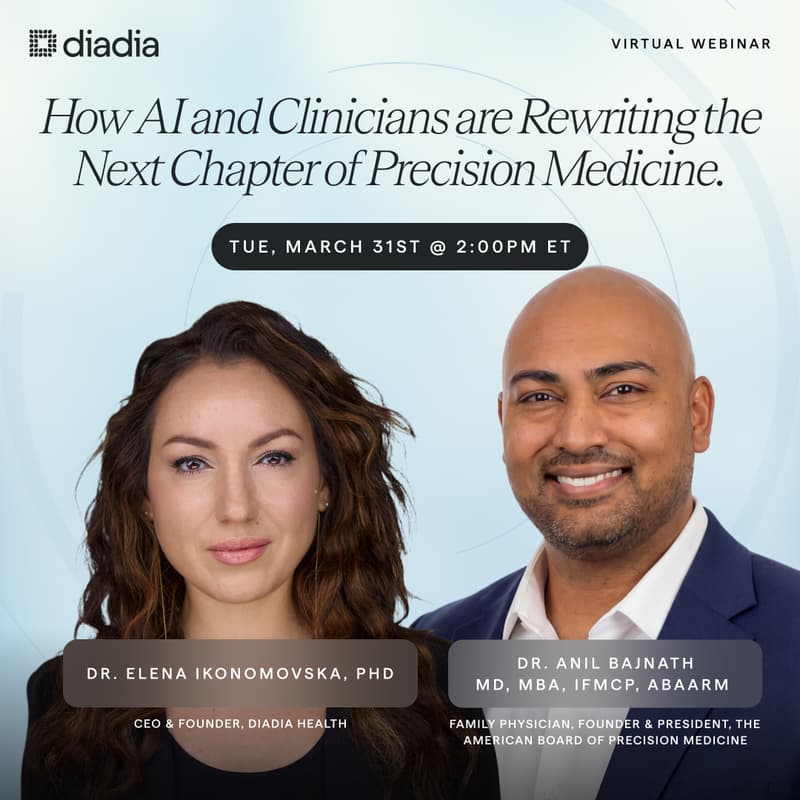
From Data to Diagnosis: Causal AI Reasoning in Precision Medicine (with Dr. Anil Bajnath)
A genetic test comes back 65 pages long. 60+ flagged variants. Each with its own risk modifiers, literature, and pathway interactions.
Layer on biomarkers, gut microbiome, and symptom history — and you're looking at 5+ hours to reason through a single complex case.
AI should fix this. But Harvard research shows 91.8% of clinicians using AI encounter "faithful hallucinations" — recommendations that sound clinically reasonable, and aren't.
The problem isn't the data. It's the reasoning.
On March 31st, Dr. Elena Ikonomovska and Dr. Anil Bajnath will show what changes when AI is built to reason causally — not just pattern-match.
In this session:
The difference between causal reasoning and pattern-matching — and why it matters for complex cases
A real clinical case, step by step: how causal reasoning surfaces what standard synthesis would miss
The questions every clinician should ask before trusting any AI tool with patient care
Who this is for: Functional medicine, precision medicine, and longevity practitioners managing complex chronic cases with genomic data, microbiome results, and metabolic panels.
About the Speakers
Dr. Elena Ikonomovska, PhD — CEO & Co-Founder, Diadia Health Elena has spent nearly 20 years building applied AI — as Reddit's first data scientist, ML Engineer at Google, and Head of AI at Change.org. She founded Diadia Health after years of personally navigating "normal" lab results that masked serious underlying dysfunction. Diadia's genetics-informed AI clinical reasoning platform is now deployed across 20+ clinical sites with 98% clinician approval.
Dr. Anil Bajnath, MD, MBA, IFMCP — Founder, Institute for Human Optimization Dr. Bajnath is a board-certified physician and leader in precision and longevity medicine. Through the Institute for Human Optimization, he helps patients decode their unique biology — translating genomics, biomarkers, and metabolic data into measurable improvements in healthspan and vitality. He is one of the few practitioners working at the intersection of functional medicine, genomics, and clinical AI.