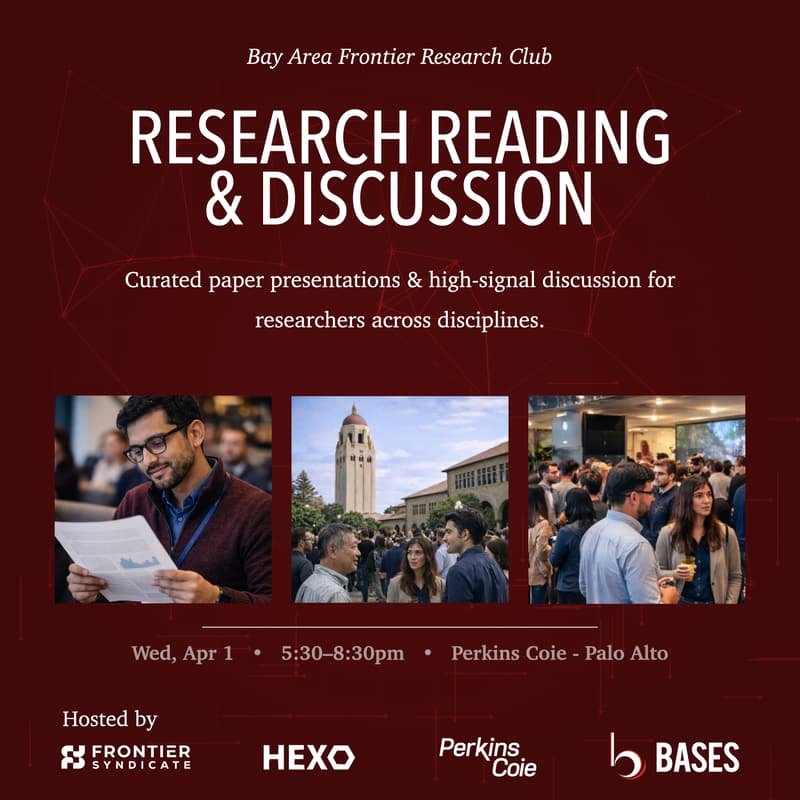


Bay Area Frontier Research Club
The Bay Area Frontier Research Club is a curated forum for rigorous discussion on how AI is reshaping the scientific research process. We convene experimental researchers, computational scientists, and research engineers across domains to examine concrete work—papers, methods, and workflows—covering literature synthesis, hypothesis generation, experimental design, simulation, analysis, and reproducibility.
For each session, we curate 2–3 papers selected for rigor and discussion value. Presentations are intentionally brief so the majority of time is reserved for questions and critique: assumptions, evaluation methodology, failure modes, and what would constitute convincing evidence. Papers and supporting materials are shared in advance to ensure a high-baseline conversation.
Agenda
5:30pm: Doors open
5:30pm – 6:30pm: Networking + light dinner
6:30pm – 8:00pm: Research presentations + discussion
8:00pm – 8:30pm: Networking
Presenters & topics
Talk #1: Small Batch Size Training for Language Models
Presented by Sanae Lotfi, a Research Scientist at Meta FAIR working on inference efficiency and pretraining optimization for large language models. During her PhD at NYU, she focused on connecting compression to generalization in deep learning, developing the first non-vacuous generalization bounds for billion-parameter LLMs. Her work received the ICML 2022 Outstanding Paper Award, and MIT recognized her as a Rising Star in EECS.
Sanae will present her NeurIPS 2025 work on small batch size training for language models. The paper revisits batch sizes all the way down to one and proposes a simple rule for scaling Adam hyperparameters that makes small batches stable and surprisingly effective — matching or beating larger batches given the same compute budget, with greater robustness to hyperparameter choices and even enabling stable training with vanilla SGD.
Talk #2: Unlocking Latent Knowledge in LLMs: A Multi-Agent Introspection Protocol for Complex Research Tasks (not yet published)
Presented by Damir Vrabac, a Stanford alum and member of the Hexo team, with research under Andrew Ng and Jure Leskovec in AI applied to healthcare. He spun out an AI diagnostics company focused on bladder cancer that raised over $26M from top-tier investors. His current work at Hexo focuses on multi-agent systems and unlocking latent knowledge in large language models.
Damir will present work showing that the core bottleneck for AI agents on complex tasks isn't reasoning or knowledge capacity — it's surfacing task-relevant knowledge locked in model weights into the working context. His team's multi-agent protocol uses a question-only advisor that compels a research agent to retrieve and articulate its own latent parametric knowledge through structured introspection, leading to more rigorous validation and earlier detection of methodological pitfalls on MLE-Bench Kaggle challenges.
Talk #3: Very Short and Accurate Explanations by Design
Prisha Shroff is a freshman at Stanford University and the founder of Sustainability Stars, a nonprofit empowering youth to tackle global challenges. Her work spans interpretable AI, wildfire prevention systems using NASA data, and quantum-AI frameworks for materials discovery. At Stanford, she serves as a Teaching Assistant for CS106A and CS106B.
Prisha will present a novel interpretable-by-design algorithm that generates accurate, human-readable explanations for image classification decisions. The system combines an information-theoretic query selector (IP-OMP), a concept-based question answerer, and a network classifier to produce short, faithful explanations — outperforming existing methods in accuracy, interpretability, and efficiency. The work addresses a critical gap in AI trustworthiness for high-stakes domains like healthcare.
Want to present your work?
If you have a research paper you’d like to discuss at one of our next sessions, please submit it for consideration.
Submit your paper here.
Who should attend
Experimental researchers
Computational scientists across domains (bio/chem/materials/climate/neuro/physics)
Research engineers + lab automation people
Folks building tools for literature review, experiment planning, robotics, simulation, or scientific data
No ML background required. If you’ve ever wished research moved faster, you belong here.
Capacity is limited.
We will take photos and short video clips for event recap and promotion. By attending, you consent to being photographed and recorded, and to the use of those images and clips by the organizers on social media and other event marketing channels.
Hosted by
Frontier Syndicate is a private venture circle for frontier tech builders, researchers, and investors. We convene high-trust rooms and back exceptional companies at the frontier.
Hexo Labs is building an AI-native platform for scientific discovery. Through Emily, its AI scientist system, Hexo helps researchers generate hypotheses, design experiments, and accelerate research workflows across ambitious scientific domains, with the goal of helping more breakthrough ideas move toward real-world impact.
BASES (Business Association of Stanford Entrepreneurial Students) is one of the world's largest and most established student-run entrepreneurship organizations. Founded in 1996, it serves as the hub for student entrepreneurship at Stanford University, bridging the gap between academia, innovation, and industry.
Perkins Coie is a leading international law firm known for its deep expertise in technology, life sciences, and emerging growth companies. With offices across the U.S. and globally, the firm has been a trusted advisor to some of the world's most innovative companies from startup through IPO and beyond.