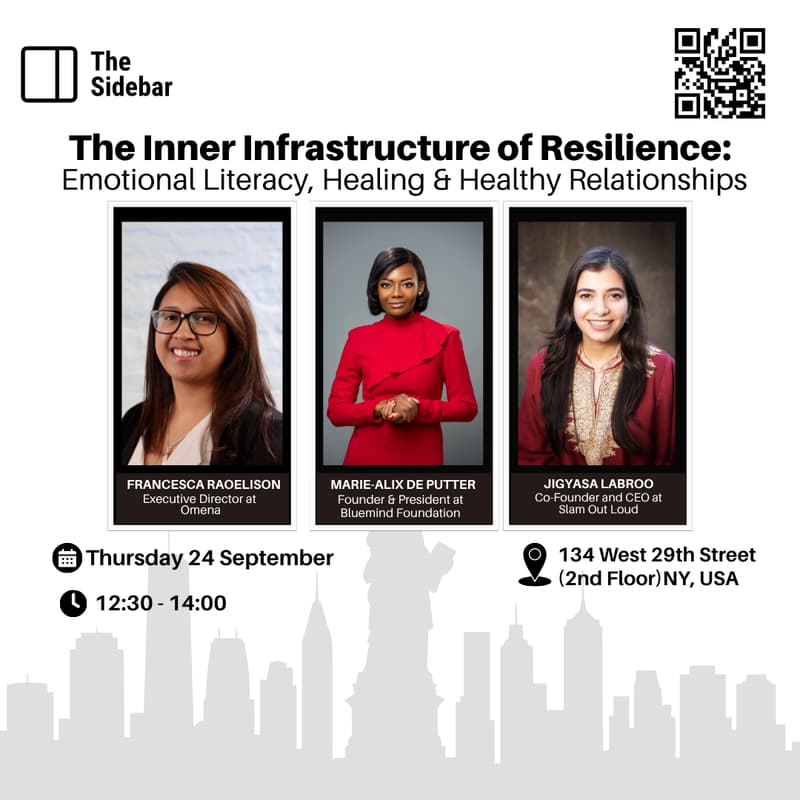

The Inner Infrastructure of Resilience: Emotional Literacy, Healing & Healthy Relationships
About the session
When we talk about resilience, we tend to talk about systems: Climate infrastructure, financing, policy, institutions, emergency preparedness or social protection.
However, every resilient system ultimately depends on people: people who have to live through uncertainty, absorb shocks, make difficult decisions, maintain relationships, care for one another, and find ways to act collectively when circumstances become harder.
What infrastructure do they need?
This session explores emotional literacy, healing, and healthy relationships as an overlooked form of human infrastructure for resilience. Rather than treating these capacities as separate from climate adaptation or community resilience, it asks what happens when we recognize them as part of the foundation.
How do people learn to process adversity without reproducing harm? What enables families and communities to navigate conflict and rapid change while maintaining healthy relationships? What helps young people develop agency when the future feels uncertain? And what relational capacities allow communities to organize, cooperate, and respond collectively rather than simply survive?
The conversation will be grounded in experience from Omena, which works with children, families, and communities in Madagascar and the United States to prevent emotional abuse and build emotional literacy. It will connect that work with perspectives from climate resilience, youth leadership, and Global South communities.
The premise is not that emotional literacy can solve structural problems. Communities still need resources, functioning institutions, climate finance, public services, and political action. The question is whether those investments can deliver lasting resilience without also paying attention to the human and relational capacities that allow people to navigate change together.
What to expect
An intimate, highly participatory conversation that makes room for reflection as well as discussion.
The session will begin with perspectives from people working across emotional literacy, community resilience, youth leadership, and related fields before opening into a wider exchange with the room.
Rather than another conversation about what communities need externally, participants will be invited to consider a different question: What do people need internally and relationally to sustain the resilient communities we are trying to build?
The aim is to connect fields that rarely share the same room and explore what each might learn from the other.
Who this is for
This session is for funders, policymakers, social entrepreneurs, climate and adaptation practitioners, youth leaders, educators, community-based organizations, and others interested in what it takes for people and communities not only to withstand disruption, but to navigate it together.
What you will get out of it
A broader understanding of what constitutes infrastructure for community resilience
Practical insight into the role of emotional literacy and healthy relationships in navigating adversity and change
Connections between approaches to emotional wellbeing, youth development, and climate resilience
New questions for how funders and practitioners design and support resilience initiatives
Space to reflect on the human capacities our current approaches to resilience may be overlooking
Hosted by
Francesca Raoelison — Founder & Executive Director, Omena
Building emotional literacy and healthy relationships as a foundation for preventing relational harm and strengthening community resilience across Madagascar and the United States.Marie-Alix de Putter — Founder & President, Bluemind Foundation
Reimagining access to mental healthcare in Africa by embedding care within trusted community relationships, including Bluemind’s Heal by Hair model, which trains hairdressers as pathways to mental health support.Jigyasa Labroo — Co-Founder & CEO, Slam Out Loud
Using arts-based social-emotional learning to build children’s voice, agency, imagination, and emotional awareness, including approaches connecting climate emotions with collective action.