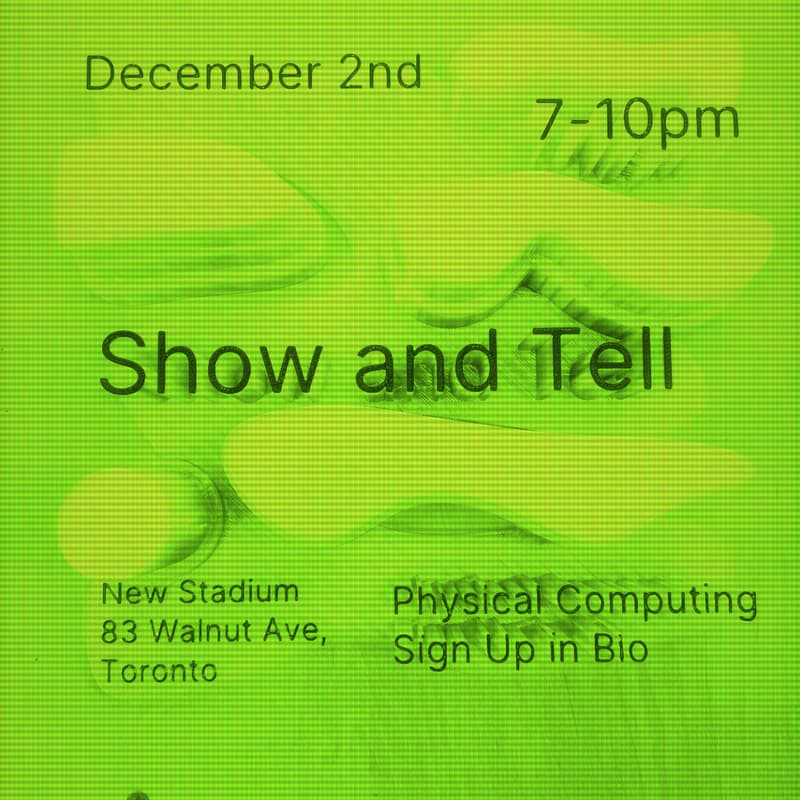
Show & Tell: Physical Computing
A cozy, low-stakes gathering where artists and makers talk about their finished or in progress creative coding & physical computing work for 4-minutes each, to help demystify creative coding and physical computing, and connect over fun ideas and good snacks.
This space is for artists, designers, engineers, and curious creatives, whether you have been coding for years or have never touched a microcontroller in your life. If you want a fun, approachable spot to see what people are building, share your own experiments, or just meet others messing around with tech and art, this gathering is for you.
Program
7:00 PM - 7:30 PM: Doors open, light snacks, speaker signup, and casual mingling
7:30 PM - 7:45 PM: Malcolm McKenzie
7:45 PM - 7:55 PM: Snack & mingle break
7:55 PM - 8:15 PM: Audience Show & Tell (3 people 3-minute talks + quick Q&A)
8:15 PM - 8:25 PM: Snack & mingle break
8:25 PM - 8:40 PM: Jack Harrison (Digital Joy)
8:40 PM - 8:50 PM: Snack & mingle break
8:50 PM - 9:10 PM: Audience Show & Tell (3 people 3-minute talks + quick Q&A)
9:10 PM – 9:30 PM: Wrap-up, final goodbyes
Audience Show & Tell signups are first come, first served
Facilitator
Rubiat Fusigboye is a Nigerian new media artist, designer, and creative technologist split between Toronto and NYC. Rooted in physical computing, her practice centers on interactivity, Afrofuturism, and creating physical spaces for shared human experience.
As a facilitator, Rubiat is passionate about building warm, accessible communities that strip away the corporate pretense and intimidation around technology. She believes creative coding and hardware should be open to everyone, focusing her work on lowering the barrier to entry for artists and designers. Through low-stakes gatherings and collaborative show-and-tells, she transforms complex tech into approachable tools for storytelling, conversation, and collective play.
Speakers
Malcolm McKenzie is a Toronto based filmmaker and visual artist. He has spent 13 years working in the film industry. He has worked on projects such as Firecrackers, Blackberry, Nirvana the Band the Show the Movie, and Joji’s Past Won’t Leave My Bed.
His art practices focuses on optics, light, and sculpture using found objects and trash. Materials range from concrete, to textiles, to 3d printed plastics.
Malcolm is going to talk about his use of creative technology in film and how to start using technology, how you can teach yourself new skills, and integrating play and learning.
Jack Harrison: A fine tuned workflow developed by animator Jack Harrison that leverages the warm joy of analog equipment for the cold precision of digital computers to produce organic, tangible animations.
Introducing the Digital Joy Method.
Over the last 5 years, I’ve incorporated a wide variety of analog video equipment into my Animation process. But, I’ve discovered their most valuable contribution isn’t any of their specific visual quirks or textures, but rather the joy I experience when working with them.
My ability to capture that joy, and package it into my animations, has gained the attention of clients such as Vulfpeck, J.Cole, Channel 5, and so many more that trusted me to create visuals that match not only in quality, but also in passion.