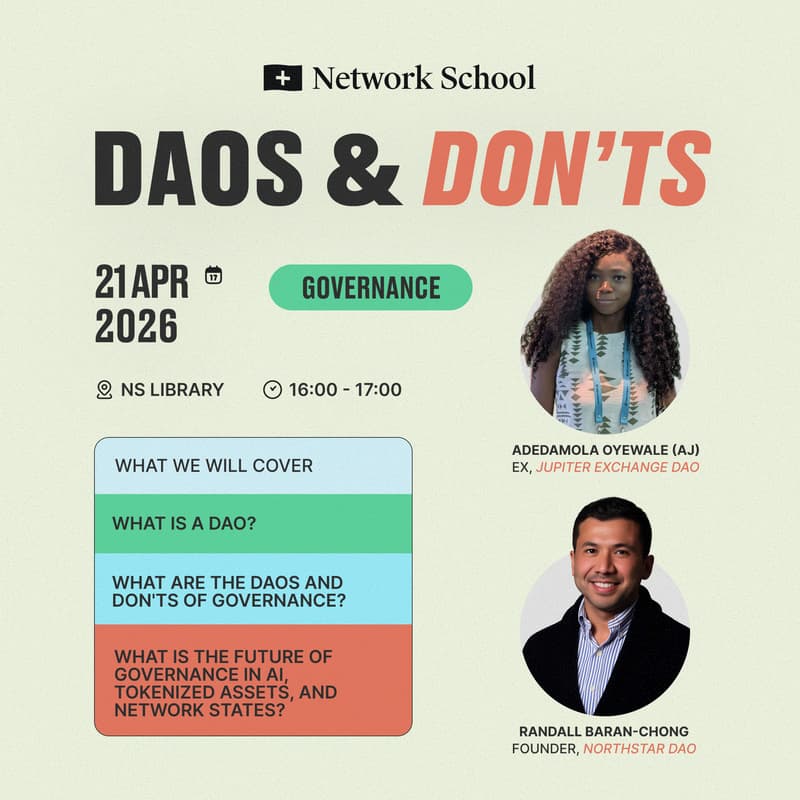
DAOs and Don'ts: Lessons and Foresight in Decentralized Governance
In 2016, the first Decentralized Autonomous Organization (DAO) was launched to solve Web3's coordination problem. 10 years, multiple failures, and millions in losses later - DAOs still don't seem to work.
But we shouldn't give up hope — if we learn from the positives (the DAOs), avoid mistakes of the past (the don'ts), and look to the future, we can re-design DAOs to be the enabler of tomorrow's technologies: AI, asset tokenization, and network states.
What will we explore in the sesion?
What is a DAO?
What are the DAOs and Don'ts of Governance?
What is the future of Governance in AI, Tokenized Assets, and Network States?
Who should attend?
People interested in governance, AI, tokenization, and coordination mechanisms of the future - and can benefit from learning from the successes and failures of DAOs.
Who will be guiding the discussion?
Adedamola Oyewale (AJ) is a product designer and ecosystem builder working at the intersection of design, community, and decentralized systems. At Jupiter Exchange, she led a governance proposal with 291M JUP in favor (~$145M in voting power), establishing the DAO’s design arm. She has five years of experience across product design and community-led education, impacting 500+ designers globally.
Randall Baran-Chong is founder of NorthstarDAO, a first-of-its-kind policy and advocacy DAO, coordinating founders to lobby all 3 levels government, and General Partner in TMC, a fund that backed Canada's first asset tokenization platform.