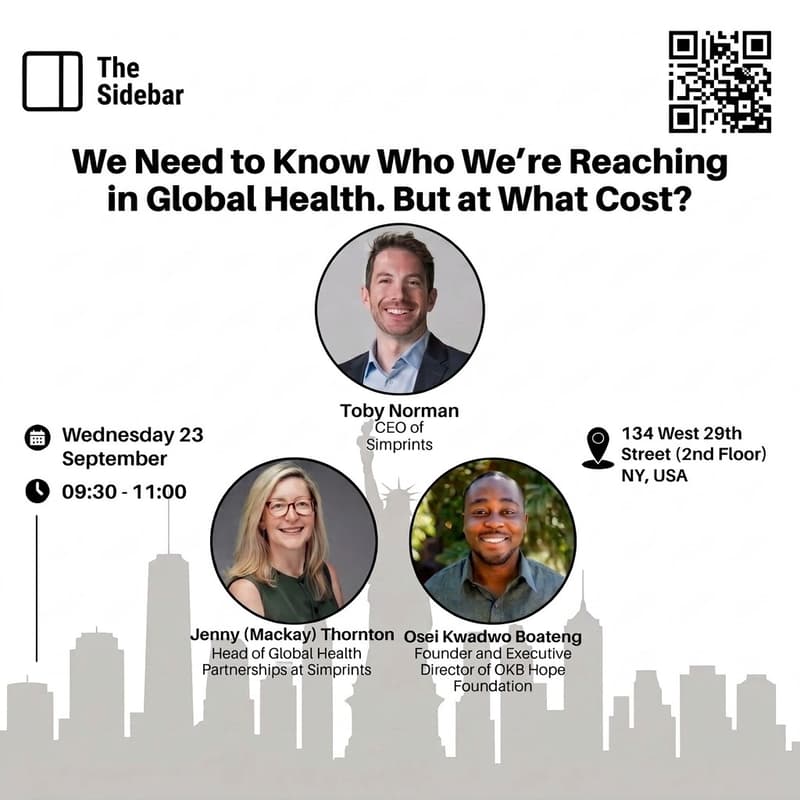

We Need to Know Who We’re Reaching in Global Health. But at What Cost?
About the session
A community health worker opens a paper register at a nutrition clinic. A child is in front of them, but the system cannot reliably tell them whether that same child has relapsed, visited another clinic, received Vitamin A supplementation, completed their vaccinations, or previously arrived with a different caregiver.
Across health and humanitarian systems, we are very good at counting interventions. Doses delivered. Vaccines administered. Nutrition treatments provided. People enrolled.
It is much harder to know whether the same person received the complete package of services they needed.
That makes connected identity an increasingly important piece of health infrastructure. If systems can recognize the same child across services and over time, frontline workers can provide better continuity of care, programs can understand who is being missed, and funders and governments can make decisions based on outcomes rather than simply counting activities.
But solving that problem creates another one.
The systems designed to recognize people can contain some of their most sensitive and permanent data. In humanitarian assistance, health programs, refugee registration, and social protection, biometric technologies are increasingly being used to establish identity at scale.
A password can be changed after a breach. A face or fingerprint cannot.
The people whose data sits inside these systems are also frequently those with the least power to determine how it is collected, stored, shared, or protected.
So how do we reconcile two legitimate demands?
We need to know whether we are reaching the same person with the services they need. And we need to make sure the infrastructure that allows us to do that does not create new risks for the people it is intended to serve.
This session will explore connected identity from both sides.
First, what is the cost of not being able to recognize the same person across fragmented health systems? Who should pay for the infrastructure connecting services when funders finance commodities, governments finance national information systems, and frontline workers absorb the administrative burden in between?
Then, what responsibilities come with building that infrastructure? If biometrics are used, should protections that make compromised biometric templates unusable outside their intended system be required from the beginning? Who sets that standard? Who pays for it? And when does the pursuit of better identification create risks greater than the problems it is trying to solve?
The goal is not to assume that more identity infrastructure is always better. It is to ask what responsible identity infrastructure should look like when both continuity of care and protection from harm matter.
What to expect
A practical and deliberately contested conversation grounded in frontline health and humanitarian experience.
The session will begin with examples of what happens when identity breaks down across child health services, including experiences following children through nutrition treatment, relapse, and vaccination systems. From there, the conversation will move into the privacy and security implications of the digital and biometric infrastructure increasingly being built to solve those problems.
Participants will interrogate both sides: where better identity could improve outcomes, where it could create new vulnerabilities, what alternatives exist, and what funders and governments should require before supporting systems at scale.
Scepticism is welcome. The room needs people who believe connected identity is essential and people who think some proposed solutions create risks we have not adequately confronted.
Who this is for
This session is for health ministries and implementers, frontline health workers, nutrition and immunization practitioners, digital health and digital public infrastructure leaders, humanitarian data protection officers, funders, privacy and security specialists, identity practitioners, and anyone making decisions about how vulnerable populations are identified across health and humanitarian systems.
What you will get out of it
A clearer understanding of how fragmented identity and record systems affect continuity of care and our ability to understand who is actually being reached
Ground-level examples of what health workers encounter when the same child moves between services, facilities, and caregivers
A framework for thinking about connected identity as infrastructure, including the unresolved question of who should own and finance it
A practical understanding of the privacy and security risks created by biometric identity systems and the protections available to reduce them
A sharper set of questions for funders, governments, and implementers about when identity infrastructure improves outcomes, when it creates unacceptable risk, and what responsible deployment should require
Featuring
Jenny Thornton, Head of Global Health Partnerships, Simprints
Toby Norman, CEO and Co-Founder, Simprints
Hosted by
Simprints