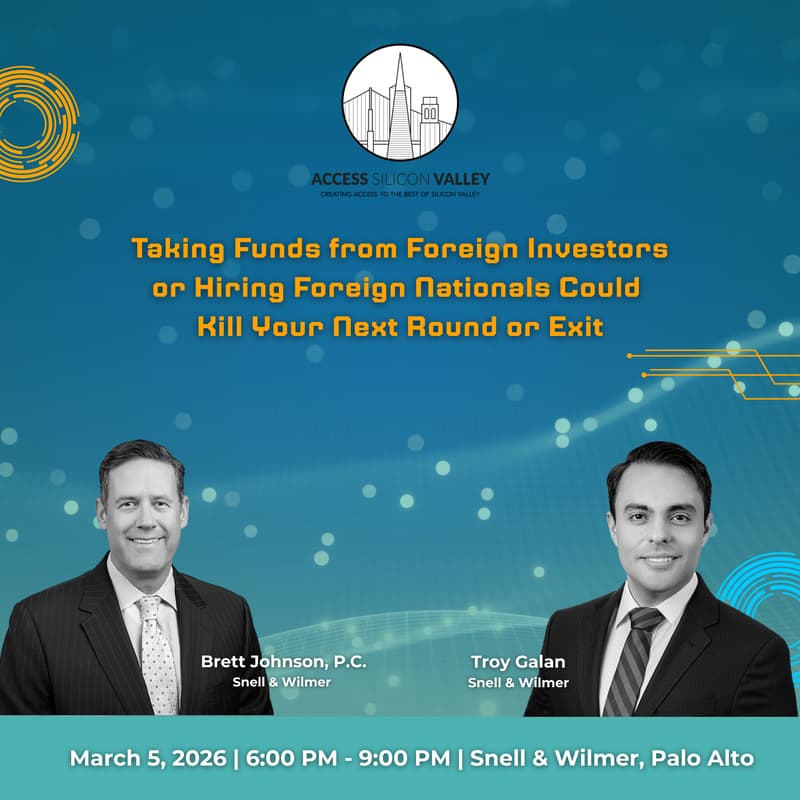
Taking Funds from Foreign Investors or Hiring Foreign Nationals Could Kill Your Next Round or Exit
For many startups, foreign capital and global talent are essential to growth. But what most founders don’t realize is that one early decision - made long before your Series A or exit - can quietly poison your cap table, stall a deal, or dramatically reduce valuation years later.
Accepting funds from a foreign investor (individual or fund), granting a board seat/observer rights or information rights, or hiring foreign national developers in the United States can trigger CFIUS review, export control violations, and national security concerns, often without any warning at the time. These issues rarely surface until a major financing, acquisition, or IPO, when they become expensive, time-consuming, and sometimes impossible to fix.
This must-attend workshop is designed specifically for startup founders and early-stage operators in tech, AI, biotech, fintech, robotics, and other innovation-driven sectors who want to grow globally without unknowingly creating deal-killing risk.
In this highly practical session, Snell & Wilmer attorneys Brett Johnson, P.C. and Troy Galan will break down the regulatory landmines that routinely derail otherwise successful startups—and explain what founders need to do early to avoid them.
What we’ll cover
Foreign Investment Pitfalls
How taking money from foreign individuals or funds can trigger scrutiny years later - and why “standard” early-stage terms can create unexpected national security issues.CFIUS Traps That Blindside Founders
How the Committee on Foreign Investment in the United States (CFIUS) can affect fundraising, governance, and exits, including common mistakes involving board seats, observer rights, and information rights that create serious obstacles in diligence.Export Controls - Even Before You Have Revenue
Why export control laws apply to early-stage startups, including software, AI models, data access, and technical know-how - and how founders unintentionally violate them.Foreign Nationals on Your U.S. Team
What founders must understand when hiring or working with foreign national engineers or developers in the U.S., including “deemed export” risks that many companies don’t discover until investors or acquirers raise red flags.Due Diligence Deal-Killers
What sophisticated investors and buyers are actually looking for and how failure to address these issues early can delay, restructure, or collapse a transaction entirely.
Why this workshop is critical
Most founders assume these issues can be “cleaned up later.” In reality, CFIUS and export control problems often cannot be fixed retroactively. By the time they surface, the damage may already be done - slowing a financing, forcing deal concessions, or killing an exit outright.
This workshop gives founders the foresight to design their company correctly from the start, rather than scrambling under pressure when stakes are highest.
What you’ll walk away with
A clear understanding of how foreign investment and export controls intersect with startup growth
A founder-friendly checklist to evaluate risks before taking foreign money or hiring foreign nationals (in the U.S. or abroad)
Practical steps you can implement immediately to reduce regulatory and diligence risk
A framework for asking the right questions early - before investors, acquirors, or regulators do
If your startup plans to raise capital, hire globally, or build technology with international reach, this workshop isn’t optional—it’s preventative medicine.
SPEAKER INFORMATION
Brett Johnson, P.C., Partner, Snell & Wilmer
Brett Johnson focuses his practice on international trade, advising businesses on export controls, global regulatory compliance, and cross-border transactions. He counsels multinational and U.S. companies on CFIUS and foreign ownership compliance, tariff mitigation strategies, customs rulings, export licensing, and enforcement risks, and helps develop internal compliance programs for international operations and supply chains. Brett also supports clients in navigating government investigations related to trade laws and regulations, and regularly provides guidance on international sales, distribution, and agency agreements.
Troy Galan, Associate, Snell & Wilmer
Troy Galan advises domestic and international clients on matters at the intersection of national security and international trade, with a focus on international transactions, government contracting, and regulatory compliance. He counsels companies on CFIUS reviews, export controls, economic sanctions, customs regulations, and foreign anti-corruption laws, helping them navigate foreign investment risks, cross-border transactions, and federal contracting requirements. Troy also assists clients with due diligence, licensing, tariff and duty determinations, and developing internal compliance programs tied to global operations and supply chains.