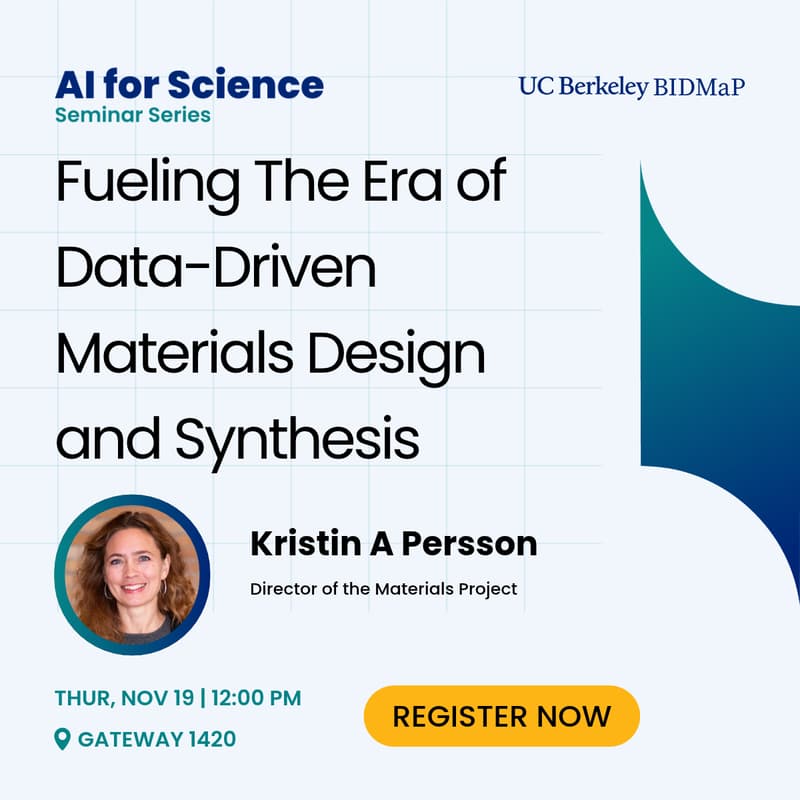

Kristin Persson: Fueling The Era of Data-Driven Materials Design and Synthesis
About this Seminar
Fueling The Era of Data-Driven Materials Design and Synthesis
Fueled by increased availability of materials data, machine learning is poised to revolutionize materials science by enabling accelerated discovery, design, and optimization of materials. As one of the first and most visible of materials data providers, the Materials Project (www.materialsproject.org) uses supercomputing and an industry-standard software infrastructure together with state-of-the-art quantum mechanical theory to compute the properties of all known inorganic materials and beyond. The data, currently covering over 160,000 materials and millions of properties, is offered for free to the community together with online analysis and design algorithms. Serving a rapidly expanding community of more than 600,000 registered users, the Materials Project delivers millions of data records daily through its API, fostering data-rich research across materials science. This wealth of data is inspiring the development of machine learning algorithms aimed at predicting material properties, characteristics, and synthesizability. However, we note that truly accelerating materials innovation also requires rapid synthesis, testing and feedback, seamlessly coupled to existing data-driven predictions and computations. The ability to devise data-driven methodologies to guide synthesis efforts is needed as well as rapid interrogation and recording of results – including ‘non-successful’ ones. This talk will outline the rise of data-driven materials design, predictive synthesis and showcase successes as well as comment on future directions.
Our Speaker:
Kristin A Persson
Kristin Persson uses atomistic and first-principles computational methods coupled with high-performance computing technology and machine learning to advance materials for clean energy production and storage. She is the Director of the Materials Project (www.materialsproject.org) which is a multi-national effort to compute the properties of all inorganic materials and provide the data and associated analysis algorithms free of charge. The ultimate goal of the initiative is to drastically reduce the time needed to invent new materials to serve societal needs, in particular advancing clean energy solutions. Within the Persson group, we leverage the software and data infrastructure of the Materials Project together with our expertise in materials informatics to study the physics and chemistry of materials particularly for energy production and storage applications. Current focus areas include design of novel photocatalysts, multi-valent battery electrode materials, Li-ion battery electrode materials, polar materials and liquid electrolytes for Li energy storage solutions and beyond.
The Bakar Institute of Digital Materials for the Planet (BIDMaP) accelerates the discovery, development, and deployment of advanced materials to address some of the most urgent challenges facing our planet. By combining cutting-edge chemistry with artificial intelligence, machine learning, and robotics, BIDMaP is reimagining how materials can be designed and optimized for clean energy, clean air, clean water, advanced batteries, and sustainable chemical production.