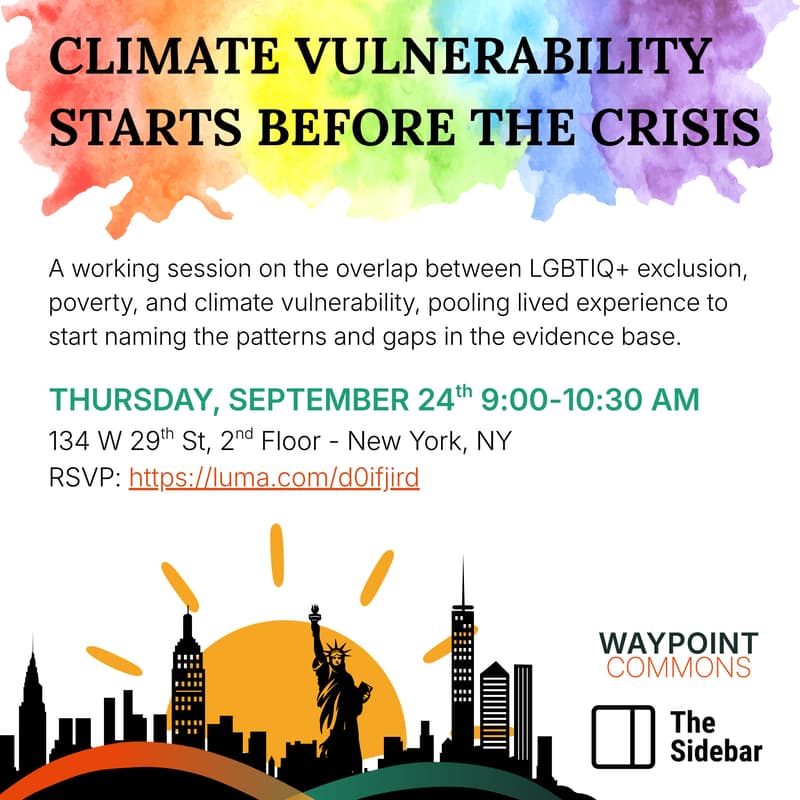

Climate Vulnerability Starts Before the Climate Crisis: LGBTIQ+ Communities, Poverty and Resilience
A flood, heatwave, storm, or other environmental shock does not arrive on equal ground.
People enter a climate crisis with very different levels of income, housing security, family support, access to services, legal protection, and ability to recover. Those conditions can determine who is most exposed long before the environmental shock itself occurs.
For many LGBTIQ+ people, that starting point can already be precarious.
Exclusion from economic opportunity, family support, and formal safety nets can contribute to greater poverty and insecurity. When environmental shocks arrive, those existing vulnerabilities can compound, potentially affecting everything from access to safe housing and healthcare to displacement, employment, emergency support, and recovery.
Yet we know remarkably little about this intersection.
There is currently limited meaningful data bringing together LGBTIQ+ experience, poverty, security, and environmental or climate vulnerability. Relevant knowledge exists within communities and organizations, but much of it has not been pooled, documented, or translated into an evidence base that funders, researchers, and practitioners can use.
This session is an attempt to begin doing that.
Rather than arriving with a predetermined framework, the conversation will start with lived and practitioner experience. What are LGBTIQ+ organizations already seeing? Where does economic or social exclusion increase climate vulnerability? How are communities responding? What climate-resilient approaches may already exist but have not been recognized or documented as such?
The ambition is deliberately early-stage: begin naming the patterns before claiming to have the answers.
What to expect
A working conversation bringing together LGBTIQ+ organizations and individuals with direct experience of environmental and economic vulnerability, alongside researchers and funders working across poverty, safety, environment, and climate resilience.
Participants will pool what they already know: lived experience, organizational learning, existing reports or data, emerging interventions, and examples of communities building resilience in different contexts.
The conversation will also identify what we do not know. Which questions should researchers be asking? What experiences need to be documented? Where might national contexts produce very different patterns? And what would a useful evidence base need to contain if it were going to inform funding, programming, and climate-resilient action?
The aim is not to manufacture consensus in one session. It is to leave with a clearer initial framing of an intersection that has received too little attention and identify where deeper inquiry could go next.
Who this is for
This session is for LGBTIQ+ organizations and individuals with direct experience of environmental or economic vulnerability, particularly those already developing climate-resilient responses within their communities, as well as researchers, funders, and practitioners working across poverty, social protection, safety, environment, and climate resilience.
What you will get out of it
Lived and practitioner perspectives on how poverty and insecurity shape climate vulnerability for LGBTIQ+ communities
An opportunity to surface relevant evidence, reports, interventions, and experiences that currently sit in different places
Greater clarity about the gaps in the existing evidence base
Connections between LGBTIQ+ organizations and climate, poverty, and resilience practitioners who may not otherwise work together
A starting point for documenting patterns, examples, and questions that could contribute to a stronger evidence base
Hosted by
Waypoint Commons