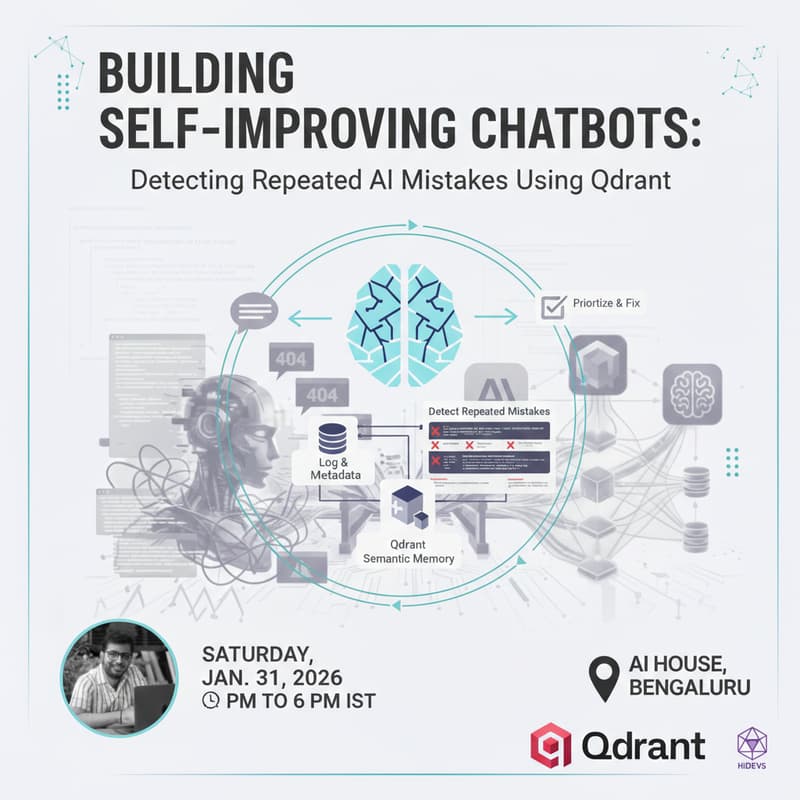

Building Self-Improving Chatbots: Detecting Repeated AI Mistakes Using Qdrant
About the Event
Modern chatbots generate massive amounts of logs, errors, and low-quality responses, but most systems treat these as passive data. The result? The same mistakes get fixed again and again by different teams, wasting time, compute, and effort.
In this hands-on workshop, we’ll build a self-improving chatbot architecture that learns from its own failures.
You’ll learn how to:
Capture chatbot mistakes automatically using confidence scores, user feedback, and validation checks
Store raw error logs and metadata reliably using MongoDB
Convert AI mistakes into embeddings and index them in Qdrant
Detect repeated or semantically similar errors across users and sessions
Identify patterns like “this mistake has already occurred 15+ times”
Use these insights to prioritize fixes, improve prompts, and stabilize AI behavior
We’ll also discuss why MongoDB fits here for long-term log storage, and how Qdrant acts as the semantic memory layer that enables meaning-based search and clustering — something traditional databases can’t do alone.
By the end of the session, you’ll understand how real AI teams move from reactive debugging to proactive AI quality control.
Who Should Join?
This workshop is ideal for:
AI / ML Engineers building chatbots, copilots, or LLM-based systems
Backend & Full-Stack Developers working with AI-driven applications
Startup founders & product engineers scaling AI products
Developers already using Qdrant who want real-world, production-grade use cases
Teams tired of fixing the same AI mistakes again and again
Basic familiarity with APIs and JSON is helpful, but no deep ML background is required.
We’ll Provide:
Full Starter Code Repositories 📦
Live Mentorship from the team 👨🏻🏫
Hosted by
Deepak Chawla – AI Entrepreneur, Founder of HiDevs
Deepak is on a mission to build the world’s largest Gen AI workforce. He has trained 2500+ learners, hosted 50+ AI workshops, and is actively building real-world applications with LLMs, LangChain, and vector databases.
Location is our AI House