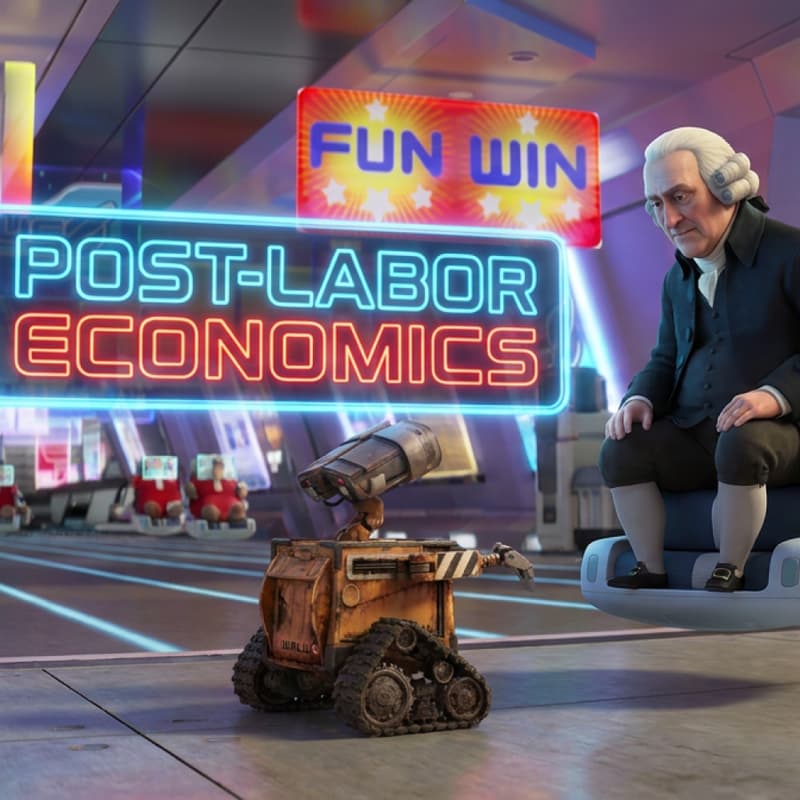

Post-Labor Economics Reading Night
As automation and AI accelerate, questions arise about labor displacement, capital ownership, and whether our economic systems can adapt to changing definitions of “work.” Join us to read, reflect, and discuss how we might shape an economy that aligns with human needs and preferences—both now and in a post-labor future.
No formal economics background required! Bring a book, and let’s learn together through reading and sharing.
Agenda
6:00 PM – Silent Reading & Note-Taking. Choose a text from our reading list or bring your own.
8:00 PM – Group Discussions. Form small circles and share your thoughts.
9:00 PM – Lightning Presentations. Take 2–3 minutes to summarize a book, propose a bold new model, or challenge an existing one.
10:00 PM – Adjourn. Stay connected for follow-up gatherings and deeper dives!
A SAMPLING OF TEXTS
Below is an expanded reading list—grouped loosely by theme—to spark inspiration. Each category includes classics, contemporary works, and everything in between.
FOUNDATIONAL & HISTORICAL PERSPECTIVES
The Wealth of Nations, Adam Smith (Market allocation and its limits; the foundation of classical economics)
Capital: A Critique of Political Economy, Karl Marx (Examines how labor and capital interact, plus the nature of surplus value)
The General Theory of Employment, Interest and Money, John Maynard Keynes (Macroeconomic insight into unemployment, demand, and government policy)
Principles of Economics, Various editions (Introductory frameworks for micro and macroeconomic thinking)
Microeconomic Theory: Basic Principles and Extensions, Various authors (More in-depth view of consumer/producer theory and market structures)
Human Action, Ludwig von Mises (A cornerstone of Austrian economics focusing on individual choice)
The Great Transformation, Karl Polanyi (How modern market economies emerged and reshaped social relations)
Capitalism, Socialism and Democracy, Joseph Schumpeter (Explores the dynamics of capitalist development and creative destruction)
LIBERTARIAN & CLASSICAL LIBERAL CRITIQUES
Capitalism and Freedom, Milton Friedman (Examines the role and limits of government intervention in markets)
Free to Choose, Milton & Rose Friedman (Examines the role and limits of government intervention in markets)
The Road to Serfdom, Friedrich Hayek (Examines the role and limits of government intervention in markets)
The Anti-Capitalistic Mentality, Ludwig von Mises (Examines the role and limits of government intervention in markets)
GAME THEORY & MECHANISM DESIGN
Theory of Games and Economic Behavior, John von Neumann & Oskar Morgenstern (Foundational text for modern game theory)
Game Theory, Various authors (Accessible entry points to strategic interactions and equilibrium concepts)
Game Theory: An Introduction, Various authors (Accessible entry points to strategic interactions and equilibrium concepts)
Algorithmic Game Theory, Various authors (How algorithms meet strategic behavior—key for digital and AI-driven markets)
Designing Economic Mechanisms, Leonid Hurwicz & Stanley Reiter (Focuses on designing rules/institutions that align private incentives with social goals)
Mechanism Design, R. V. Vohra (Focuses on designing rules/institutions that align private incentives with social goals)
An Introduction to the Theory of Mechanism Design, Various authors (Focuses on designing rules/institutions that align private incentives with social goals)
SYSTEMS & FEEDBACK LOOPS
An Introduction to Cybernetics, W. Ross Ashby (Foundations of feedback/control—vital for understanding dynamic economies)
Thinking in Systems, Donella Meadows (A straightforward introduction to viewing economies as feedback loops)
Why Information Grows: The Evolution of Order, From Atoms to Economies, César Hidalgo (Explores how knowledge and information shape economic complexity)
METRICS, DATA, AND EMPIRICAL INSIGHTS
Mostly Harmless Econometrics, Joshua Angrist & Jörn-Steffen Pischke (Focuses on rigorous approaches to cause-and-effect in economics)
Mastering 'Metrics: The Path from Cause to Effect, Angrist & Pischke (Focuses on rigorous approaches to cause-and-effect in economics)
The Economics of Information Technology, Various authors (Examines IT's role in shaping modern economic structures)
Scarcity, Sendhil Mullainathan & Eldar Shafir (Explores how limited resources—time, money, bandwidth—influence behavior)
CAPITAL, INEQUALITY & ALTERNATIVE VISIONS
Capital in the Twenty-First Century, Thomas Piketty (Investigates historical data on wealth concentration and the future of inequality)
Radical Markets, Eric A. Posner & E. Glen Weyl (Proposes rethinking property rights, data, and voting)
The Myth of Capitalism, Jonathan Tepper & Denise Hearn (Critiques modern market concentration and the decline of competition)
The People's Republic of Walmart, Leigh Phillips & Michal Rozworski (Provocative look at large-scale planning vs. market-driven economies)
WORK, COOPERATION & POST-LABOR FUTURES
Why Nations Fail, Daron Acemoglu & James A. Robinson (How inclusive institutions drive prosperity—key in a post-labor context)
Cities and the Wealth of Nations, Jane Jacobs (Argues vibrant cities, not nations, are the true engines of growth)
Bullshit Jobs, David Graeber (Challenges the necessity of many modern jobs)
The Second Machine Age, Erik Brynjolfsson & Andrew McAfee (How AI and robotics might transform productivity and "work")
The Evolution of Cooperation, Robert Axelrod (Key insights into how cooperative strategies might emerge in competitive environments)
BROADER MARKET & CULTURAL EXPLORATIONS
Undercover Economist, Tim Harford (Everyday economic principles hidden in daily life)
Americana: A 400-Year History of American Capitalism, Bhu Srinivasan (Historical overview of capitalism through the lens of American development)
The Underpinnings of Social Choice, Kenneth Arrow / Social Choice and Individual Values (Arrow's Impossibility Theorem on aggregating preferences)