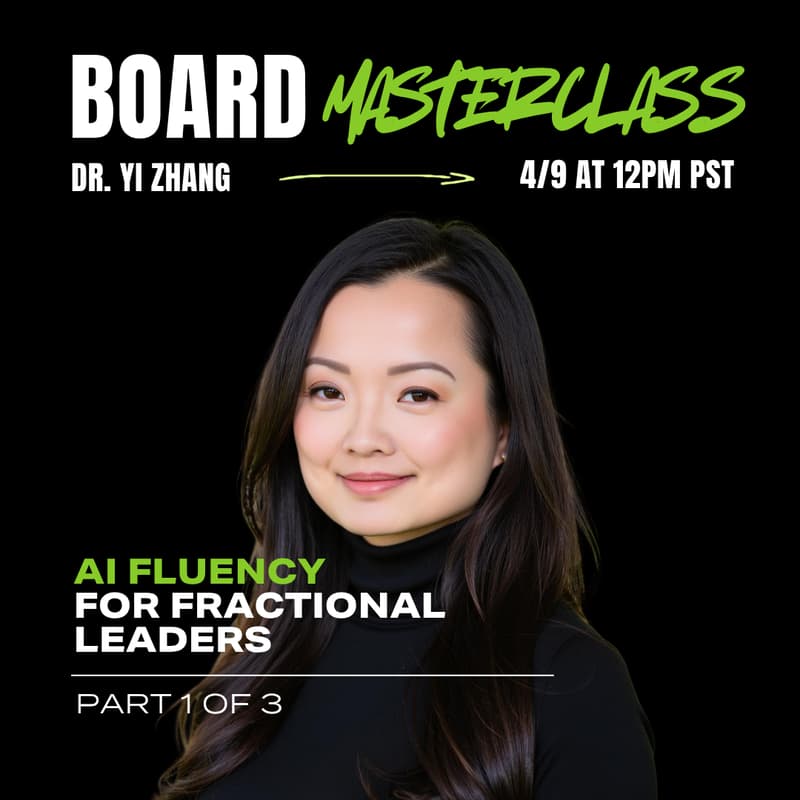
TICKETED MASTERCLASS: AI Fluency for Fractional Leaders: Language, Genres, and What Actually Matters
Fractional leaders now are expected to have an AI opinion. You'll leave knowing how to talk about AI with credibility in rooms you walk into.
Most AI training wasn't built for you. You've been operating at the executive level for 15–30+ years.
The client asks "What do you think about AI?" and you give a vague answer because you aren't sure where the hype ends and the reality begins. The information just hasn't been packaged for how you work across functions, companies, and engagements.
You need AI fluency as the first step—enough to advise clients, evaluate tools, assess your own workflow, and actively lead the client conversation.
WE ARE THE BOARD's Masterclass on AI Fluency: Language, Genres, and What Actually Matters will cover:
The AI Moment & Why Now: the stats and business case for fluency, not hype
AI History in Minutes: how we got here, fast
The AI Glossary: 10–15 terms you hear in boardrooms, decoded
Genres of AI: not all AI is ChatGPT, and your clients are already using more than they think
Strengths & Limits: where AI is powerful and where it falls short
Breakout Sessions: You will tackle a Buzzword Bingo challenge with peers, complete an AI mapping exercise, and determine whether your fractional tasks belong to AI, to you, or somewhere in between.
You will leave this Masterclass knowing what AI is, what it isn't, and how to talk about it with credibility in any room you walk into.
Dr. Yi Zhang partners with C-suite executives and senior leaders to drive measurable business results by closing workforce skill gaps. Her learning strategies have guided Fortune 100 companies including Microsoft, Walmart, Morgan Stanley, and United Airlines, through successful workforce development, technology adoption, and Customer Experience (CX) transformation. Yi is the founder of The Learning Brand, a principal learning strategist, and a member at WE ARE THE BOARD who built this series because most AI training targets engineers or beginners—not for the operators who make it work inside organizations.