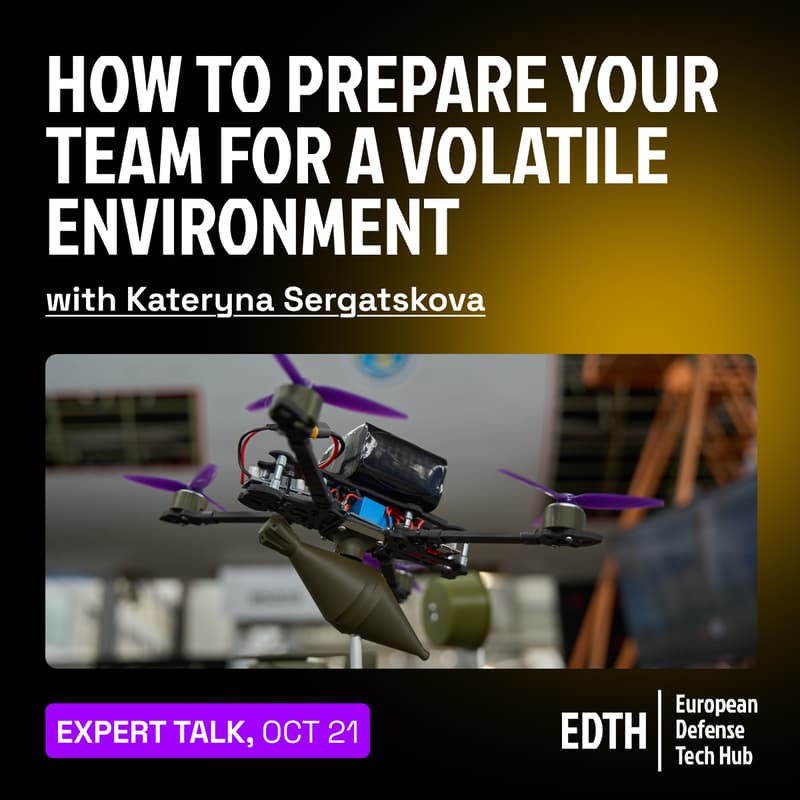

EDTH x Daily Humanity: How to Prepare Your Team for a Volatile Environment
Ukraine is receiving international teams — reconstruction, energy, defense-adjacent, humanitarian, and media — in volumes not seen since 2022. Most of their safety protocols haven't caught up with how the threat picture has actually changed.
On July 24, ballistic missiles hit a defense-industry exhibition at a private training ground in Kyiv Oblast, killing at least 12 and injuring around 100 — a location everyone involved would have called "the rear." On August 28, a drone strike on a warehouse in Myla, Bucha district, triggered secondary explosions that killed 37 people who weren't the target at all — they simply lived and worked next to it. In September, Russia spent two days attacking the rail network, striking a passenger train in Lutsk and a locomotive at Yahodyn, near the Polish border, with 200+ passengers aboard — the only reason no one on that train was hurt is that a monitoring team caught the warning in time and the crew acted on it.
Geography stopped being a reliable proxy for risk months ago. This session is about what replaces it.
Kateryna Sergatskova, CEO of Daily Humanity — an award-winning Ukrainian journalist who has covered the war since 2014, now leading a hostile-environment training and duty-of-care consultancy for media, humanitarian, and corporate teams — will walk through:
What's actually changed in the threat picture: long-range jet-powered drones (2,500+ in August alone), daytime strikes on previously "rear" locations, and a target set that's shifted toward the civilian-adjacent economy — warehouses, logistics hubs, rail, industrial sites.
Why standard duty-of-care policies, built for ordinary business travel, don't survive contact with this environment.
A practical, five-step risk assessment any manager can run in under an hour: identify specific risks, rate likelihood against impact, make a go/no-go call against pre-set criteria, mitigate what ranks highest, and plan for the situation changing after departure.
Why one named person needs unambiguous go/no-go authority before departure — and why the culture around that decision (never penalizing someone for stopping) matters as much as who holds it.
Why a risk assessment is worthless if the team can't execute it — and why proximity to experienced colleagues is not the same as trained muscle memory under stress.
Not yet part of the EDTH Community? 👇
1) Subscribe on our website to become a member: https://community.eurodefense.tech/
2) Get free access to all EDTH Community events for one year, including hackathon demo days, webinars, networking sessions, and the New Defense Summit