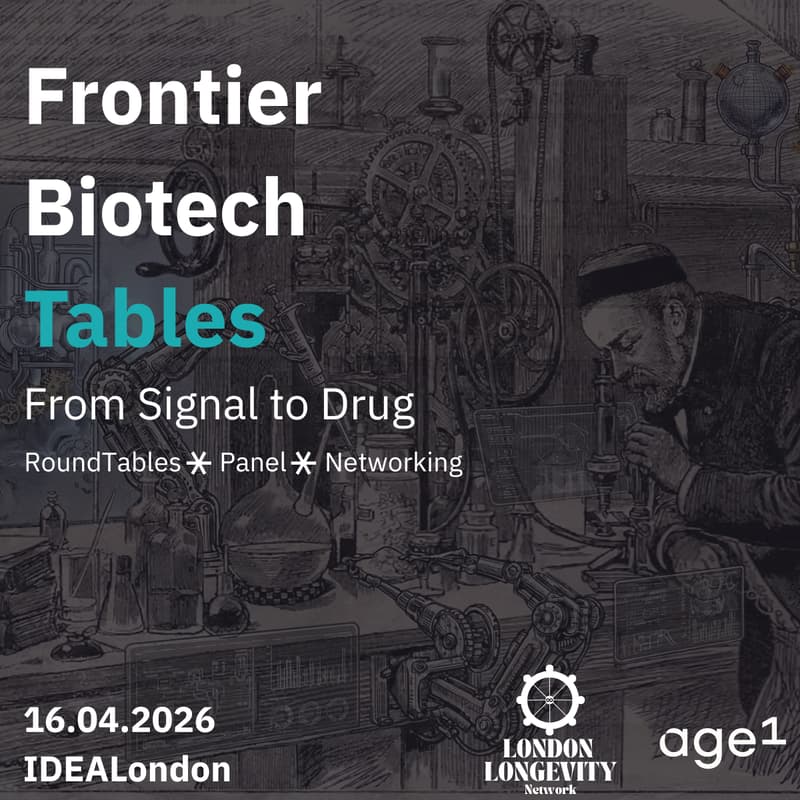


Frontier Biotech Tables: From Signal to Drug
Most promising biology never becomes a drug.
Ageing biology is where this is hardest. Confusing animal models, longer endpoints, more diffuse mechanisms, no clean biomarker consensus. The biology is real. The translation gap is real too.
This evening is about confronting the real bottlenecks between discovery and clinical-stage therapeutics.
We are curating a room of founders building in drug discovery, researchers at the frontier, pharma BD leaders who have seen what works (and what doesn't), and investors who've had to make bets on incomplete data.
The Evening
Registration — starts from 5:30pm
The Tables — 6:00–7:00pm
Five facilitated tables. Ten seats each. One problem per table. Choose up to two when you register and rotate halfway through.
The AI Value Shift — William Bolton, Encode AI for Science
As AI makes therapeutic candidates faster and cheaper to generate, where does value shift in drug development? This discussion will explore how AI may support clinical development, what limits progress, and what such a world could mean for business models built on defensibility.
Ageing-First Drug Development — Kazuhiro Ito, Imperial College London, National Heart and Lung Institute (NHLI)
To define a biology-driven framework to accelerate the development of interventions for age-related diseases by aligning target selection, model systems, and clinical translation. The discussion on this roundtable aims to de-risk and streamline the pipeline for novel senotherapies (combination with rejuvenation strategy), enabling more efficient progression from discovery to human efficacy.
Genomics based Target Selection — Davide Gianni, AstraZeneca
The roundtable will focus on addressing the key challenges of target selection as one of the important decisions in the drug discovery process and how we could address these challenges by leveraging translatable disease in vitro models, large human genetic datasets and functional genomics.
Virtual Cells & scRNA-seq based Target Prediction — James Opzoomer, Relation Therapeutics
This roundtable discussion will explore how large-scale perturbational single-cell RNA-seq datasets are being generated to train and refine models with the goal of predicting cellular responses to genetic and chemical perturbations. It will also consider the state of the field and how these datasets, together with AI-enabled virtual cell models, might be used to identify and prioritize potential therapeutic targets.
Why AI Drug Discovery Isn't Working — Dan Swerdlow, GSK
This roundtable will ask "How can we increase the success rate of AI-enabled drug discovery?" Volumes of data are increasing at unprecedented rates, AI model performance and versatility are rapidly strengthening, we have access to huge compute power and yet the number of drugs whose discovery was truly AI-enabled remains low. Why, and what can we do about it?
The Panel: From Signal to Drug: Where It Actually Breaks Down — 7:00–7:30pm
Panellists:
Daniel Ives — Founder and CEO at Shift Bioscience
Jack Castle — Chief Business Officer at Ochre Bio
Mythili Iyer — Corporate Strategy Lead at UCB
Lynetta Wang (moderator) — age1
Questions on the table:
— Where does systematic self-deception enter early-stage target validation?
— What makes ageing targets harder to validate than disease targets — and are the tools catching up?
— What does pharma actually need to see to engage seriously with a pre-clinical company?
— At what point does platform breadth become a liability?
Open Floor — 7:30–8:30pm
Drinks. Snacks. The conversations that follow.
Come if you are a founder, scientist, clinician, investor, or BD leader serious about closing the gap between discovery and the clinic.
London. 16 April.
Organised by
London Longevity catalysing breakthroughs, connections and momentum to extend healthy human lifespan
age1 backing contrarian founders building the technologies to extend healthy human life.
Community support from Imperial Aging & Longevity Society and Frontier Tower London
Hosted at IdeaLondon – a workspace for early teams and operators in science and tech. Founded by UCL Engineering and managed by WilbeLAB.