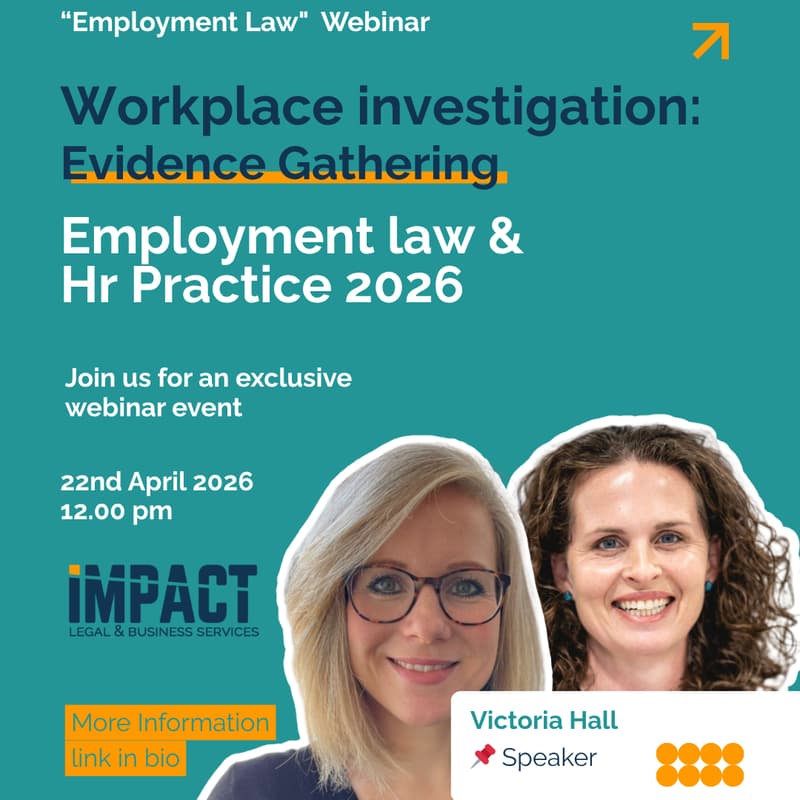

Evidence Gathering in Workplace Investigations
Evidence Gathering in Workplace Investigations
Getting the right evidence (and knowing when to stop)
The evidence-gathering stage is critical.
Too little evidence and you risk an unfair, unsafe outcome. Too much (or the wrong kind) and you create delay, cost, and unnecessary disruption without getting any closer to the truth.
In this Phase 2 session, we’ll step back from interviews (covered in our March webinar) and look at evidence gathering more broadly: where to start, what to look for, how far to go, and how to keep the process reasonable, proportionate, and balanced. (That “balance” matters, a fair investigation tests evidence for and against the allegation, rather than building a case in one direction.)
I’ll also be joined by Abi Carter, Director at Forensic Resources Ltd, who will share practical insight on when external support can strengthen investigation evidence, for example, where you may need help with digital forensics, e-disclosure, or audio/video analysis (e.g., CCTV or voice).
We will cover:
Where to start with evidence gathering (turning allegations into evidence lines and a plan)
What “reasonable and proportionate” looks like (how far you need to go and when you can stop)
Types of evidence to consider, including: emails, messages (Teams/WhatsApp), notes, meeting records, CCTV, and medical evidence (where relevant)
Handling “he said / she said” cases: credibility, consistency, context, and corroboration (without slipping into assumptions)
Balancing evidence for and against the allegation (what fairness looks like in practice, not just on paper)
When to bring in external expertise (practical examples), including:
Digital forensics (phones, laptops, data trails)
E-disclosure support (large volumes of documents/messages)
Audio/video enhancement & analysis (e.g., CCTV, voice/recordings) FRL Disciplines & Employment Law
Speakers: Victoria Hall (Employment Lawyer, Impact Legal & Business Services) and Abi Carter (Director, Forensic Resources Ltd)