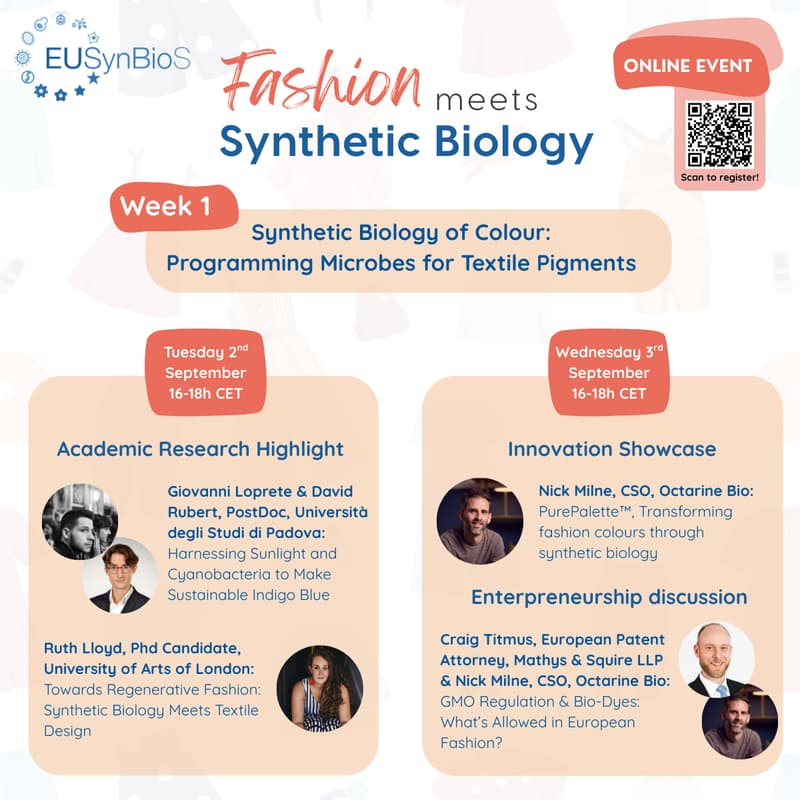

Week 1 - Synthetic Biology of Colours - Session 1
Programming Microbes for Textile Pigments
Academic Research Highlights!!
Giovanni Loprete and David Rubert, Università degli Studi di Padova: Harnessing Sunlight and Cyanobacteria to Make Sustainable Indigo Blue
Indigo blue, one of the world’s most iconic dyes, is still largely produced through chemical processes that rely on petroleum. Synthetic biology offers a greener path. In this work, we turned the photosynthetic bacterium Synechocystis into a light-powered dye factory. By introducing a single enzyme, a flavin-containing monooxygenase (mFMO), the engineered strain converts indole into indigo using only light and its own natural reducing power. Under optimized conditions, the cells produced up to 112 mg/L of indigo, corresponding to an 86% conversion of the supplied indole. We also developed a simple method to capture the secreted dye directly from the growth medium using polyamide nets. Together, these results show how living systems can be designed to tap into sunlight for sustainable chemical production, highlighting a step toward bio-based alternatives to traditional dye manufacturing. Link to article: https://enviromicro-journals.onlinelibrary.wiley.com/doi/10.1111/1751-7915.70146
Ruth Lloyd, Phd Candidate, University of Arts of London: Towards Regenerative Fashion: Synthetic Biology Meets Textile Design
Ruth Lloyd, former designer-in-residence at Colorifix and now a PhD researcher, is exploring how synthetic biology can transform one of the world’s most resource-intensive industries: textile dyeing. Conventional dyeing consumes over 5 trillion liters of water each year and relies on around 70 toxic chemicals. Colorifix offers an alternative, using engineered microbes fed with simple sugars and plant by-products to produce and fix colors onto fabrics, dramatically reducing water, energy, and chemical use. In this talk, Ruth will share her research journey at the intersection of design and biotechnology, and how scalable bio-based colour systems could contribute to a regenerative fashion industry.