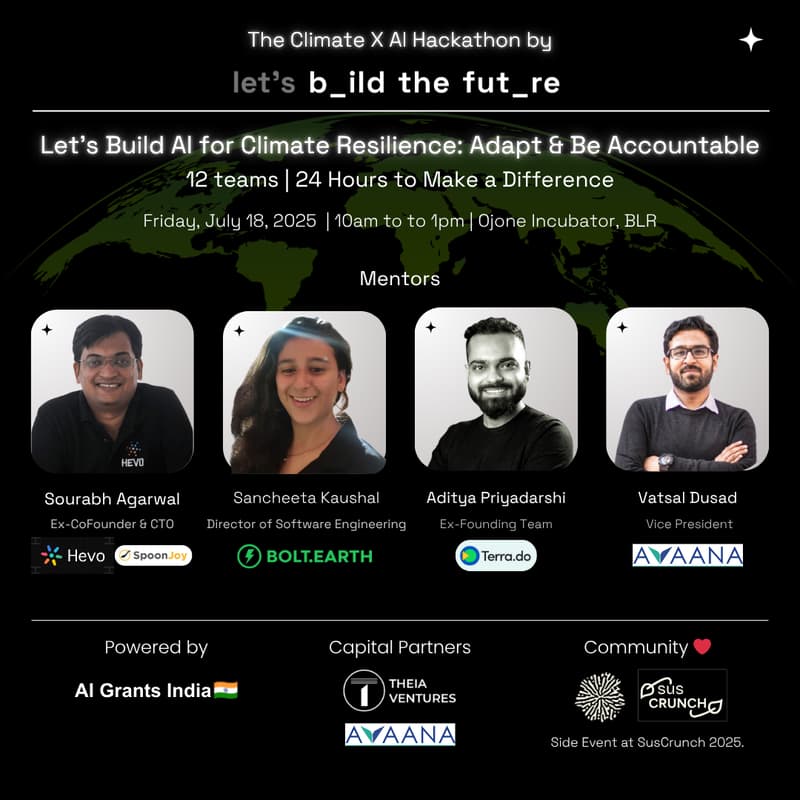

Hackathon | Let’s Build AI for Climate Resilience: Adapt & Be Accountable
Let’s Build AI for Climate Resilience: Adapt & Be Accountable
We have crossed crucial inflection points of climate change and environmental degradation, which means that even if mitigation efforts go as planned (🫠), there are catastrophic impacts which will be faced by humanity at large, and disproportionately borne by societies which have done the least to cause this problem.
This also, however, provides an opportunity to rethink a lot of our systems and societies from first principles, ground-up. Which translated to massive amounts of money flowing in and business opportunities for players that can help with building this resilience.
Solutions fall in the following major buckets:
- Better visibility: Anything and everything that helps us predict impacts of climate change, both in the short term as well as long term
- Immediate response: How can technology be used to minimise the impact of extreme weather events in the short term, through better alerting, communication, resource allocation and deep tech innovation
- Long term adaptation for industries: Since we know that a lot of climate impacts are right on the horizon, how do we build industry specific solutions to make industries more resilient to the events which are relevant for them?
- Financial solutions: Insurance and loans play a major role in helping industries and communities adapt and face challenges. Innovative financial products can be created which solve the problem in a profitable way
- Long term adaptation for societies: This goes into community and city scale adaptation efforts in terms of built environment, mobility, green cover, air quality and urban land preservation
- Behaviour change: Customer facing solutions which focus on community engagement, promoting more resilient choices or creating general awareness
Problem Statements for the Hackathon
Visibility
Anything and everything that helps us predict impacts of climate change, both in the short term as well as long term
- Digital twins that analyze infrastructure plans for climate risks
- Smarter weather alerting systems, which are either more granular or consider longer timeframes
- Risk assessment for low income communities and high vulnerability areas
Crisis Management
How can technology be used to minimise the impact of extreme weather events in the short term, through better alerting, communication, resource allocation and deep tech innovation
- Emergency response and communication systems
- Healthcare and frontline inventory management for crises
- Prediction and containment of vector borne diseases right after disasters
Industry specific resilience
Since we know that a lot of climate impacts are right on the horizon, how do we build industry specific solutions to make industries more resilient to the events which are relevant for them?
- Seed varieties which are more resilient to extreme weather
- supply chains that are resilient to extreme weather
- resilient and sustainable energy grids
- urban/peri-urban farming systems that are more resilient
- AI copilots for disclosures and reporting
Financial products
Insurance and loans play a major role in helping industries and communities adapt and face challenges. Innovative financial products can be created which solve the problem in a profitable way
- parametric insurance products for farming
- hyper-local disaster data for motor and property insurance providers
- disaster relief insurance products for small business
- MRV systems or marketplaces for biodiversity credits
- prediction models for assessing assets at risk
Behavior change
Customer facing solutions which focus on community engagement, promoting more resilient choices or creating general awareness
- localized circular economy networks
- waste management solutions (like waste food → hungry people)
- solutions that increase public participation in local policy decisions
- educational products that can create awareness and/or drive behavior change
Rules, Format & Criteria
Date: July 18-19, 2025
Start Time: 9:00 AM
Participants: ~100 (Teams of 2 to 4 members)
Duration: 24 Hours
Hackathon Format
9:00 AM – Kickoff & Mentor Talks (1 Hour)
Welcome note
Theme walkthrough and expectations
Short, sharp talks from mentors to inspire and guide participants
Logistics and submission guidelines
10:00 AM – Concept Submission (1 Hour)
Teams finalize and submit a 2-slide concept outline:
Problem statement and proposed solution
What they plan to build in 24 hours
11:00 AM – Mentor Huddle + Build Begins (2 Hours)
Mentors available for hands-on guidance
Teams start prototyping
Final clarifications and nudges before remote work begins
1:00 PM – Lunch & Break
Informal networking
Venue disbands; teams continue building remotely
Post 2:00 PM – Remote Build Phase
Teams have the remaining time to design, develop, and document their solution
Mentors will be available via whatsapp group for support (up to 9:00 PM)
8:00 AM, July 19 – Final Submission Deadline
Teams must submit:
🛠️ Project link / demo (webpage, deck, app, repo, etc.)
🎥 2-3 min video walkthrough (explain + demo)
🔗 GitHub repo (clean code, with README)
Hackathon Rules
Team Size: 2-4 members per team. Please ask your team mates to apply individually. Solo entries will be paired with other people.
Originality: All work must be done during the hackathon. No pre-built projects or code please.
Use of AI: Must use AI in a meaningful way to address the climate problem.
Fair Play: No plagiarism. Any external libraries or datasets used must be credited.
Remote Support: Mentors available on WhatsApp; queries post 9:00 PM will be difficult to address.
Submission Format: Video + GitHub Repo + Live Demo/Link (if possible)
Deadline Strictness: Late submissions will not be accepted beyond 8:00 AM on July 19.