Workshop Maze Circuit: AI-Assisted Prototyping for Physical-Digital Interaction
Maze Circuit is a hands-on workshop where bodies, conductive materials, simple electronics, web-based interfaces, and AI-assisted coding come together to create playful physical-digital experiences.
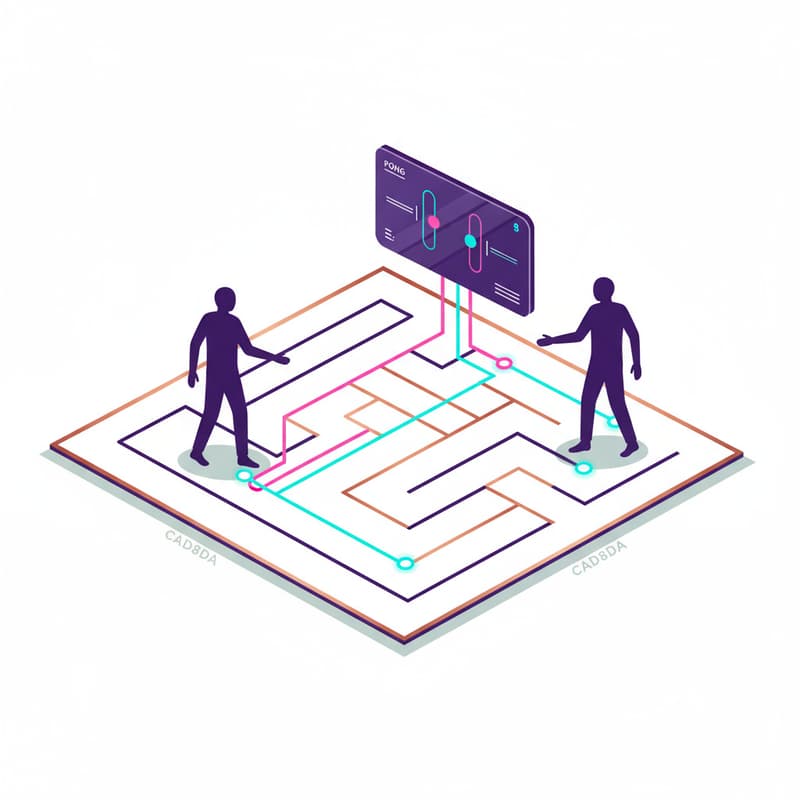
Participants step into a maze built on the floor: a conductive playground made with copper tape, aluminum, graphite, paper, and other accessible materials. As they move through the space, touch hands, connect skin to skin, or complete paths with their bodies, they discover how closing a simple circuit can control what happens on screen.
But Maze Circuit is not only about circuits. It is also about designing the digital experience connected to them.
Working in small groups of 4 to 5 people, participants will create a simple web-based interface, game, or interactive experience that responds to the physical maze. This could become a collaborative Pong game, a visual feedback system, a playful navigation interface, a collective challenge, or another interaction imagined by the group.
Throughout the workshop, we will use AI-assisted prototyping, also known as vibe coding, as a creative method. AI tools will support brainstorming, interaction design, game mechanics, code generation, debugging, and rapid experimentation. The goal is not to become an expert programmer in one afternoon, but to understand how an interaction idea can become a working prototype.
Inspiration
The workshop is inspired by the logic of the Makey Makey board: a playful circuit that reacts when human bodies and conductive materials complete a connection.
In Maze Circuit, this principle becomes both a game and a prototyping tool. Imagine a floor labyrinth made of copper tape, aluminum, graphite, or paper. As players navigate it, they sometimes need to touch hands, feet, or connect with other bodies in order to advance. Their connection closes the circuit, and the circuit becomes an input for a digital interface.
A well-known example of this logic is the Banana Piano, where bananas become the keys of a musical instrument. Just like fruit can become a keyboard, Maze Circuit invites you to rethink how everyday conductive materials, spatial movement, and even the human body can become unexpected interfaces for play.
This workshop expands that idea into a collective prototyping environment. Instead of only testing a pre-built interaction, participants will design their own physical-digital system: one part conductive maze, one part web interface, one part game, one part social experiment.
Why You Must Do This Workshop
Most conversations about AI in design still happen around text, chatbots, image generation, productivity, and automation.
Maze Circuit brings AI into a more physical, playful, and social space.
In this workshop, AI becomes part of the making process. You will use it to help imagine interactions, structure ideas, write simple code, test behaviours, and connect a physical input to a digital output.
You should join if you want to explore:
how to prototype interactions beyond the screen
how AI can support early-stage interaction design
how physical materials can become interfaces
how simple circuits can trigger digital experiences
how bodies, movement, and collaboration can shape UX
how vibe coding can support rapid prototyping
how to move from concept to working prototype in one afternoon
Maze Circuit is especially relevant for people from the UX, interaction, and design communities, as well as artists, educators, creative technologists, product thinkers, and anyone curious about playful interfaces, embodied interaction, and AI-assisted making.
No previous coding or electronics experience is required.
What You Will Learn
How conductive materials such as copper tape, aluminum, graphite, and paper can be used to build simple circuits.
How Makey Makey-style boards or similar input systems can register touch and transform it into input for a computer.
How a physical circuit can communicate with a simple web-based interface.
How to design a playful interaction that connects bodies, materials, and digital feedback.
How to use AI tools to brainstorm, prototype, generate code, debug, and iterate quickly.
How to create a simple interactive game, visual interface, or web-based experience using AI-assisted coding.
How to collaborate in small groups to build a physical-digital prototype.
Who It’s For
No previous experience is required.
Maze Circuit is designed for curious beginners as well as people with experience in UX, interaction design, product design, education, creative technology, art, performance, or coding.
The workshop is especially suitable for:
UX designers
interaction designers
product designers
educators
artists
creative technologists
researchers
performers
people curious about AI-assisted prototyping
anyone interested in designing experiences beyond the screen
Participants will work in small groups of 4 to 5 people. Each group may combine different interests: some people may focus on the physical interface, others on the digital experience, others on game mechanics, performance, documentation, or interaction design.
Practical Details
Format
One-day in-person workshop
Date
Saturday, May 23, 2026
Time
13:00–18:00 CET
Location
Schönauareal, Wetzikon
Zurich area, Switzerland
Capacity
20 participants
Group size
4 to 5 people per group
Participation
Free, with a suggested donation of 59 CHF to help cover materials and workshop costs.
What You Take With You
By the end of the workshop, each group will have created a working physical-digital prototype: a conductive maze or interface connected to a simple web-based experience.
You will leave with:
a practical understanding of how simple circuits can become interactive inputs
experience using AI as a prototyping partner
a working group prototype
documentation of the process through photos and videos
new ideas for playful UX, embodied interaction, and physical-digital interfaces
More than a finished product, you take with you a method: how to combine bodies, materials, circuits, AI tools, and web interfaces to design new forms of interaction.
About the Host
Lina Lopes is an artist, creative technologist, and data scientist exploring the intersections of performance, interactive spaces, machine learning, physical interfaces, and experimental education.
With over a decade of experience across art, design, technology, and innovation, she has presented her work internationally in museums, universities, festivals, and learning spaces. Her practice includes collaborations and experiences with institutions such as the MIT Media Lab, Arte1 TV, FabLabs, and creative technology communities.
She creates collaborative workshops where technology becomes a tool for imagination, play, prototyping, and radical experimentation.
✨ Join us to turn touch into interaction, and transform the room into a living circuit.