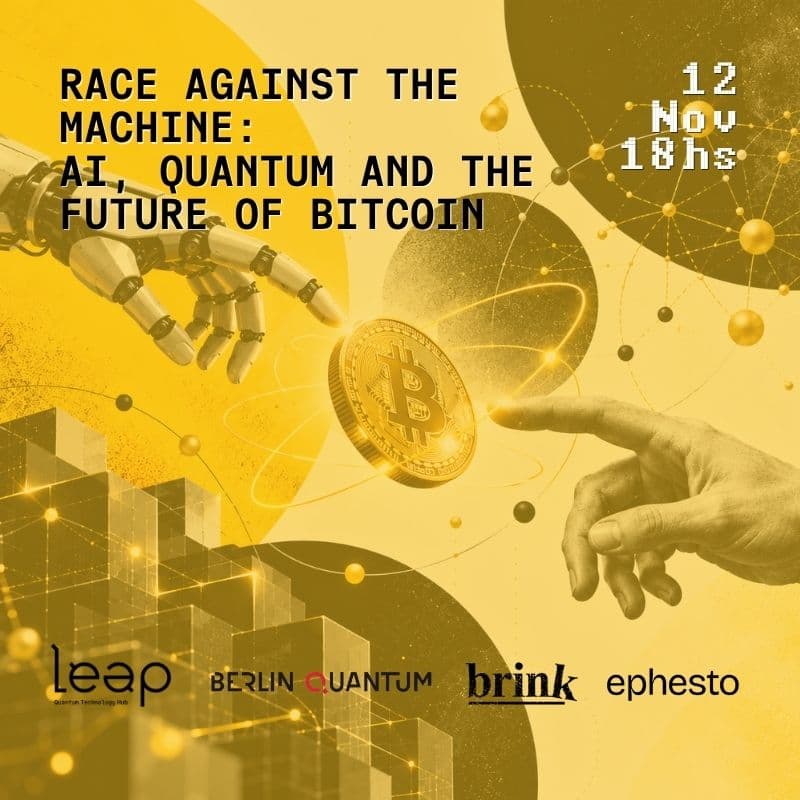

Race Against the Machine: AI, Quantum and the Future of Bitcoin
Intro
Almost everything we trust online, from banking and web traffic to messaging and digital identity, rests on public-key cryptography. Two threats are now calling that very foundation into question. Quantum computers could break today's signatures and key exchange, with the hardware required shrinking steadily. AI could reach the same result with breakthroughs in mathematics, and it is already helping quantum attacks along by optimizing the circuits behind them.
The synergy between them is unmistakable, and even the post-quantum schemes meant to replace today's cryptography may not be safe either. With finance and the internet facing a long, fragmented migration, the stakes are highest where cryptography protects value directly. Cryptocurrencies add their own exposure: public keys sit on a public ledger, assets are bearer instruments, and theft is irreversible. Given Bitcoin's history, the challenge is particularly acute: every serious option (do nothing, freeze, force a deadline) violates a principle the Bitcoin community cares about, and the work must start before the threat is visible.
Join us at this interdisciplinary event where AI, quantum and Bitcoin experts come together in a novel panel to discuss the technical foundations of this challenge and its potential solutions.
Speakers
Wadim Wormsbecher:
Theoretical physicist turned tech innovator. With a PhD from Humboldt-Universität zu Berlin and a background developing AI products, Wadim now works at Bundesdruckerei focusing on applied cybersecurity in the era of Quantum and AI. His focus goes beyond hardware. AI-driven discoveries and algorithmic improvements can reduce the resources needed to challenge today’s cryptography. Understanding these shifts is essential to assessing quantum threats and making informed security decisions.
wadimwormsbecher
Fabian Jahr:
Fabian Jahr has contributed to Bitcoin Core since 2019 and currently works on it full-time with a grant from Brink. He reviews critical changes to Bitcoin Core, develops ASMap for a more decentralized peer-to-peer network, and researches protocol upgrades. With the support of the Human Rights Foundation, he published a report on how Cross-Input Signature Aggregation could change Bitcoin, and he is now turning it into a soft fork proposal with BIPs 458 to 460.
Manuel Moran:
Over the past 12 years, Manuel has built software across research, media, and both traditional and decentralized finance. His path has run from software engineering, through data science and machine learning, to AI engineering, where he now owns end-to-end agentic workflows. At the ephesto consultancy he collaborates with experts in design, strategy, finance, and law to help organizations stay competitive as AI redefines what it takes to be successful.
This event is organized by Leap Quantum Technology Hub as part of the Thursday Gathering by Venture Café Berlin.
https://leap.berlin/ https://venturecafeberlin.org/