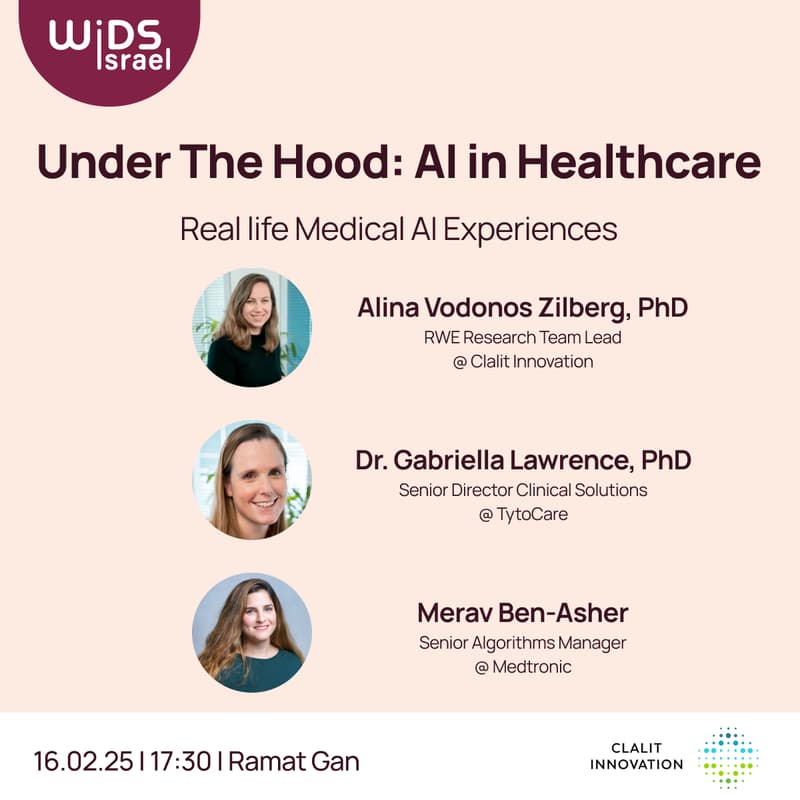
Under the Hood: AI in Healthcare
AI looks impressive on slides.
Healthcare rarely behaves like that.
At our upcoming Women in Data Science Israel (WiDS) meetup, together with Clalit Innovation, we’re not debating whether AI can work in healthcare.
We’re looking at what it takes once it’s expected to operate in real clinical settings.
We’re dealing with clinical data that was created for care delivery and reimbursement, not for modeling.
AI systems that must operate inside existing clinical workflows, under regulatory and safety constraints.
And evaluation questions that go far beyond offline accuracy metrics.
Itinerary:
17:30-18:00 Greeting and Registration
18:00-18:15 Opening words
18:15-18:45 High-Value and Deeply Imperfect - Turning messy data from the real-world into trustworthy clinical insights and products / Dr. Gabriella Lawrence, PhD
18:45-18:55 Short break
18:55-19:25 AI Algorithms Powering Spine Robotics / Merav Ben-Asher
19:30 - 20:00 Evaluating the Real-World Impact of AI in Healthcare / Alina Vodonos Zilberg, PhD
Talk Abstracts:
High-Value and Deeply Imperfect - Turning messy data from the real-world into trustworthy clinical insights and products / Dr. Gabriella Lawrence, PhD
Clinical data is among the most valuable data we have in healthcare and among the most imperfect. Generated in the context of care delivery and reimbursement rather than analysis, it is messy, biased, incomplete, and deeply contextual. Care-delivery data captures clinical nuance and real-time decision-making, but is constrained by workflow, documentation burden and fragmented systems. Claims data adds scale and longitudinal visibility, but introduces its own distortions through coding incentives, delays, and proxy labels. Yet these data drive the insights, models, and products shaping clinical, operational and consumer-facing decisions. I’ll draw on real-world experience working with clinical and claims data to explore the tension between value and imperfection and how we can transform real-world healthcare data into trustworthy insights and products.
AI Algorithms Powering Spine Robotics / Merav Ben-Asher
The rapid advancement of artificial intelligence in recent years has opened the door to significant breakthroughs in healthcare, and particularly in robotic spine surgery. AI-based algorithms enable the automation of surgical planning and intraoperative processes, reduce reliance on radiation, and improve precision and patient safety. At the same time, the integration of AI into clinical workflows introduces new challenges, including the handling of sensitive patient data and the rigorous validation required to ensure safety, reliability, and regulatory compliance of AI-driven systems.
Evaluating the Real-World Impact of AI in Healthcare / Alina Vodonos Zilberg, PhD
As AI integrates into clinical workflows, there is a need for impact evaluation to bridge the gap between model accuracy and actual patient outcomes.
Drawing from our work at Clalit Innovation’s RWE Research Team, I will explore why RWE is the backbone of modern healthcare innovation, allowing us to observe how medical interventions and AI tools perform across diverse, "messy," and unselected populations, far beyond the controlled environment of clinical trials.
About The Speakers:
Dr. Gabriella Lawrence, PhD
A Senior Director Clinical Solutions @ TytoCare. Epidemiologist and healthcare leader translating data and rigorous research into clinical, economic, and business impact. I lead teams at the intersection of data science, digital health, and strategy, always grounded in the belief that behind every data point is a human life.
Merav Ben-Asher
A Senior Algorithms Manager @ Medtronic Caesarea.
Leading a team focused on developing advanced algorithms and computer vision solutions to enable cutting-edge spine robotic surgery.
Alina Vodonos Zilberg, PhD
Serves as the RWE Research Team Lead at Clalit Innovation, where she leads real-world evidence initiatives and focuses on the impact evaluation of AI in healthcare.