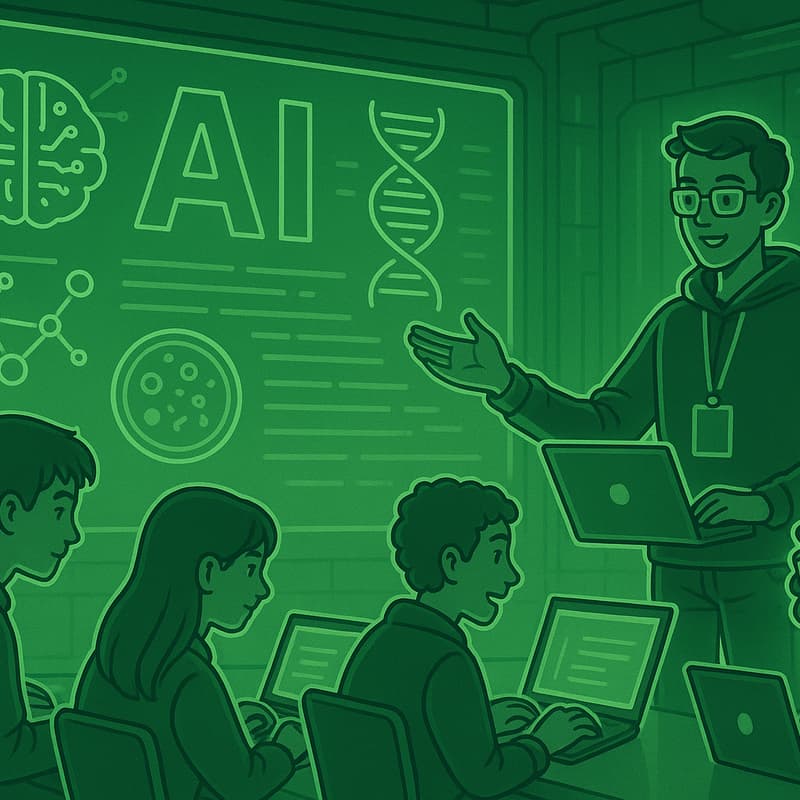

Automating Bioinformatics & SynBio with MCP: AI Workflows for IGEM and Beyond
Stop Wrestling with Tools, Start Building Cool Bio-Tech
Imagine working on your biology or bioinformatics research project. You need gene information, 3D protein structures, drug targets, plasmid searches, genetic construct designs, safety analysis, team updates, and documentation. Currently, that's 10+ websites, endless copy-pasting, and hours lost.
Reality Check:
Researchers spend 60-80% of their time manually juggling tools.
IGEM or other biology research teams typically use 10-15 resources per project.
Endless copy-pasting between tools instead of actual science.
What if you could simply say:
"Find longevity genes → get their structures → identify drugs → design plasmids and genetic constructs → analyze interactions → update team → generate report"
That's exactly what this workshop covers.
We'll expand our previous LLM agents workshop (https://www.youtube.com/watch?v=2aism5Lex5s) by introducing Model Context Protocol (MCP) — technology that seamlessly connects your research tools, including both AI conversational tools and AI-aided development environments like Cursor and Windsurf.
Though our examples focus on synthetic biology and IGEM (https://igem.org/), these automation techniques broadly apply across biological research.
Workshop Outline:
Part 1: MCP Theory That Actually Matters (30-40 min)
Why biological research tools are fragmented (and how MCP fixes it)
Transitioning from manual tasks to automated conversational workflows
Live demo using Cursor: Complex query → instant synthesized result
Part 2: Hands-On Workflow Revolution (1 hour)
Before MCP:
Gene info (NCBI), Protein details (UniProt), 3D structures (PDB), plasmid databases (Addgene), construct design tools (Benchling), literature (PubMed), spreadsheets, manual updates.
After MCP:
Single command: "Analyze my target genes, design genetic constructs, check safety, and update team."
Real-world scenarios:
Project research workflows
Genetic construct design and plasmid searching
Team coordination and updates
Documentation automation
Part 3: Build Custom Team Automation (60-75 min)
Choose your project:
Basic tool tailored to your needs
Simple productivity bot for your team
Automated workflow templates
IGEM Bonus: MCP servers you build can enter IGEM's Software Track (https://igem.org/Tracks/Software).
Example MCP Servers:
Bioinformatics:
gget-mcp (https://github.com/longevity-genie/gget-mcp): Genomics queries
opengenes-mcp (https://github.com/longevity-genie/opengenes-mcp): Longevity research
synergy-age-mcp (https://github.com/longevity-genie/synergy-age-mcp): Genetic interactions
biothings-mcp (https://github.com/longevity-genie/biothings-mcp): BioThings.io API
pharmacology-mcp (https://github.com/antonkulaga/pharmacology-mcp): Drug-target data
Productivity:
Slack/WhatsApp updates
Gmail automation
Social media scheduling
Document and timeline management
What You'll Need:
Required:
Laptop (Linux ideal, Mac or Windows with WSL2 okay)
Python proficiency (writing/modifying code)
MCP client: Cursor (https://cursor.sh/) recommended, Windsurf (https://codeium.com/windsurf), Claude Desktop (https://claude.ai/download), or Witsy (https://github.com/nbonamy/witsy)
Python package manager: uv (https://docs.astral.sh/uv/getting-started/installation)
Recent Node.js for npx ( https://docs.npmjs.com/downloading-and-installing-node-js-and-npm )
git
Verify setup: Cursor MCP setup video (https://youtu.be/Xo0sHWGJvE0)
IMPORTANT: If you come unprepared, the whole group will not wait until you download and install all the software! Coming prepared is mandatory; if you have any installation issues, contact the hosts in advance, and we will try to help. You also have to know basic Python and git (check numerous free online courses/tutorials if you do not know it); nobody will explain basic Python syntax to you.
Optional:
Previous LLM agents workshop recording (https://www.youtube.com/watch?v=2aism5Lex5s )
MCP course at DeepLearning.AI (https://www.deeplearning.ai/short-courses/mcp-build-rich-context-ai-apps-with-anthropic)
Theory of how LLM work ( https://www.youtube.com/watch?v=wjZofJX0v4M )
Outcomes:
By the end of the workshop, you'll have:
Automated research tasks via MCP
Understanding of bioinformatics MCP servers
A functional MCP prototype
Clear next steps to expand automation in your projects
Venue and Partners:
Venue: Verita School (https://veritaschool.ro/), home of the IGEM VIS High School Team (https://teams.igem.org/5912)
Supporting organizations: Romanian Bioinformatics Society (https://rsbi.ro/), IBIMA (https://ibima.med.uni-rostock.de/), HEALES (https://heales.org/), Systems Biology of Aging Group (https://aging-research.group), CellFabrik (https://cellfabrik.bio/)
IMPORTANT: All attendees and organizers who are not part of Verita School must check in at the front desk of the main building and obtain a visitor badge. After check-in, a Verita staff member will escort the group to the main event room.
Instructors:
Anton Kulaga: Bioinformatician in aging research, founder of Just-DNA-Seq (https://just-dna.life/), co-founder of Longevity Genie (https://longevity-genie.info/).
Livia Zaharia: Citizen scientist, founder of GlucoseDAO (https://github.com/Livia-Zaharia/glucosedao), contributor to Longevity Genie, making tech approachable for newcomers.
Why This Matters:
This isn't theoretical—it's practical automation developed by researchers tired of manual processes. Our goal is empowering you with automation skills for streamlined bio-research.
Come ready to learn, experiment, and embrace the future of scientific workflows.