
Hosts: Junfan Zhu, Aurora Feng
discord.gg/WH7DrTHRXK
🥂 Saturday Robotics x SF Deep Tech Week Research Night 06/25 | Robotics & World Models Reading Club 14
🥂 Saturday Robotics x SF Deep Tech Week Research Night 06/25 | Robotics & World Models Reading Club 14
Date: June 25, 2026 (Thursday)
Time: 5:30 PM — 9:30 PM (tentative)
Location: San Francisco, CA
Organized by: Saturday Robotics & World Models Reading Club x Pebblebed
This will keep the same high-signal, deep-discussion format that defines our weekly Saturday sessions: technical sharing, sharp questions, open discussion, and real exchange between people actively working on robotics, world models, embodied AI, computer vision, and physical intelligence.
Hosts: Saturday Robotics. Saturday Robotics is a high signal reading group for robotics & world models researchers, founders, and builders in SF. Previous sessions have hosted researchers and builders from teams including Boston Dynamics, Google DeepMind, NVIDIA, Stanford, UC Berkeley, Rhoda AI, Meta FAIR, Generalist, Dyna Robotics, and leading Bay Area robotics startups. The weekly discussions have also generated in-depth public technical writeups and community posts that have drawn attention from researchers across the field, including engagement from Yann LeCun.
Opening Remarks
Junfan Zhu & Aurora Feng, Founders of Saturday Robotics
SF Deep Tech Week Research Night Lightning Talks & Panels
Mike Roberts. Senior Research Scientist, Adobe Research. Stanford PhD. Author of Hypersim (synthetic computer vision dataset. SPEAR: A Simulator for Photorealistic Embodied AI Research. (ECCV 2026 accepted).
Interactive simulators have become powerful tools for training embodied agents and generating synthetic visual data, but existing photorealistic simulators suffer from limited generality, programmability, and rendering speed. We address these limitations by introducing SPEAR: A Simulator for Photorealistic Embodied AI Research. At its core, SPEAR is a Python library that can connect to, and programmatically control, any Unreal Engine (UE) application via a modular plugin architecture. SPEAR exposes over 14K unique UE functions to Python, representing an order-of-magnitude increase in programmable functionality over existing UE-based simulators. Additionally, a single SPEAR instance can render 1920x1080 photorealistic beauty images directly into a user's NumPy array at 70 frames per second -- an order of magnitude faster than existing UE plugins -- while also providing ground truth image modalities that are not available in any existing UE-based simulator (e.g., a non-diffuse intrinsic image decomposition, material IDs, and physically based shading parameters). Finally, SPEAR introduces an expressive high-level programming model that enables users to specify complex graphs of UE work with arbitrary data dependencies among work items, and to execute these graphs deterministically within a single UE frame. We demonstrate the utility of SPEAR through a diverse collection of example applications: controlling multiple embodied agents with distinct action spaces (e.g., humans, cars, and robots) across several in-the-wild UE projects; rendering photorealistic city-scale environments; manipulating UE's procedural content generation system; rendering synchronized multi-view images of detailed human faces; running an interactive co-simulation with the MuJoCo physics simulator; and editing scenes using natural-language instructions via a vision-and-language coding assistant.
Panel / Open technical Q&A.
Simone Totaro, CTO at Saturn Dynamics.
Saturn Dynamics are building compute-efficient world models for robotics, focused on making physical-world intelligence observable, verifiable, and scalable.
Compute-efficient World Models
Evaluation Gap in World Models
Precision Gap in World Models — and whether data alone will ever get us there
Shumo Chu, CEO at General Intelligence Labs
General Intelligence Labs (GI) is the training infrastructure for physical AI. GI designs its own egocentric data-collection hardware — stereo capture headsets, UMI grippers, and motion-capture gloves — and runs the whole post-training loop around it: a global data operation, post-training, and physical RL. Together they turn human motion into deployable, accurate robot policies, letting industrial companies train their own sovereign robot models and frontier labs train the specific skills a generalist needs.
Margaret Zhang, CEO at ThirdBrain Labs
ThirdBrain Labs is unlocking the next 1 billion specialized models. They help frontier robotics and industrial teams own and continuously improve, custom private models. Their training and research infrastructure encodes proprietary operational knowledge into real-world physical AI execution, at a fraction of the time and labor, allowing teams to continuously steer production models without the burden of massive datasets.
Nikhil Abraham, CEO at Cloudchef
CloudChef is an innovative food technology startup utilizing embodied AI, computer vision, and machine learning to build what it calls a "Spotify for food." The company’s proprietary technology platform captures a master chef’s exact culinary actions—including precise metrics like ingredient weight, thermal properties, and moisture loss—and codifies them into a "machine-readable recipe file." This data is then deployed to autonomous, bimanual robots and smart collaborative kitchen setups that can flawlessly replicate complex, Michelin-starred dishes with perfect consistency anywhere in the world.
Open Floor Discussions + Q&A
We'd also love to hear your hot takes on:
"What's still the bottleneck around embodied AI systems? more by model architecture, embodied data, physical grounding, or evaluation?"
We welcome researchers, engineers, founders, and builders working on relevant frontier topics, including but not limited to:
Robotics world models and action-conditioned prediction
JEPA / V-JEPA-style predictive representation learning
Vision-language-action models, world-action models, and robot foundation models
Human egocentric video, UMI-style data, teleoperation, and robot-collected interaction data
Multimodal world models across vision, tactile, proprioception, language, and action
Cross-embodiment transfer, long-horizon planning, and embodied generalization
Physical grounding, spatial understanding, simulation, and evaluation for robot learning
Video generation/video world models for robotics
Schedule (tentative)
5:30 to 6:00 PM
Doors open, dinner, drinks, strawberries, and networking. 🥘🍾🍓
6:00 to 6:15 PM
Opening remarks from Saturday Robotics.
6:15 to 7:15 PM
Keynote/lightning talks.
7:15 to 8:15 PM
Panels, open technical Q&A and roundtable discussion.
8:15 to 9:30 PM
Free-form discussion, curated introductions, and open mingling.
Join Discord Community
Follow Saturday Robotics
saturdayrobotic
saturdayrobotic
Follow Our YouTube Channel
Call for Keynotes, Panelists & Lightning Talks
🚀 Calling for Keynotes, Panelists & Lightning Talks
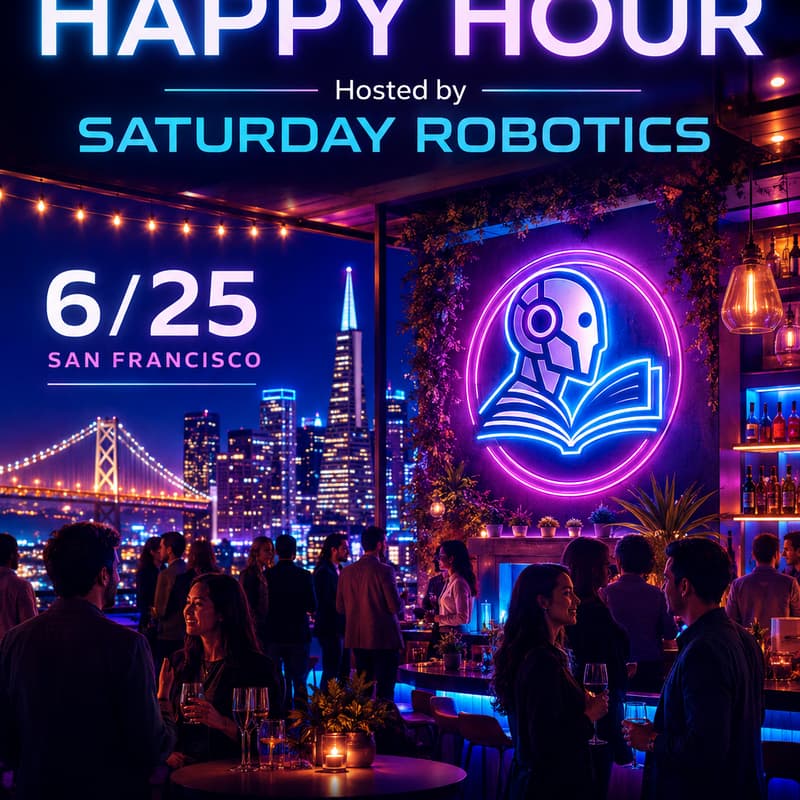
🥂 Saturday Robotics x SF Deep Tech Week Happy Hour 06/25 | Robotics & World Models Reading Club 14
👉🏻 RSVP: https://luma.com/l1g9c2l1
As part of Saturday Robotics Deep Tech Week Summit (June 2026), we're bringing together robotics researchers, founders, investors, and builders during SF Deep Tech Week for an evening of discussions on the future of embodied AI and robotics.
📅 June 25, 2026
⏰ 5:30 PM – 9:30 PM
📍 San Francisco
We're currently looking for speakers, panelists, and lightning talk presenters interested in sharing insights on:
• World Models
• Robotics Frontiers: Industry and Academia
• Dexterous Manipulation, Cross-Embodiment
• Video Generation, Simulation
Researchers, startup founders, industry practitioners, and investors are all welcome.
If you'd like to be a lightning talk speaker or panelist, please message Junfan Zhu or 📧 junfanzhu98@gmail.com
Include:
• Name + Affiliation
• Lightning Talk Abstract, or Proposed Panel Discussion Topics
Looking forward to bringing together the robotics and embodied AI community for an evening of technical discussion, networking, and collaboration.
Hosts: Junfan Zhu, Aurora Feng
discord.gg/WH7DrTHRXK