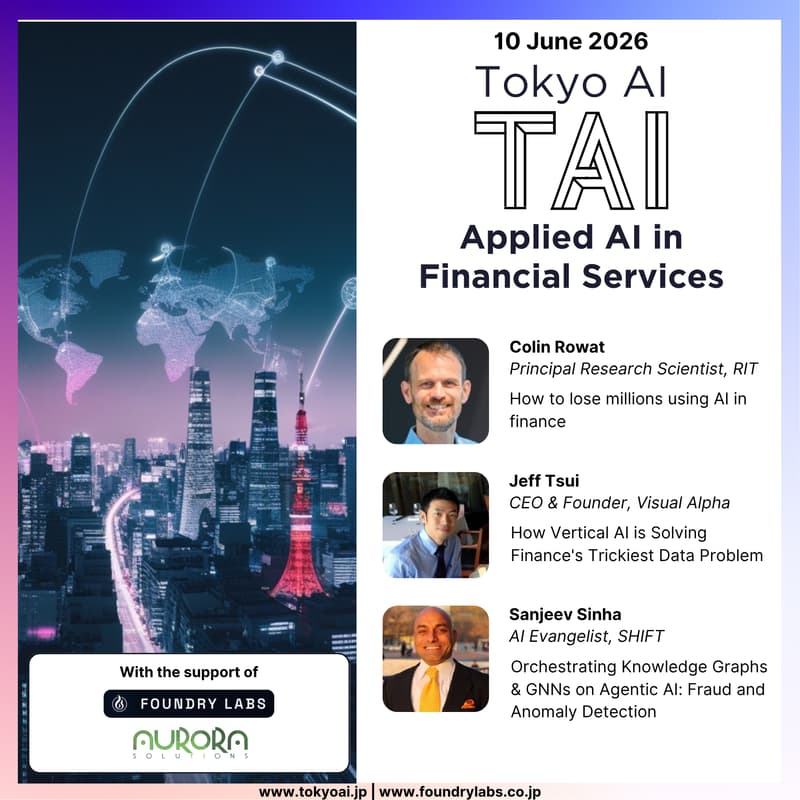

AI in Financial Services: From LLM Failure Modes to Graph-Based Fraud Detection
Description
The second session of Tokyo AI (TAI)’s Financial Services series explores the practical engineering challenges, systemic risks, and architectural trade-offs of deploying artificial intelligence in high-stakes financial environments. We'll discuss failure modes of large language models in quantitative workflows, the orchestration of Knowledge Graphs and Graph Neural Networks (GNNs) for network-level fraud and anomaly detection, and the design of multi-model vertical AI systems capable of structuring complex, unstructured institutional investment data.
Designed for researchers, engineers, and technical leaders, the event provides concrete insights into building production-grade financial AI infrastructure that balances automation with strict domain-specific constraints.
Agenda
We'll start by establishing the baseline risks and operational boundaries of general-purpose LLMs in financial contexts. We'll then demonstrate how a multi-model vertical AI system can circumvent generic LLM deficiencies to automate highly specific data extraction workflows. We'll conclude with a discussion of advanced multi-layered systems.
18:00 — Doors Open & Check-in
18:30 — How to Lose Millions Using AI in Finance (Colin Rowat)
19:00 — How Vertical AI is Solving Finance's Trickiest Data Problem (Jeff Tsui)
19:30 — Orchestrating Knowledge Graphs & GNNs on Agentic AI: Fraud and Anomaly Detection (Sanjeev Sinha)
20:00 — Networking
21:00 — Doors Close
Speakers
Talk 1 - How to Lose Millions Using AI in Finance
Speakers: Colin Rowat (Principal Research Scientist @ Rakuten Institute of Technology)
Abstract: Finance has always attracted people hoping to strike it rich with the latest technology. This talk explores how AI and large language models can go spectacularly wrong in financial applications, from flawed trading strategies and unreliable reasoning to automation failures and overconfident decision-making. Drawing on examples from hedge funds, trading systems, benchmarks, and recent AI research, the session examines why leading financial firms remain cautious about deploying LLMs in high-stakes environments. It will also discuss practical ways AI can still improve financial workflows when paired with specialist tools, strong domain expertise, and careful human supervision.
Bio: Colin Rowat is a Principal Research Scientist in Rakuten’s AI & Data Division, where he has worked with Rakuten Securities and Rakuten Bank on AI applications in finance. He holds a PhD in Economics from the University of Cambridge, founded the fintech startup fovefi to formally verify market risk software, and previously established and directed the University of Birmingham’s MSc in Mathematical Finance programme, where he taught Risk. He has also worked in the London-based quantitative research company G-Research.
Talk 2 - How Vertical AI is Solving Finance's Trickiest Data Problem
Speakers: Jeff Tsui (CEO & Founder @ Visual Alpha)
Abstract: What happens when you deploy multi-model vertical AI against one of finance's nastiest unstructured data problems?
Institutional LP investors manage hundreds of alternative fund positions — private equity, private debt, infrastructure, real estate, and hedge funds. Every GP sends data in a different format. Layouts shift without notice. There's no schema, no standard, no mercy.
The challenge isn't just extraction. It's reconciliation across back-office accounting, middle-office risk, and front-office performance — all feeding into bespoke reporting that institutions actually rely on to make decisions.
In this session, we'll get into the real engineering tradeoffs: why generic LLMs break down on this problem, how a multi-model architecture pushes extraction accuracy to institutional-grade levels, and what it actually takes to automate an end-to-end financial workflow in production
Bio: Jeff's career spans enterprise systems, AI research, and institutional finance. He began building NLP systems for Japanese and Chinese before joining State Street, where he led development of the core data infrastructure for one of Japan's largest public pension funds. He later drove investment data analysis and workflow automation at Wellington Management, and later helped Kensho (a Boston-based AI startup) expand into APAC trading desks at top-tier investment banks.
In 2018, Jeff began advising the Tokyo Metropolitan Government's Global Financial City initiative, where direct feedback from institutional investors and financial institutions motivated him to found Visual Alpha later on. The platform combines machine learning, data engineering, and deep financial domain expertise to modernize investment data infrastructure across Japan and globally.
Talk 3 - Orchestrating Knowledge Graphs & GNNs on Agentic AI: Fraud and Anomaly Detection
Speakers: Sanjeev Sinha (AI Evangelist @ SHIFT)
Abstract: The Vision. Money now moves at machine speed across a borderless, always-on network — and fraud has learned to move the same way. Modern financial crime is rarely a lone act; it is adaptive, distributed, and increasingly AI-assisted, splintering a single scheme across accounts, institutions, and jurisdictions so no individual piece looks wrong. To catch a network adversary, you must reason over the network. Connection itself becomes the primary signal, with Agentic and Generative AI as the orchestration layer that turns separate techniques into one explainable system that sees the whole picture.
The Tech. A Knowledge Graph models entities, accounts, and fund flows as a connected whole. Graph Neural Networks (GraphSAGE, GATv2) learn from that topology to separate circular flows, layering, structuring, and account takeover from legitimate behavior. Vector databases with HNSW indexing add millisecond similarity search over embeddings, surfacing actors that resemble known fraud before any explicit link forms. Generative AI then renders model outputs as analyst-ready narratives, while an Agentic layer runs the investigative loop end to end — graph context, embedding queries, business logic, and escalation with full traceability. The same architecture extends to 不整合検知 (inconsistency detection): fraud and inconsistency are one problem wearing two faces — the anomaly invisible in isolation, obvious once you see the connected whole.
Bio: AI expert and innovation leader. Worked across Goldman Sachs, Mizuho, UBS (Head of New Business/IT), TATA AM/PE (Japan Chief), Financial AI (CEO), SBI Group (leading AI initiatives), and now leading AI for the Finance industry at SHIFT.
Rare combination of hands-on technical proficiency, strategic leadership, and deep finance, business, and socioeconomic insights in the context of the new AI-driven world, alongside fluent cross-cultural collaboration in both English and Japanese.
Deep expertise in orchestrating cutting-edge Agentic and Generative AI as the core platform for Graph AI, transformer models, LSTMs, and CNNs.
Holds an Integrated BS+MS in Physics from IIT and a Master's in Finance, with advanced studies in finance and AI at MIT, Harvard, and Stanford. Has been an author of four books published in Japanese, visiting faculty at the University of Tokyo and Keio, advisor to Kyoto University and JAIST, and a member of an AI committee advising the Japanese government.
Organizers
Ilya Kulyatin is an entrepreneur with work and academic experience in the US, Netherlands, Singapore, UK, and Japan. He holds a BA in Economics, an MA in Finance, and an MSc in Machine Learning. He's a 3x founder, now helping Japan grow the local AI ecosystem through a not-for-profit community, Tokyo AI (TAI), while building an AI-native system integrator and solutions provider, Foundry Labs株式会社.
Supporters
Tokyo AI (TAI) is the largest international AI community in Japan, with 5,000+ members mainly based in Tokyo: engineers, researchers, investors, product managers, and corporate innovation leaders. Through 80+ events a year and 300+ speakers spanning startups, enterprises, and academia, TAI connects the people building AI in Japan with the global ecosystem, working to transform Tokyo into a global AI hub.
Foundry Labs K.K. is a Tokyo-based AI systems integrator and solutions provider, delivering end-to-end support for enterprises: from strategy design through implementation, deployment, and operations. They tailor AI to each client's operational, regulatory, and security requirements, with hands-on experience across finance, government, and industry, and a track record of shipping production systems in secure and regulated environments.
Aurora Solutions K.K. is a specialist consulting firm in CCP clearing, Collateral and Risk Management, Digital Regulatory Reporting (DRR), DLT, and Generative AI for financial institutions. They partner with banks, clearing houses, and market infrastructures to deliver end-to-end solutions, from idea to production, helping their clients navigate complex regulations, modernise legacy platforms, and harness emerging technologies to accelerate the delivery of innovative services.
Privacy Policy
We will process your email address for the purposes of event-related communications and ongoing newsletter communications. You may unsubscribe from the newsletter at any time. Further details on how we process personal data are available in our Privacy Policy.