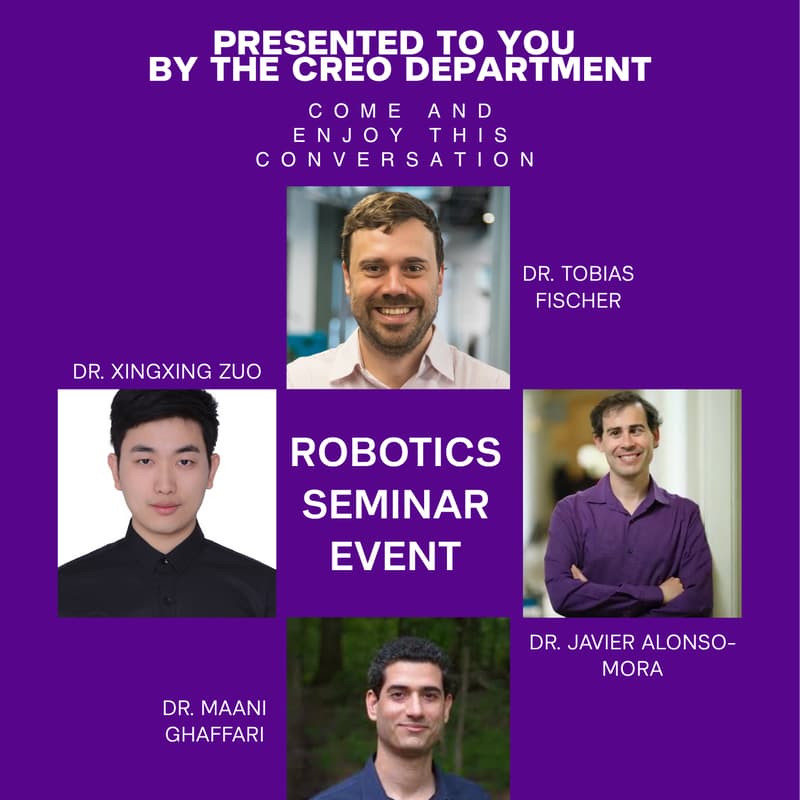
Robotics Seminar Event
Welcome to the Robotics & Embodied Intelligence Seminar!
Join us for an engaging session exploring how AI, robotics, and wireless innovation are converging to transform the physical world. This hybrid event will be held at 5 Metrotech Center and online mark your calendars and don’t miss this opportunity to connect with leading researchers shaping the future of intelligent machines. Whether you’re a student, professional, or enthusiast, this seminar offers a front-row seat to the breakthroughs redefining how robots sense, learn, and act.
About the Seminar: You will be entertained by 4 dynamic speakers!!
1st Speaker: Tobias Fischer
Title: Sensing Change: Brain-Inspired Navigation Beyond GPS
Abstract: Knowing your location is fundamental to navigation - for humans, animals, and autonomous systems alike. But how can robots and other autonomous agents determine their position with confidence and precision in environments where satellite systems are unavailable or unreliable? The central theme of this talk explores Visual Place Recognition (VPR), which is the ability to recognise previously visited locations using only visual data. I will demonstrate how energy-efficient approaches using bio-inspired event-based cameras and spiking neural networks can provide low-power edge devices with location information with superior energy efficiency, adaptability, and data efficiency. Beyond this central theme, I will also touch on my work on underwater perception for reef restoration, and about Pixi, a powerful tool to run many robotics, computer vision, and AI libraries on any operating system (Linux, MacOS, Windows, or even your browser!).
Bio: Dr Tobias Fischer is a Senior Lecturer (US: Associate Professor) and ARC DECRA Fellow at the Queensland University of Technology (QUT), where he conducts research at the intersection of neuromorphic computing, computer vision, and robotics. He conducts research in robot localisation and underwater perception, blending neuroscience and robotics to push the boundaries of intelligent systems operating under resource constraints. Dr Fischer has attracted over $3 million in competitive funding and leads research within the QUT Centre for Robotics and the Reef Restoration and Adaptation Program, with previous grants from Intel and Amazon. He obtained his PhD from Imperial College London, where his thesis won the UK Best PhD in Robotics Award. He has published more than 50 papers in top venues including Science Robotics, IEEE Transactions on Robotics, IEEE Transactions on Pattern Analysis and Machine Intelligence, CVPR, ICCV, ECCV, ICRA, and IROS. Dr Fischer serves as Associate Editor for leading robotics journals and conferences and co-chairs the IEEE Robotics and Automation Society Women in Engineering Committee. His PhD students have gone on to successful careers as Assistant Professor, Research Scientists, and Research Fellows. Website: https://www.tobiasfischer.info
2nd Speaker: Xingxing Zuo
Title: Towards Spatially Intelligent Robots: Robust 3D Perception for Open-World Autonomy
Abstract: 3D spatial perception is a fundamental component of embodied AI, yet achieving consistent robustness remains a significant challenge. In this talk, I will present my research aimed at advancing "Holistic 3D Perception" for mobile robots, with the goal of providing them with robust, comprehensive, real-time awareness of their state and a deep understanding of 3D space in unstructured, real-world environments. The talk will focus on four key areas: (1) Trustworthy Localization, focusing on achieving unprecedented robustness through on-board computing; (2) Unlocking Robot Insights, where I address kinematics and spatiotemporal calibration to improve state estimation and sensor fusion; (3) Real-time Incremental Mapping, which integrates sparse tracking with dense reconstruction to enable efficient, real-time 3D mapping; and (4) Understanding and Interaction Beyond Labels, where I explore open-vocabulary 3D scene representation to push the boundaries of scene understanding and robot interaction.
Bio: Xingxing Zuo is an Assistant Professor in the Robotics Department at MBZUAI (Mohamed bin Zayed University of Artificial Intelligence). His research interests include robotics, spatial intelligence, state estimation, 3D scene understanding, and embodied AI. Before joining MBZUAI, Xingxing was a Postdoctoral Researcher at Caltech and a Visiting Faculty Researcher at Google (USA). He also held a postdoctoral position at the Technical University of Munich (Germany). Xingxing serves as an Associate Editor/Area Chair for top-tier robotics publications, including T-RO, RSS, RA-L, ICRA, and IROS, and is a regular reviewer for more many leading journals and conferences in the field.
3rd Speaker: Maani Ghaffari
Title: Computational Symmetry and Learning for Robotics
Abstract: Forthcoming mobile robots require efficient generalizable algorithms to operate in challenging and unknown environments without human intervention while collaborating with humans. Today, despite the rapid progress in robotics and autonomy, no robot can deliver human-level performance in everyday tasks and missions such as search and rescue, exploration, and environmental monitoring and conservation. In this talk, I will put forward a vision for enabling efficiency and generalization requirements of real-world robotics via computational symmetry and learning. I will walk you through structures that arise from combining symmetry, geometry, and learning in various foundational problems in robotics and showcase their performance in experiments ranging from perception to control. In the end, I will share my thoughts on promising future directions and opportunities based on lessons learned in the field and on campus.
Bio: Maani Ghaffari received the Ph.D. in Engineering (Robotics) from the Centre for Autonomous Systems (CAS), University of Technology Sydney, NSW, Australia, in 2017. He is currently an Assistant Professor at the Department of Naval Architecture and Marine Engineering and the Department of Robotics, University of Michigan, Ann Arbor, MI, USA, where he directs the Computational Autonomy and Robotics Laboratory (CURLY). His work on sparse, globally optimal kinodynamic motion planning on Lie groups received the best paper award finalist title at the 2023 Robotics: Science and Systems conference. He received the 2025 AFOSR Young Investigator Research Program (YIP) and the 2021 Amazon Research Awards. His research interests lie in the theory and applications of robotics and autonomous systems. He has expertise in developing efficient generalizable algorithms for robot autonomy operating in unstructured, dynamic, and uncertain environments. He has developed geometric state estimation, geometric control methods, geometric deep neural network architectures (Lie Neurons), information-theoretic motion planning, and mapping algorithms for mobile robots.
4th Speaker: Javier Alonso-Mora
Title: Multi-Agent Autonomy: From Interaction-Aware Navigation to Coordinated Mobile Manipulation
Abstract: In the pursuit of scalable, socially aware, and safety-critical autonomous systems, our recent research has focused on integrating learning, planning, and control across aerial, ground, and maritime robotic platforms. Central to this effort is the fusion of model-based and data-driven approaches, enabling robust decision-making in dynamic and uncertain environments, seamless multi-robot coordination, and the ability to learn from human demonstrations. This talk will highlight recent advances in three key areas: 1) interaction-aware navigation among other robots and humans, using sampling-based model predictive control, socially compliant behavior learning, and semantic mapping; 2) real-time task and motion planning for teams of mobile manipulators through expert demonstrations, physically grounded plans, and whole-body control; and 3) decentralized 6-DoF manipulation of cable-suspended loads by a team of drones using multi-agent reinforcement learning. These contributions advance the frontier of scalable autonomy in dynamic, multi-agent environments across diverse robotic platforms.
Bio: Javier Alonso-Mora is a Full Professor in the Cognitive Robotics Department at Delft University of Technology, where he leads the Autonomous Multi-Robot Systems Lab and serves as Director of the TU Delft Robotics Institute. He received his Ph.D. from ETH Zurich, in partnership with Disney Research Zurich, and was a Postdoctoral Associate at the Massachusetts Institute of Technology. He co‑chairs the IEEE Robotics and Automation Society Technical Committee on Multi‑Robot Systems and serves as an Associate Editor for IEEE Transactions on Robotics and Autonomous Robots, as well as for several major robotics conferences.
His research focuses on autonomous mobile robotics, with an emphasis on navigation, motion planning, learning, and control. Key application areas include mobile manipulation, autonomous vehicles, aerial robotics, on‑demand mobility, and multi‑robot coordination in dynamic, human‑shared environments. His awards include an NWO VENI Talent Scheme Award (2017), the ICRA Best Paper Award on Multi‑Robot Systems (2019), an ERC Starting Grant (2021), the IEEE Transactions on Automation Science and Engineering Best Paper Award (2024), and the IEEE Intelligent Transportation Systems Young Researcher Award (2025). His research on ride‑pooling has led to the creation of a commercial spin‑off company, The Routing Company.
Visitor Information
This event is open to NYU students, faculty, and staff.
📍 Location: NYU Tandon School of Engineering,
370 Jay St 8th Floor Room 825
📍 Location: Zoom
Link: https://nyu.zoom.us/j/3931883522?pwd=zX2ElkuOHcxWyaC16OhmcqvzaUzAuh.1&omn=98517379120
meeting ID: 393 188 3522
About the Robotics & Embodied Intelligence Series
The Robotics & Embodied Intelligence Seminar Series highlights the interdisciplinary work happening across NYU Tandon’s robotics ecosystem — uniting AI, mechanical systems, mechatronics, and wireless technologies.
From bio-inspired locomotion and AI4CE Lab’s autonomous construction research to Machines in Motion’s dynamic control and Bio mechatronics Lab’s assistive robotics, each session offers a deep dive into the innovations reshaping how humans and machines interact.