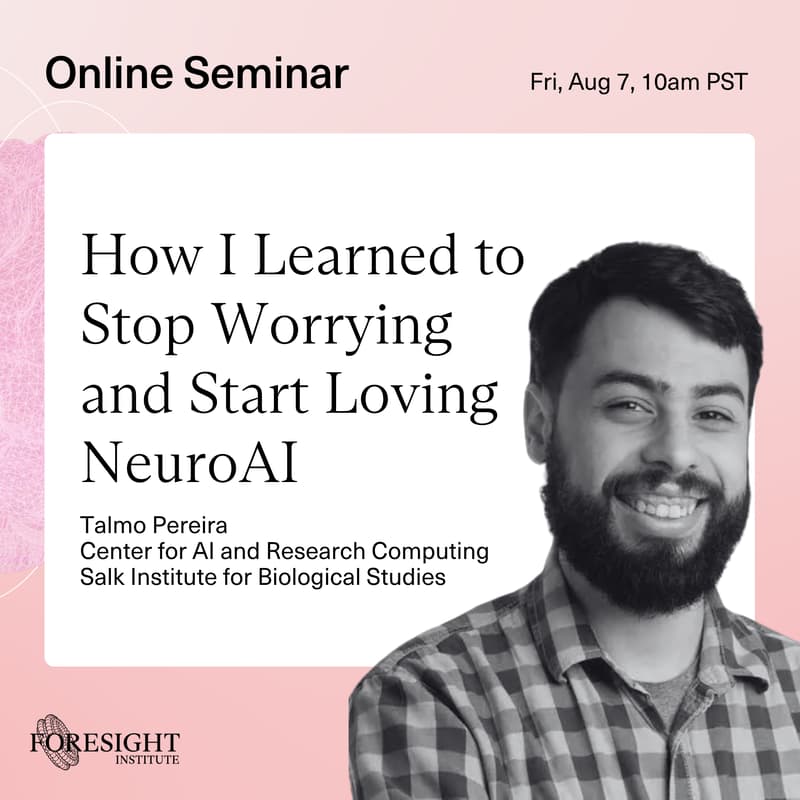

Talmo Pereira | How I Learned to Stop Worrying and Start Loving NeuroAI
Foresight Institute’s Neurotech Group
If you'd like to add a non-neuro group colleague to this seminar, please share this link with them 🧠
Embodied Neuromechanics or: How I Learned to Stop Worrying and Love NeuroAI
Abstract: A central goal of neuroscience is to understand how neural circuits transform sensory input into the complex behavior that animals use to survive in a dynamic world. Realizing this goal has been limited less by a shortage of data than by our ability to measure, model, and integrate it: behavior in particular has long resisted quantification despite being the ultimate output of the nervous system. Data-driven AI has begun to change this. Deep learning systems can now extract fine-grained behavioral kinematics from raw video at scale, turning behavior into a rich, quantitative dataset on par with large-scale neural recordings and connectomes. Here we argue that the next opportunity lies in using AI not only to measure these signals but to model the system that links them. We will discuss an emerging class of approaches that use artificial neural networks as models of biological neural systems, jointly capturing the interactions between circuits, bodies, physics, and behavior. By incorporating the biomechanical intelligence embedded in physical bodies, these models provide a principled bridge across the functional gaps between environmental stimuli, neural activity, and behavioral output—gaps that no single experimental paradigm can span alone. Critically, such models are not only analytical but generative: they can simulate novel conditions, predict the consequences of perturbations, and produce mechanistic hypotheses that are directly testable at the bench. The resulting experiments yield data that refine the models in turn, establishing a self-reinforcing flywheel between data-driven AI and experimental neuroscience.
Speaker Bio: Talmo is an Assistant Professor and Director of the Center for AI and Research Computing at the Salk Institute for Biological Studies. He leads a research lab that focuses on the development and application of computational tools for neuroscience and biology more broadly. He started my lab as a Salk Fellow in November 2021, a faculty-level appointment that gives advanced PhD students the opportunity to achieve early independence and bypass the traditional postdoctoral training stage by providing startup funds, lab space, and the ability to hire lab staff at any level. Before joining Salk, He was a research intern in Perception at Google AI, working on pose-based action recognition. He holds a Ph.D. in Neuroscience (2021) and an M.S. in Neuroscience (2017), both from Princeton University, where he received the NSF Graduate Research Fellowship and the Porter Ogden Jacobus Fellowship (2019), Princeton’s highest graduate student honor. Their work has made foundational contributions to the emerging field of computational ethology by pioneering methods for quantifying complex animal behavior using deep learning and computer vision, for which he was awarded the Harold M. Weintraub Graduate Student Award. This work has been published at top-tier scientific journals including Nature Methods and Nature Neuroscience. A defining research product of this work is SLEAP, a popular open-source tool for multi-animal pose tracking using deep learning. SLEAP and its predecessor LEAP have garnered over 1,900 citations, 150,000 downloads, and 45,000 users across 90 countries. His lab at Salk continues to advance these methods through a combination of software engineering, basic computer science, probabilistic modeling, and generalization to new biological domains including the humanities, plant biology, cancer biology and neurodegenerative diseases. Their research is supported by multiple NIH, NSF, NASA, and private funders, comprising over $10 million in research funding awards.]
Links:
Neurotech Group
A group of neuroscience researchers, entrepreneurs, and allies advancing beneficial short-term and long-term neurotechnology applications.
Subscribe to our newsletter
Nominate a seminar presenter/topic
Share this application with colleagues who’d like to join