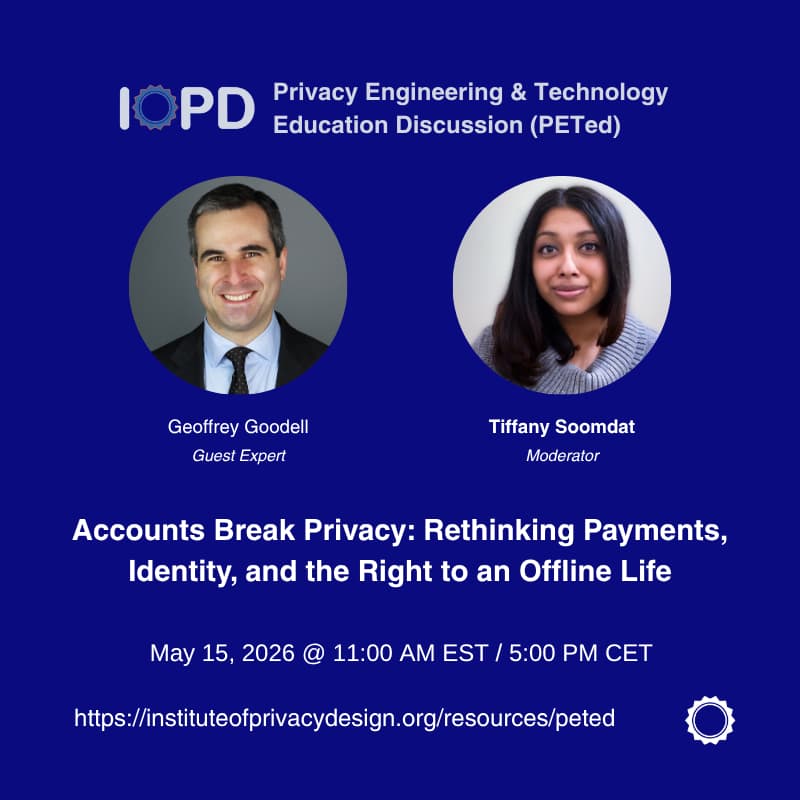

Accounts Break Privacy: Rethinking Payments, Identity, and the Right to an Offline Life
Ask the Expert ft. Geoffrey Goodell
Synopsis:
Modern digital payments involve custodial accounts for both the payer and the payee. Today’s systems are built on the assumption that financial activity must flow through third-party custodians (e.g., banks and payment providers). For transactions to succeed, these intermediaries must share information. In doing so, payment activity becomes inherently linkable to identity. The chain of custody created by successive custodians links all successive payees to the history of the transactions. Over time, this creates a persistent, traceable record of behavior. This raises a broader question: what happens to the ability to live an “offline life” in a world where participation in society increasingly requires digital, trackable interactions?
What if participation in digital systems did not require persistent, identity-linked accounts?
Geoffrey Goodell highlights that modern retail banking systems create a form of continuous visibility into consumer behavior, where financial transactions are linked to a single, unitary identity, enabling extensive surveillance. As digital payments replace cash and online-only services expand, this visibility can shape behavior, limit autonomy, and introduce new risks of profiling and control. At the same time, losing privacy in digital systems is not inevitable. His research shows that it is possible to build systems that protect user anonymity while meeting regulatory requirements—offering a way to preserve the key benefits of cash (privacy, fungibility, accessibility) in a digital world. The discussion will also explore practical tensions in today’s ecosystem, including payment surveillance, the limitations of account-based systems (e.g., VPN subscriptions), and emerging ideas such as token-based access models that decouple identity from usage.
Problem Statement:
The erosion of privacy and autonomy as digital systems increasingly require persistent, identity-linked accounts for participation.
Related Privacy Enhancing Technologies (PETs):
VPN
Tor
Zero-knowledge proofs
Anonymous / token-based authentication models
Discussion Themes:
The “right to an offline life” and its relevance in digital-first economies
Payment surveillance and the decline of cash
Why “accounts break privacy” (accountification of digital systems)
Risks of linking identity across sessions and services
Rethinking authentication: tokens vs accounts
Pre-Discussion Resources:
G Goodell. "Digital currency hardware wallets and the essence of money." In 'Accounting, Economics, and Law: A Convivium', R Avi-Yonah, Y Biondi, and S Sunder, eds. De Gruyter Brill, 2026. ISSN: 2194-6051. https://www.degruyterbrill.com/document/doi/10.1515/ael-2025-0057/html
G Goodell, D Toliver, and H Nakib. ‘A Scalable Architecture for Electronic Payments.’ In S Matsuo et al., Financial Cryptography and Data Security. FC 2022. Lecture Notes in Computer Science 13412. https://doi.org/10.1007/978-3-031-32415-4_38
G Goodell, H Nakib, and T Aste. ‘Retail Central Bank Digital Currency: Motivations, Opportunities, and Mistakes.’ March 2024. To appear, International Journal of Political Economy (2025). https://doi.org/10.2139/ssrn.4769226
D Friolo, G Goodell, D Toliver, and H Nakib. ‘Private Electronic Payments with Self-Custody and Zero-Knowledge Verified Reissuance.’ To appear, Lecture Notes in Computer Science. Presented at CoDecFin, Miyakojima, Japan, April 2025. https://doi.org/10.48550/arXiv.2409.01958
G Goodell. ‘A Protocol for Compliant, Obliviously Managed Electronic Transfers.’ Working paper, January 2025. https://doi.org/10.48550/arXiv.2501.10419
G Goodell. ‘Digital currency hardware wallets and the essence of money.’ Under review, April 2025. https://doi.org/10.48550/arXiv.2209.12076
G Goodell. ‘Token-Based Payment Systems.’ July 2021. To appear, Elgar Encyclopedia of Cryptocurrencies, Blockchain, and DLT. https://doi.org/10.48550/arXiv.2207.07530
G Goodell, H Nakib, and P Tasca. ‘A Digital Currency Architecture for Privacy and Owner-Custodianship.’ Future Internet 2021, 13(5), May 2021. https://doi.org/10.3390/fi13050130
G Goodell and T Aste. ‘Can Cryptocurrencies Preserve Privacy and Comply with Regulations?’ Frontiers in Blockchain, May 2019. https://doi.org/10.3389/fbloc.2019.00004
Shoshana Zuboff - The Age of Surveillance Capitalism: The Fight for a Human Future at the New Frontier of Power (2019)
Helen Nissenbaum - Obfuscation: A User’s Guide for Privacy and Protest (2015, with Finn Brunton)
Guest Expert: Geoffrey Goodell
Geoffrey Goodell is a Lecturer in Financial Computing at University College London (UCL) in England, where he leads the UCL Future of Money Initiative. He is affiliated with the Department of Computer Science and focuses his research on socio-technical systems in financial services, particularly digital currencies, payment systems, and privacy-preserving technologies. Goodell also serves as Convenor of multiple ISO working groups on distributed ledger technologies and digital currency, and he advises several European industry groups on digital assets.
Moderator: Tiffany Soomdat
Tiffany Soomdat helps organizations navigate complex data protection landscapes and build scalable, business-aligned privacy and governance programs that do more than check compliance boxes. Her work sits at the intersection of digital responsibility, data governance, and emerging technology, with a focus on supporting more responsible and sustainable business practices in an increasingly digital economy. She is a trusted advisor who helps companies operate effectively amid evolving privacy and regulatory expectations, while building trust with customers and stakeholders in the digital age. Tiffany is particularly interested in how digital systems shape trust, autonomy, and long-term value creation, including the role of privacy, AI governance, and data stewardship in building more resilient and accountable organizations. Master of Studies in Law (MSL) in Corporate Compliance. Certified in CIPP/US and OneTrust.