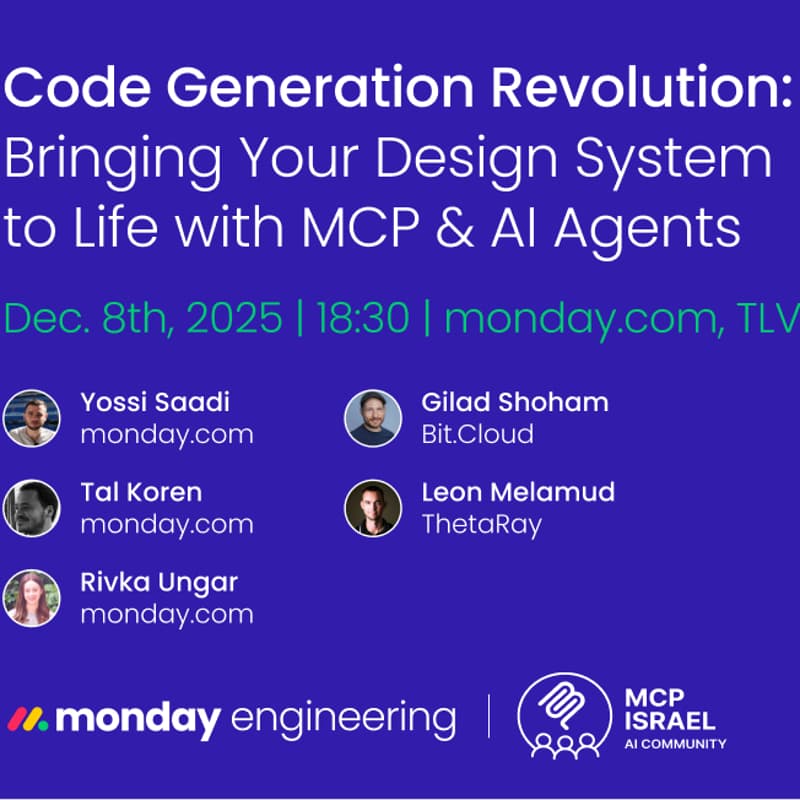


Code Generation Revolution: Bringing Your Design System to Life with MCP & AI Agents
Join the MCP Israel community and the team at monday.com for a deep dive into the future of design system with MCP. We're opening up our playbook to show you how we're using Model Context Protocol (MCP) and Agentic AI to transform static design files into production-ready code, instantly.
Design-to-code has always been a bottleneck.
Learn how the Model Context Protocol (MCP) bridges this gap by giving AI agents the structured, real-time context they need from tools like Figma to generate consistent, reliable code components every time.
This is a must-attend event for engineers, AI developers, and anyone managing a design system.
Your Design System Needs an MCP
Speaker: Yossi Saadi | monday.com
MCP turns your design system into a consumable context for agents - because AI agents today need more than the components and tokens; they need to know how to use them properly.
In this talk, I’ll share why we built the Vibe MCP, an open Model Context Protocol server that exposes the Vibe Design System as a living API for AI - component metadata, usage examples, accessibility guidance, icons, tokens, and even full‑project migration from Vibe 2 to Vibe 3.
I’ll also walk through our agentic Figma‑to‑Vibe workflow - built with LangChain and LangGraph: how it parses Figma, architects a specification, embeds accessibility, generates Storybook stories and testing guidance, and incorporates human‑in‑the‑loop checkpoints via our Vibe VSCode (Cursor) extension. I’ll also cover how our Cursor rules operate as lightweight, enforceable “living docs”, raising velocity and consistency across the team.
What does this unlock? Developers ship accessible components by default, migrations take minutes instead of sprints, and AI gets precise, source‑of‑truth context - no guesswork. If your design system doesn’t have an MCP yet, it’s leaving leverage on the table.
Key takeaways:
Why an MCP is a force‑multiplier for design systems (consistency, velocity, a11y‑by‑default)
How our Figma‑to‑Vibe agent + HITL produces production‑ready components
How Cursor rules act as operational docs for Cursor, agents, and humans alike
Real wins: one‑prompt migrations, automated a11y prop fixes, instant component discovery
From Design to Deployment - How We Use AI to Turn Figma Designs into Production Code at monday.com
Speakers: Rivka Ungar & Tal Koren | monday.com
Imagine copying a Figma link to Cursor and getting a production-ready React implementation plan - not a prototype, not a playground export - real code: accurate, accessible, analytics-ready, and aligned with your design system.
No specs. No handoff. No guesswork.
In this session, Rivka and Tal will walk through how monday.com’s R&D team built and scaled Figma-to-Code, an internal AI agent that transforms Figma designs into real, production-grade code.
You’ll learn how the agent:
Parses design context using Figma’s MCP
Maps designs to real Vibe components, resolving props, layout, and tokens
Injects accessibility, translations, and event tracking by default
Returns a structured plan into Cursor for devs to review and ship
Enables deep linking directly from Figma to pre-filled prompts in Cursor (yes, it’s as fast as it sounds)
More than a time-saver, this tool raises the bar for quality, ensuring consistency, accessibility, and design-system alignment.
A real-world case study in agentic workflows, built for scale, and already powering production code at monday.com.
Surprise Topic Session!
Speaker: Gilad Shoham/Leon Melamud (MCP Israel admins)
Stay tuned for a special, cutting-edge talk from Gilad Shoham/Leon Melamud, bringing another fascinating perspective on AI and software development.
The only way to find out is to be there!
Don't miss this unique opportunity to network with the brightest minds in the Israeli AI community and see how monday.com is leading the charge in developer productivity with the Model Context Protocol.
Register Now! (Because the future of your design-to-code workflow starts here.)