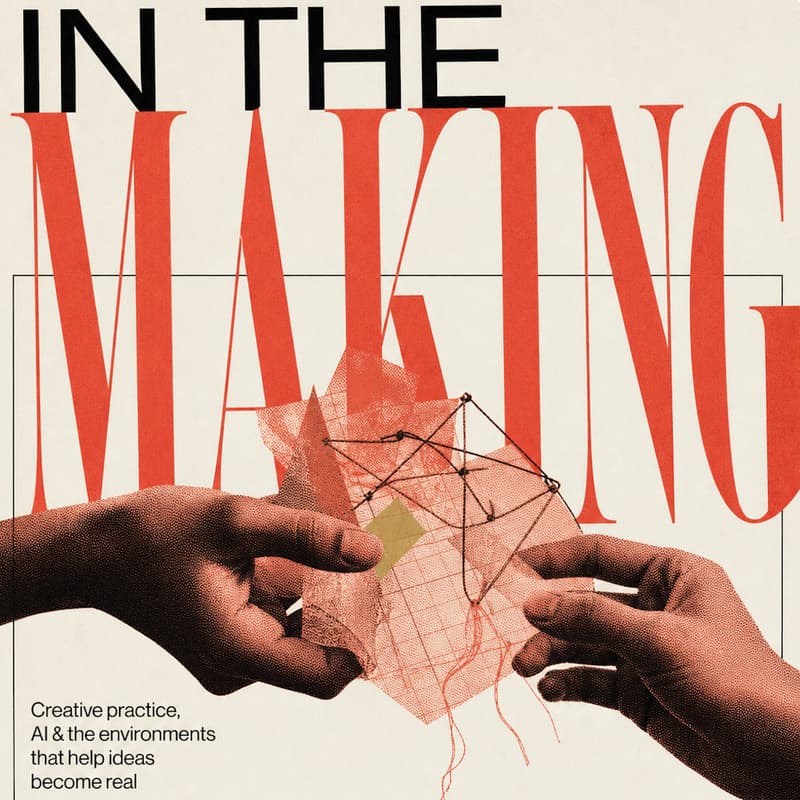

Cross-City Whisper On Artistic way
Creativity, AI, and the environments that help ideas become real
Saturday Evening · San Francisco ($20 pp cost of tea required)
Sunday Morning · Shanghai 20–30 people · SF × Shanghai live exchange
How does an idea become a work—and what kinds of environments help creativity flourish?
Join us for an intimate, two-city gathering connecting creators in San Francisco and Shanghai. Together, we’ll explore the conditions that help people make things: the creative process, AI tools, collaborators, communities, and the cities and spaces around us.
Two cities, two rooms, one live conversation.
Our guests are artists, creative technologists, musicians, community builders, and founders working across interactive art, live coding, audiovisual performance, spatial media, design, and AI. They will not be delivering polished lectures from a distant stage. Instead, they will open up their creative processes: how an idea becomes a next step, where a project gets stuck, how tools shape what is possible, and which choices still belong to the creator.
The San Francisco and Shanghai rooms will take turns sharing and responding before coming together for a cross-city discussion. Bring a work in progress, an unfinished thought, or a creative question of your own—the conversation begins there.
[San Francisco · Night]
Aaron Wong-Ellis — Artist & AI EngineerAaron works across interactive installations, creative coding, computer vision, and music, and has helped build artist communities in Toronto. He will explore how a creative vision moves into execution—and how artists can preserve their judgment and agency when AI enters the process.
R Tyler — Algorave
ArtistJoining remotely from Los Angeles, R Tyler creates live dance music with code and works with algorithmic composition, microtonality, and performance. For him, code is a tool; what the work becomes still depends on the person using it.
Tayler Vo — Founder, Kindred StudioTayler is a creative practitioner working at the intersection of community and design. Through space, tea, and collective making, she creates conditions for small but meaningful connections—and for people to find a greater sense of belonging in the city.
[Shanghai · Morning]
Ewan Qian / 钱誉文 — Media Artist & Spatial Image MakerEwan’s practice spans audiovisual performance, spatial scanning, real-time image systems, and digital environments. His work does not always begin with a finished sketch; it often grows gradually from space, sound, and images generated in real time.
Sydney Hu / Jinzy — Musician, Artist & Community BuilderWorking between Shanghai and Los Angeles, Sydney is the founder of the 021 creator community. Through music, moving image, and live experiences, she explores the relationship between technology and people—and keeps asking what authenticity and creativity mean in an algorithmic world.
Race Li — Digital Artist & Serial EntrepreneurRace has built a product with more than one million downloads and raised multiple rounds of funding. He is now developing an AI system that connects music with stage visuals in real time, reading musical and visual input from DJs and performers to orchestrate lighting and screen content. He joins the conversation from the intersection of digital art, AI, and entrepreneurship.
[People Behind the Event]
Aurora — Initiator & OrganizerAurora works across borderless technology, product strategy, and analysis. She curates tools for thought and makes room for the human questions beneath them—bringing the two cities, their creative communities, and this exchange into conversation.
Xiaochuan / 小川 — Core Contributor, 706 Youth SpaceXiaochuan is a researcher and practitioner of future communities. He has long worked across cities on community initiatives, public projects, and international collaborations, translating research questions into events, tools, and reusable ways of working together.
Gloria — San Francisco Collaboration SupportBased in Silicon Valley, Gloria is a cross-cultural observer working at the intersection of technology and the humanities, with a research focus on the philosophy of technology. She supports the San Francisco side of the exchange.
Event preparation
Before We Meet: A Small Reading List
This is not a comprehensive AI-and-art syllabus. It is a small, evolving canon organized around one question:
As the cost of making approaches zero, what becomes more important about being human, developing taste, and living a creative life?
You do not need to read everything. Choose one or two pieces that speak to you, and bring a question, disagreement, or unfinished thought to the room.
If you would like to go a step further, sign up as a Reading Lead and introduce one selection in a short English share. You do not need to explain the entire work; basic spoken English is enough.
Contemporary / Why Now
Kevin Kelly — “Latent Space as a New Medium” (2026)Latent space may be a genuinely new creative medium, not merely a faster tool for familiar forms.
Jason Liu — “If You Want Taste, You’re Gonna Have to Eat” (2026)Ability is abundant. Taste grows from attention, judgment, exposure, and the courage to move away from the average.
Ted Chiang — “Why A.I. Isn’t Going to Make Art” (2024)If art is constituted by intentional choices, what happens when a tool removes many of them?
Classic Creative Practice
Julia Cameron — The Artist’s Way (1992)Recover and protect the capacity to create through attention, play, and moving past internal censorship.
Rick Rubin — The Creative Act: A Way of Being (2023)Creativity is a way of perceiving and relating to the world, not merely a way of producing outputs.
Taste / Seeing / Judgment
John Berger — Ways of Seeing (1972)Taste does not emerge in a vacuum; technologies, institutions, commerce, history, class, and power shape how we see.
Brian Eno & Peter Schmidt — Oblique Strategies (1975–)A pre-AI external creative system: constraints and prompts that interrupt habitual solutions.
Alternative Models of Creativity
Ursula K. Le Guin — “The Carrier Bag Theory of Fiction” (1986)Creativity as collecting, carrying, connecting, and containing rather than heroic conquest.
Location & Time
SF venue: Kindred Studio, please note that there will be $20 per person charge for tea consumption
For Shanghai Attendants (and SF attendants with WeChat), please scan to join our WeChat group chat for questions and inquiry: