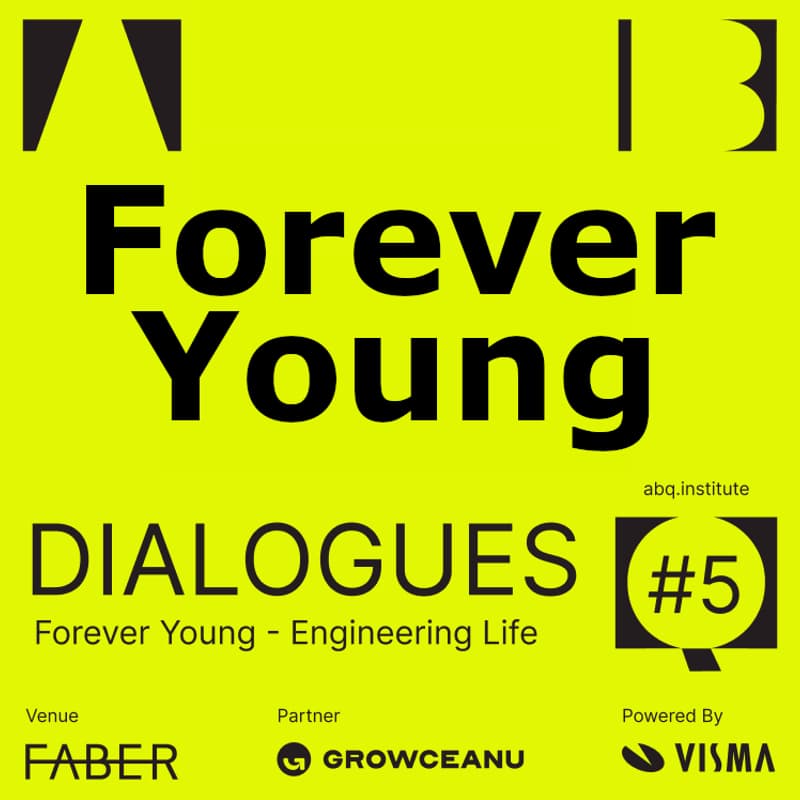

ABQ.Dialogues #5/10 Forever Young - Engineering Life
The context
Biology was for centuries a descriptive science. Biologists used to watch (eventually using a magnifying glass or a microscope), to classify and to explore the functioning of living organisms. After WW2 they realized there’s a transmittable code layer, controlling all the life details of all those living organisms. 70 years and dozens of Nobel Prizes later, humankind not only understands this code’s rules but discovered and/or developed ways to read, write and edit the code, adding an engineering character to biology and transforming it into a prescriptive science.
ABQ.Dialogues #5/10 Speakers:
Radu Ticiu
Michael Bogdan Margineanu
Octavian Jurma, MD
Horatiu Moldovan
Dan Fanu
The Current Situation
As a species, humans can now ”domesticate” microscopic organisms (or just parts of them), programming them to take over new roles, behaving in unexpected ways as diagnostic means, producing precisely designed desired substances, including nutrients or drugs, fuels, industrial raw or building materials, neutralizing environmentally harmful chemicals or even function as instruments for future terraformation.
Bioengineering is not limited to the microscopic, unicellular end of the living world scale but goes up to the most complex organisms, humans included. Full recoveries from several genetic conditions were achieved, CART cell, highly personalized therapies in oncology are largely available, mRNA vaccines were critical in the pandemic response. Thousands of research groups worldwide are untangling the ultimate complexity of cellular structures and metabolic pathways, advancing science towards a complete understanding of biological processes in healthy and non-healthy organisms, down to the nanometric and picoliter scales. Other teams are searching for drugs, smaller or bigger molecules that may intervene in the dysfunctional processes including those affected by age, bringing them back in the optimal ranges on long terms. Health and long healthy life looks to get significantly closer to (almost) anyone’s grasp. Extreme longevity moves from a dreams’ realm to real people we personally know.
For this, disciplines like software and AI, data science, statistics, microelectronics, robotics, automation are becoming critical alongside biology, biochemistry, biophysics, the naturally expectable specialities to act at the bioengineering battle ground, as the complex, million-parametric processes that, in the end, represent life cannot be researched anymore in a small team, slow, superspecialized lab settings, but move in close to industrial, robotic, autonomous, AI powered biofoundries that not only validate hypothesis but generate them, design and run experiments (not a dozen but tens of thousands), present solutions and suggest potential new research directions.
We are in a hot age when Google DeepMind employees are awarded Nobel Prize for developing protein design tools, OpenAI works with Ginkgo Bioworks, Nvidia designs custom software and hardware suites for biotech and genomics research, Stripe funds Arc Institute researchers in a startup logic approach and Jeff Bezos lends his name (and invest his money) to a Sustainable Protein Center. The tech tycoons that survived Steve Jobs seem to confirm his idea that “the biggest innovations of the 21st century will be at the intersection of biology and technology".
Where is Timișoara now?
When taking a minute to look around, it will become obvious that our city can be perceived as a sealed sack containing most of the jigsaw pieces needed for reconstitute a functional and thriving life science research and entrepreneurship ecosystem: the local universities and specialized research institutes with significant unused potential in infrastructure, expertise, talent, the health system experienced in running clinical studies, the tech industries that definitely need a bit of reinvention but starts to contribute to relevant top global projects, an agriculture sector that could absorb biotech-based products and services, a solid life science diaspora, an emergent biotech community building networking events, hackathons, bootcamps and connecting with international evolutions, an early stage investment sector that literally exploded this year, new incubation facilities in preparation, tech individuals that start exploring the bio realm, etc.
What’s needed?
First of all there is a serious need to analyse and understand the opportunities brought in for the city by the life science research and business domains and the potential that can make Timișoara relevant in the field, not only on a national scale but on a continental one.
There is a solid need to act towards the alignment of individual and organizational visions, interests, resources towards ecosystem structuring and activism.
There are some significant but relatively easy to satisfy needs:
to bring in the public discussion topics related to life science, biotech, bioengineering, healthtech, longevity
to develop a systemic understanding of the fields of bioeconomy, bioinnovation, bioentrepreneurship
to build bridges between the tech and bio/medical silos,
to connect Timișoara to the most dynamic evolutions, information, financial, talent circuits in Europe,to encourage easy access to and synergizing of existing local resources (labs, equipment, expertise, contacts, etc.) for individuals and teams from Timișoara but also for visiting teams exploring life science research or startup projects,
to generate an intense calendar or events and interactions
to support the non-formal education contexts in the bio field.
How can we start working at all these?
Let’s ignite a discussion here, at ABQ Dialogues. Let’s continue after it!
About ABQ.Dialogues
The ABQ Dialogues are a human-centric conversation series where diverse voices explore how emerging technologies reshape the fundamental aspects of our lived experience and collective future.
The Dialogues follow ABQ’s main pillars: education, entrepreneurship, and societal impact by bringing together diverse professional voices in a progressive learning journey. We aim to highlight technology’s impact, creating deeper understanding of how AI, Blockchain, Bio-engineering, and Quantum Computing are reshaping our world.
The Dialogues prioritize how these innovations impact the most fundamental aspects of human experience. From healthcare systems and longevity to artistic expression, psychological well-being, social connections, and community faith structures, we explore both current changes and future implications for how we live, work, create, and find meaning. The Dialogues prioritize people over technology, ensuring that human values and needs guide our collective understanding of technological transformation.
Events Format
We propose a monthly conversation series that creates space for dialogue between experts and the public. Each session combines expert presentations with interactive questions and answers, open discussions, and networking opportunities that promote community connections. We believe this format encourages inclusive participation, amplifying voices from multiple sectors and backgrounds while building knowledge progressively across the series. Our goal is to generate practical insights that serve individuals navigating technological change, community leaders shaping local responses, and organizations implementing new technologies.
After each dialogue, we will publish findings for public access, culminating in a final synthesis document with actionable recommendations and mitigation strategies for individuals, community leaders, and organizations.
ABQ.Dialogues are a 10-part, monthly events, with 3-hour sessions divided between expert conversations, public interventions and networking.
Made possible by our partners:
Visma Romania – Main sponsor, leading business software development company
Growceanu – Platform for accessing high-growth investments.
Faber – Host venue, independent cultural center and community hub
The ABQ.Institute Team