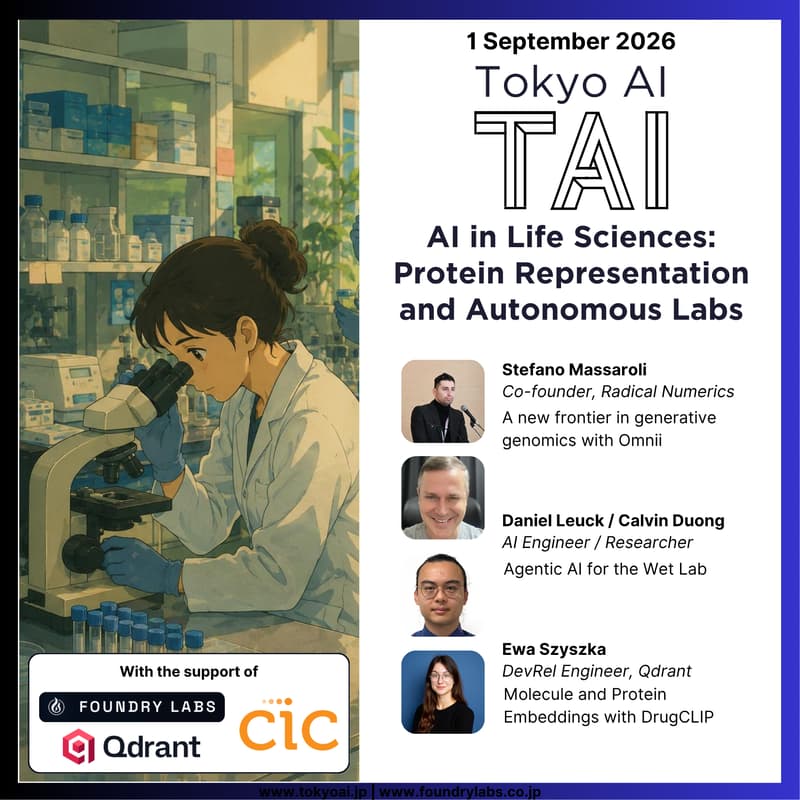


AI in Life Sciences: Protein Representation and Autonomous Labs
Description
This event explores the intersection of applied machine learning, computational biology, and wet-lab automation. The sessions will cover three critical layers of modern in silico research: representation learning for aligning molecules and proteins in a shared vector space, genome-scale language modeling capable of interpreting sequences over a 2-million base pair context window, and agentic platforms that synthesize fragmented scientific literature into actionable experimental layouts. Designed for researchers, engineers, and technical product managers in drug discovery and applied ML, this meetup will highlight current technical capabilities and address where physical wet-lab validation remains the core bottleneck.
Agenda
We start at the model layer: how sequence and structure become embeddings a system can search. From there we move up to genome-scale modeling and what post-training buys you on real clinical benchmarks. The final talk closes the loop, taking retrieved and ranked evidence through to bench work, scripting, and documentation.
18:00 Doors open
18:30 - 19:00 A new frontier in generative genomics with Omnii (Stefano Massaroli, Co-founder @ Radical Numerics)
19:00 - 19:30 Agentic AI for the Wet Lab (Daniel Leuck, AI Engineer @ Ikayzo, and Calvin Duong, Researcher @ University of Tokyo)
19:30 - 20:00 Molecule and Protein Embeddings with DrugCLIP (Ewa Szyszka, DevRel Engineer @ Qdrant)
20:00 - 21:00 Networking
21:00 Doors close
Talks
Talk 1 - A new frontier in generative genomics
Abstract: Omnii is a research preview of a genome language model built to predict, design, and interpret. It is pretrained with native fusion of genomic annotation tracks alongside DNA sequence and post-trained so it can be used without training task-specific probes on frozen embeddings. This talk covers the architecture behind it, including block convolutions and sparse attention over a 2 million base pair context window, the benchmark picture across clinical variant interpretation and complex traits, and what it looks like in practice: recovering experimentally validated functional variants in Alzheimer's microglia loci from sequence alone, and chain-of-thought design of RNA aptamers.
Bio: co-founder and president of Radical Numerics Inc., a Research Scientist on RIKEN's Deep Learning Theory team, formerly a founding scientist at Liquid AI where he helped launch Liquid AI Japan, a postdoc under Yoshua Bengio at Mila, co-inventor of hybrid convolution language models and neural differential equations, and a University of Tokyo PhD — presented "Design Principles for Training at Extreme Context Lengths."
Talk 2 - Agentic AI for the Wet Lab
Speaker: Daniel Leuck (AI Engineer, Ikayzo) and Calvin Duong (Researcher, University of Tokyo)
Abstract: In silico approaches to faster, smarter, and more comprehensive discovery, automation, scripting, and documentation
In biology, important discoveries are rarely isolated facts. They often emerge from connections between genes, proteins, pathways, experiments, and prior observations. Interaction maps help researchers organize these connections, but the evidence needed to build them is often scattered across papers, databases, and underused sources such as non-English theses that conventional search can miss.
The future wet lab will need more than better search. As software and hardware become more connected, labs will need systems that turn scattered evidence into action: candidate prioritization, assay suggestions, validation plans, plate layouts, labels, user scripting, and rich documentation that captures work as it happens.
Using influenza research as a case study, we will introduce Reveria (formerly LabNexus), a platform (beta) for AI-assisted wet-lab work built around modular CodeLets. One example is Discovery, a CodeLet that helps retrieve, translate, parse, and connect fragmented scientific evidence into traceable interaction maps and ranked candidate cards for downstream experiments. The goal is practical: help researchers understand what is already known, decide what is worth testing next, and turn scattered knowledge into better wet-lab experiments.
Bios:
Calvin Duong is a postdoctoral researcher at the University of Tokyo’s Institute of Medical Science studying influenza immunity and host responses to infection. His recent co-first-author Cell paper used CRISPR-engineered mice to uncover host factors involved in influenza infection (link). The work helped inspire Reveria Discovery, an AI-assisted platform for turning scientific literature into structured evidence and experimental hypotheses, alongside his broader interest in using AI to accelerate antibody and drug discovery.
Daniel Leuck is CEO and co-founder of Ikayzo, a boutique software development and digital design firm with offices in Tokyo and Honolulu. He currently focuses on Reveria AI and RevNexus, a suite of applications for analytics, automation, and scientific discovery. Daniel has 20+ years of technology leadership experience, including Global Head of Development at LastMinute.com and SVP of R&D at ValueCommerce. He has extensive finance and fintech experience with Bank of America, Wells Fargo, PIMCO, Nomura, and hedge funds.
Talk 3 - Molecule and Protein Embeddings with DrugCLIP
Speaker: Ewa Szyszka (DevRel Engineer, Qdrant)
Abstract: DrugCLIP places molecules and proteins in a shared embedding space, which turns "which compound binds this target?" into a vector search problem. This talk walks through how those embeddings are produced, using ESM-2 for protein sequence, how drug and protein candidates are indexed and screened at scale, and how to inspect the resulting space. Screening happens virtually; the wet lab is reserved for validating what comes out at the top.
Bio: Ewa Szyszka is a DevRel Engineer at Qdrant, working on applied vector search from how embeddings from models like ESM-2 get indexed, screened, and inspected at scale to optimizing agentic retrieval latency on edge devices. She previously worked across computer vision R&D, benchmarks, observability and applications of ai in underwater navigation devices for marine applications at Keio University.
Organizers
Ilya Kulyatin is an entrepreneur with work and academic experience in the US, Netherlands, Singapore, UK, and Japan. He holds a BA in Economics, an MA in Finance, and an MSc in Machine Learning. He's a 3x founder, now helping Japan grow the local AI ecosystem through a not-for-profit community, Tokyo AI (TAI), while building an AI-native system integrator and solutions provider, Foundry Labs株式会社.
Ewa Szyszka is a DevRel Engineer at Qdrant, the open-source vector database, where she works on retrieval for scientific and multimodal data. She co-organizes Tokyo AI events at the intersection of AI and the life sciences.
Supporters
Foundry Labs K.K. is a Tokyo-based AI systems integrator and solutions provider, delivering end-to-end support for enterprises: from strategy design through implementation, deployment, and operations. They tailor AI to each client's operational, regulatory, and security requirements, with hands-on experience across finance, government, and industry, and a track record of shipping production systems in secure and regulated environments.
Qdrant is an open-source vector search engine built to handle high-dimensional data at scale. It powers the retrieval layer behind some of the most demanding AI applications in production today, from RAG pipelines to recommendation systems to AI agents, giving developers fast, accurate similarity search wherever it's needed.
About TAI
Tokyo AI (TAI) is the largest international AI community in Japan, with 5,000+ members mainly based in Tokyo: engineers, researchers, investors, product managers, and corporate innovation leaders. Through 80+ events a year and 300+ speakers spanning startups, enterprises, and academia, TAI connects the people building AI in Japan with the global ecosystem, working to transform Tokyo into a global AI hub.
Privacy Policy
We will process your email address for the purposes of event-related communications and ongoing newsletter communications. You may unsubscribe from the newsletter at any time. Further details on how we process personal data are available in our Privacy Policy.