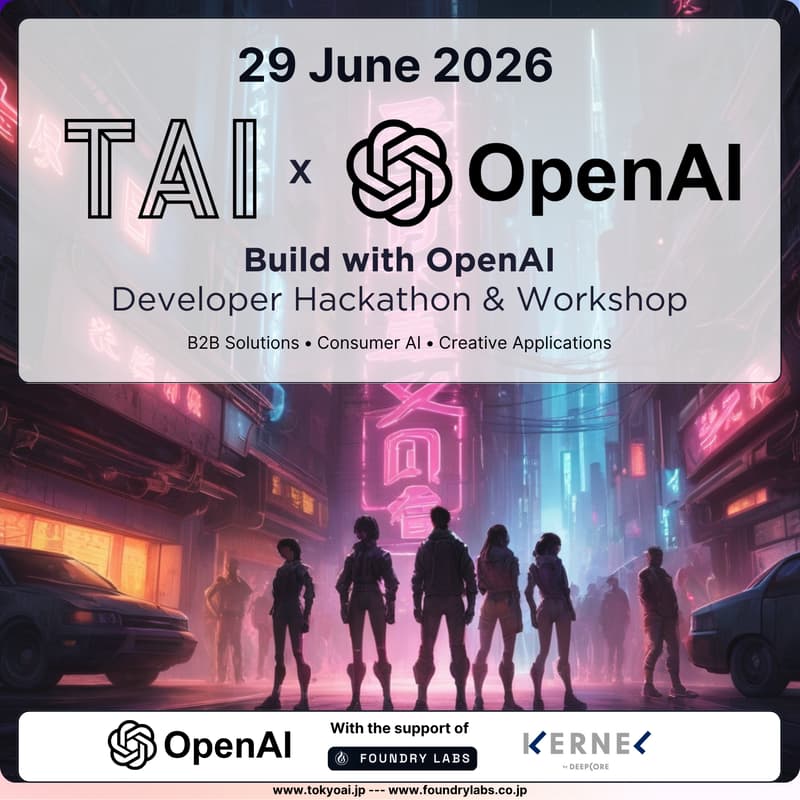


Build with OpenAI: Developer Hackathon & Workshop
Description
Join OpenAI and TokyoAI for an afternoon and evening of conversations, collaboration, and hands-on building with the latest AI developer tools.
A hands-on developer session designed for builders who want to rapidly prototype AI-native applications using OpenAI tools, APIs, and AI agents.
Participants will work in teams or individually to build practical applications across two open tracks, with support from OpenAI engineers throughout the session.
Whether you're building workflow automation tools, AI-powered enterprise solutions, creative consumer products, or entirely new experiences, this event is designed to encourage experimentation and rapid iteration.
Capacity: 40-50 people
Target Audience: developers, startup builders, engineers, and technical creators
Expected Technical Level: intermediate and advanced
Languages: English and Japanese
Min team size: 2 (we'll assign you to a team if you can't find one by the event day)
Max team size: 4
Forming teams: You will have access to TAI's Discord channel for the hackathon, where you can form groups.
Selection process: Based on background (technical level + experience), diversity, and your application timing. Some selections might be by chance. Inquiries about the application decisions won't be answered.
Agenda
04:00 PM - 04:30 PM: Introduction & Technical Context
04:30 PM - 06:15 PM: Hacking & Collaborative Prototyping
06:15 PM - 07:30 PM: Project Showcases & Technical Feedback
07:30 PM - 08:30 PM: Awards, Food, Closing
Hackathon Tracks
1. B2B Solutions
Build tools that help organizations streamline operations and unlock productivity with AI.
Potential areas include:
Documentation and knowledge workflows
Legacy system integration
Marketing and content operations
Legal and compliance workflows
Internal copilots and AI agents
AI-powered creative generation and asset production
Japan presents especially interesting opportunities due to highly specialized documentation, operational workflows, and language requirements.
2. Consumer & Creative Use Cases
Explore more open-ended consumer applications and creative AI experiences.
This track is intentionally broad to encourage original thinking and experimentation across entertainment, productivity, social experiences, design, media, and beyond.
Notes on Scope
The strongest projects usually combine technical execution with a deep understanding of a specific user problem or industry workflow. Participants are encouraged to research a domain or problem space in advance.
You will have approximately 150 minutes of build time. The goal is not to create a polished, production-ready product.
Instead, focus on identifying a real problem and demonstrating a compelling solution using OpenAI tools and Codex. The strongest projects are often those with a clear use case, a narrow scope, and one memorable "aha" moment that shows how AI can meaningfully improve a workflow or experience.
In 150 minutes, build the smallest thing that proves your idea works, and show it deserves another 150 hours.
On Tools to use
All participants have API credits and Codex subscriptions, so we expect them to make use of those resources. At a minimum, participants must use Codex for development and operations. If a developer builds an app that uses LLMs as part of its functionality, we'd like to hear how they use OpenAI APIs, such as Responses, Realtime, Transcription, and Images (this will impact the evaluation). If a developer focuses solely on Codex, using API credits is optional. Participants may use any models and tools that are publicly available on the day.
Example Project Ideas
These are just some simple ideas.
B2B
Instead of "An internal knowledge assistant", build "Ask questions about a 200-page procurement manual and get cited answers plus drafted forms."
Instead of: "A marketing copilot", build "Turn a product brief into channel-specific campaigns for Yahoo! Japan, LINE, and Rakuten."
Instead of "A compliance agent", build "Flag policy risks in vendor contracts and explain why they matter."
Consumer & Creative
Instead of: "An AI travel app", build "Turn a mood or vibe into a personalized Tokyo itinerary."
Instead of "A creative platform", build "Transform a manga idea into a storyboard with dialogue variations."
OpenAI Technical Support
OpenAI engineers will provide:
Live demos
Technical guidance
Hands-on implementation help
Best practices for working with AI agents and Codex
Featured OpenAI Engineers
Tyler Ryu is a deployment engineer at OpenAI, focusing on Codex and related developer-facing AI systems. Based in Singapore, he works on bringing large language models to real-world software engineering workflows. His background blends applied machine learning and developer operations, with an emphasis on practical implementation of AI models.
Kaz Sera is a Developer Experience Engineer at OpenAI, known for shaping the interaction between developers and advanced AI tools. His work focuses on improving usability, documentation, and developer workflows for AI technologies, ensuring smooth integration and effective feedback loops between product engineering and developer communities.
Suggested Project Timeline
Pre-hackathon, on TAI's Discord, form teams and discuss some ideas. Don't come over-prepared. If you come with a prompt already tested and just to run, it will most likely be penalized. The community is small, and you'll bring shame to yourself within TAI for eternity.
Minute 0 to 20
Agree on a problem.
Define a user.
Define the demo.
Ask: What is the one thing we want judges to remember?
Minute 20 to 110
Build one specific path.
Use Codex aggressively.
Ignore edge cases.
Fake non-essential integrations.
Minute 110 to 140 min
Polish demo.
Test.
Prepare the story.
Minute 140 to 150 min
Final pitch rehearsal.
The Pitch
Show that you know the problem, you can define the user, and solve for a specific pain point (or multiple, if you have time, but more won't necessarily mean better). If you used any particular workflow to make your delivery possible within the allotted time, spend 30-60 seconds of the pitch showing "how the sausage is done". Might add bonus points (all of the participants will be engineers, everyone with their own ways of working, their harnesses, etc.).
Criteria Weight
Problem significance 30%
Creative use of OpenAI tools/Codex 30%
Quality of the demo 30%
Future potential 10%
Credits & Prizes
All participants receive:
$250 in OpenAI API credits (valid for 12 months)
3 months of ChatGPT Pro with Codex access
Hackathon prizes:
1st Place: $25,000 in OpenAI credits
2nd Place: $10,000 in OpenAI credits
3rd Place: $5,000 in OpenAI credits
Prizes will be awarded in each track.
Food and refreshments will be provided throughout the event.
Organizers
Ilya Kulyatin is an entrepreneur with work and academic experience in the US, Netherlands, Singapore, UK, and Japan. He holds a BA in Economics, an MA in Finance, and an MSc in Machine Learning. He's a 3x founder, now helping Japan grow the local AI ecosystem through a not-for-profit community, Tokyo AI (TAI), while building an AI-native system integrator and solutions provider, Foundry Labs株式会社.
Supporters
OpenAI is a leading AI research and deployment company dedicated to ensuring that artificial general intelligence (AGI) benefits all of humanity. Through its research, APIs, and strategic partnerships, OpenAI helps organizations accelerate innovation, automate complex workflows, and deploy advanced AI capabilities while emphasizing safety, security, and responsible development.
Foundry Labs K.K. is a Tokyo-based AI systems integrator and solutions provider, delivering end-to-end support for enterprises: from strategy design through implementation, deployment, and operations. They tailor AI to each client’s operational, regulatory, and security requirements, with hands-on experience across finance, government, and industry, and a track record of shipping production systems in secure and regulated environments.
DEEPCORE is a Tokyo-based AI-focused incubator and venture capital firm, founded in 2017 as a wholly-owned subsidiary of SoftBank Group, backing pre-seed to early-stage AI and deep-tech startups across sectors from healthcare to logistics. It also operates KERNEL, an AI incubation community near the University of Tokyo, where founders, engineers, and researchers connect and co-create ventures.
About TAI
Tokyo AI (TAI) is the largest international AI community in Japan, with 5,000+ members mainly based in Tokyo: engineers, researchers, investors, product managers, and corporate innovation leaders. Through 80+ events a year and 300+ speakers spanning startups, enterprises, and academia, TAI connects the people building AI in Japan with the global ecosystem, working to transform Tokyo into a global AI hub.
Privacy Policy
We will process your email address for the purposes of event-related communications and ongoing newsletter communications. You may unsubscribe from the newsletter at any time. Further details on how we process personal data are available in our Privacy Policy.