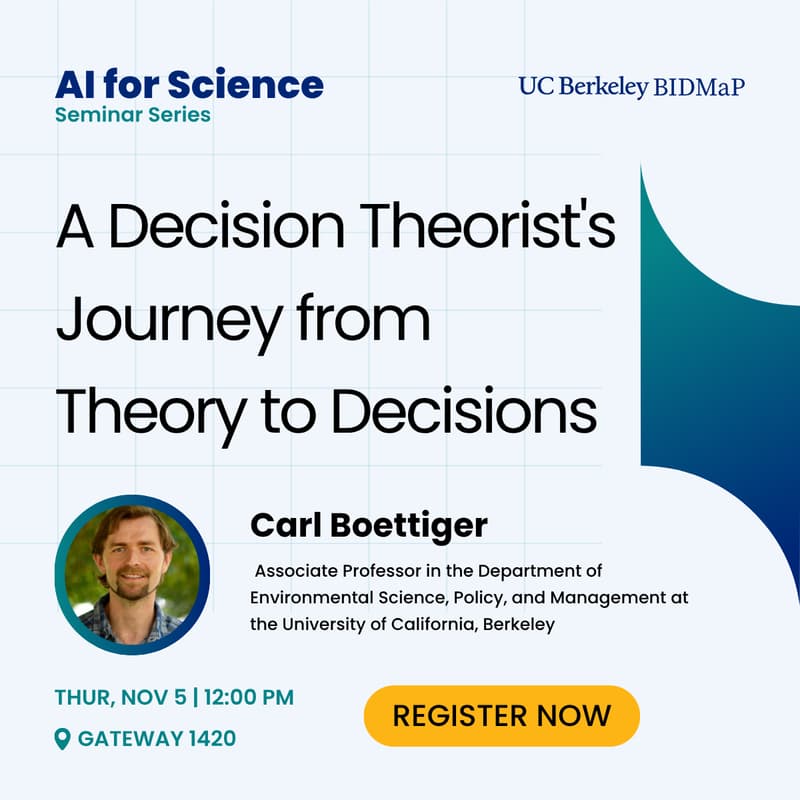

Carl Boettiger: A Decision Theorist's Journey from Theory to DecisionsThursday
About this Seminar
A Decision Theorist's Journey from Theory to Decisions
For a century, theoretical ecology has used models to mimic patterns in nature: oscillations, tipping points, and the mechanisms behind them. We got good at this, and often our models fit the data almost too well. But when models are used to make decisions, a harder question arises: which model is correct? In this talk I trace a path from that question to the tools of decision theory. Stochastic dynamic programming and partially observed Markov decision processes let us find good policies under uncertainty, and they show that how we handle uncertainty can change the decision in practice. They also reveal a trap: choosing the model that forecasts best can lead us to over-exploit an ecosystem while becoming increasingly confident that we are not. No model is a crystal ball, and the future depends on what we do. I then describe how reinforcement learning, which is closely related to adaptive management, can learn policies across many candidate models, with examples from fisheries with tipping points, age-structured stocks under partial observation, and invasive green crab management. These methods carry their own risks, since an algorithm optimizes what we say we want rather than what we actually want. The same lessons apply to large language models and agentic AI, and to biodiversity data, which tells us as much about people as about the species it records. This leads to our efforts to put these lessons into practice with partners such as the Trust for Public Land, the California Department of Fish and Wildlife, BOSL and others. Working with them, we examine what can be done with small, open AI models empowered by tool use and cloud-native data workflows. Local models need no data center, sidestepping both the energy footprint and the privacy concerns of commercial AI
https://bidmap.berkeley.edu/seminars/carl-boettiger-decision-theorists-journey-theory-decisions
Our Speaker:
Carl Boettiger
Carl Boettiger is an Associate Professor in the Department of Environmental Science, Policy, and Management at the University of California, Berkeley. His research applies data science to global change biology, focusing on ecological forecasting and decision-making under uncertainty. By blending theoretical ecology with advanced computational methods, Carl develops tools to predict and manage regime shifts in vulnerable ecosystems. A leader in the open science movement, Carl is a co-founder of rOpenSci, a project that promotes software standards and reproducibility in scientific research. He also serves as a faculty affiliate at the Berkeley Institute for Data Science (BIDS) and faculty advisor to the Eric & Wendy Schmidt Center for Data Science and Environment. His work aims to democratize access to ecological data, empowering researchers and conservationists to better understand and protect our changing planet. He holds a Ph.D. in Population Biology from UC Davis and a degree in Physics from Princeton.
The Bakar Institute of Digital Materials for the Planet (BIDMaP) accelerates the discovery, development, and deployment of advanced materials to address some of the most urgent challenges facing our planet. By combining cutting-edge chemistry with artificial intelligence, machine learning, and robotics, BIDMaP is reimagining how materials can be designed and optimized for clean energy, clean air, clean water, advanced batteries, and sustainable chemical production.