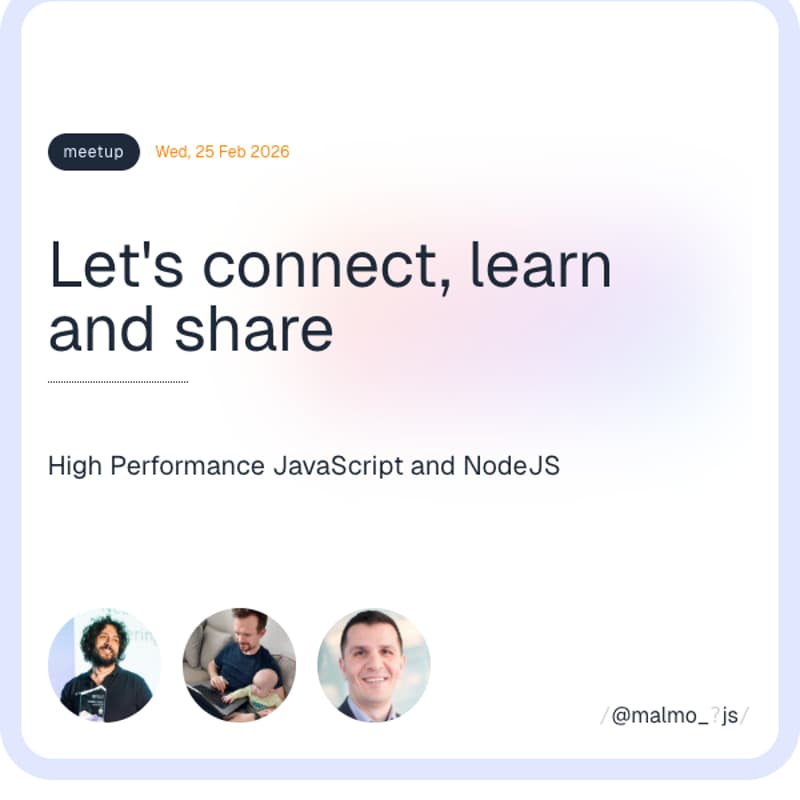

JS in Malmö - Let's Connect, Learn and Share
About the event
JavaScript has been the default language of the web for years. In the Malmö and surrounding Öresund region, it quietly powers high‑performance systems and platforms but the engineers doing that work rarely end up in the same room.
Let's change that!
This event in Malmö is the first in a new series of meetups, workshops and discussions for engineers working with JavaScript and Node.js. The focus: how to use JavaScript for high‑performance and business‑critical systems.
When you push modern JavaScript and Node.js hard enough, you run into the real questions:
What does performance actually mean beyond "it feels fast"?
How do you design services so they fail and recover safely, not spectacularly?
Where are the real limits of the system? Is it due to the event loop, V8, CPU, memory allocation, or network stack?
For this first edition, we’re bringing together runtime experts, Node.js core contributors and product engineers from across the region to talk about building and operating systems that cannot fall over: high‑throughput, high‑traffic, high‑stakes services with real users and real consequences.
We’ll go deep on:
High‑performance Node.js in production - How experts like Matteo Collina think about the event loop, backpressure, concurrency, observability and performance budgets – with examples from real systems, not contrived benchmarks.
JavaScript in cloud native systems Where Node.js fits (and where it doesn’t) in containerised, serverless and edge environments. Practical patterns for scaling, avoiding bottlenecks and keeping latency predictable under load.
Runtime and language‑level internals What you actually need to understand about V8, the event loop and async primitives to debug the weird failures, memory leaks and tail latency that don’t show up in unit tests – especially when you are under pressure on a Friday night deploy.
Who this event is for
This series is for people who care about JavaScript as an engineering tool, not just a front‑end necessity.
This first event will be most valuable for:
Product engineers working with JavaScript / Node.js
Backend and platform engineers responsible for high‑throughput or business‑critical services
Tech leads and Engineering Managers who need to make good decisions about using JavaScript in event‑driven and cloud native systems
Engineers who mostly know JavaScript from the front-end today, but want to understand its potential (and limits) in high‑stakes back‑end and infrastructure work
If you work with JavaScript in production, or you’re deciding how far to trust it in your next system, you’ll find your peers in the room.
What you’ll walk away with
A clearer mental model of how Node.js actually behaves under load
Concrete patterns for designing resilient, event‑driven and cloud native JS systems
Lessons from engineers running serious Node.js in production
Pointers to tools, libraries, patterns and approaches that actually hold up at scale
New connections with engineers and technical leaders solving similar problems in the region
Speakers
Matteo Collina - is the Co-Founder and CTO of Platformatic.dev, with the goal of removing friction from backend development. He is a member of the Node.js Technical Steering Committee and serves as Chair of the OpenJS Foundation Board. He is the author of the fast Pino logger and the Fastify web framework, and a renowned international speaker who has presented at more than 60 conferences.
Robert Nagy - is a member of the Node.js Technical Steering Committee and CEO, co-founder and former lead developer of nxtedition. He works on performance- and business-critical JavaScript systems for real-time media and broadcast. In Node.js his contributions has mainly focused on performance as well as the stream and HTTP modules.
Jirayr Arzoumanian - is a Lead Software Engineer at Ingka Group, where he builds and scales distributed, cloud-native systems powered by NodeJS. He brings the perspective of someone thinking about day-to-day JavaScript performance and reliability in production.
Evening Schedule
16:30 - Arrival
17:00 - Opening remarks and short intro
17:10 - Deep‑dive talks
18:40 - Panel with Q&A
19:10 - Networking, refreshments and continued discussions
20:30 - Close