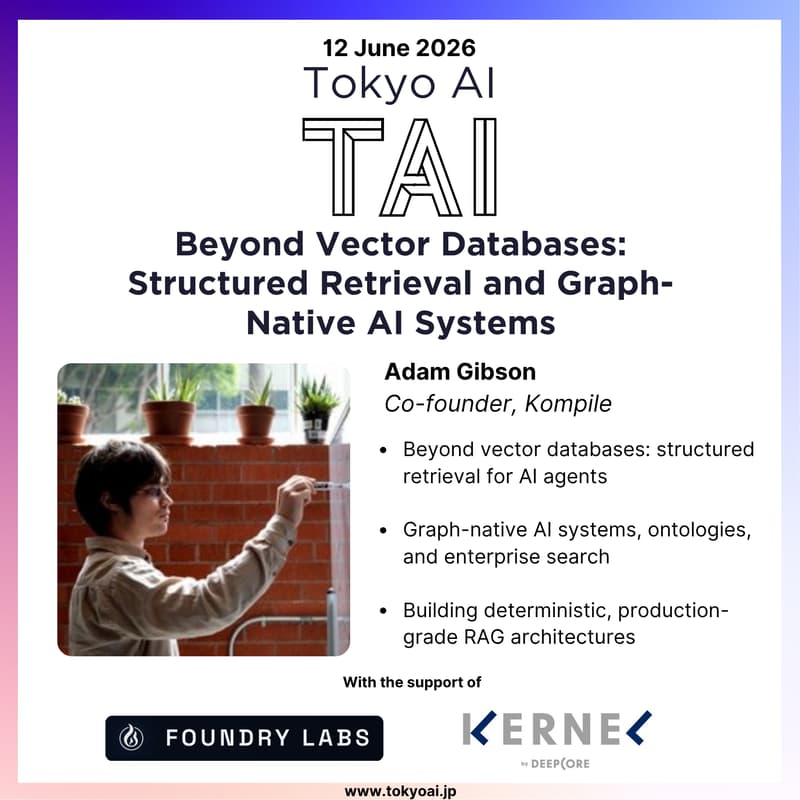

Beyond Vector Databases: Structured Retrieval and Graph-Native AI Systems
Description
Modern AI systems increasingly rely on Retrieval-Augmented Generation (RAG), typically implemented through embeddings and vector databases. While effective for unstructured corpora, vector-centric architectures often become difficult to maintain in environments with rapidly changing structured data, complex relationships, and evolving operational state.
This workshop explores alternative retrieval architectures that use relational databases, graph structures, ontologies, keyword search, and tool-mediated retrieval to ground AI systems without relying exclusively on embeddings.
Across two technical sessions, Adam Gibson will demonstrate practical approaches for building AI agents that reason over structured systems, dynamically retrieve information through tools, and manage context with significantly greater precision and control than traditional vector-only pipelines.
Topics include:
Structured retrieval architectures
Context engineering for agent systems
Relational and graph-based grounding
Ontology-driven enterprise search
Tool-mediated retrieval patterns
Graph RAG and knowledge navigation
Context budget management
AI systems operating over mutable state
The sessions are aimed at engineers, researchers, and technical leaders building production AI systems, enterprise knowledge platforms, agentic workflows, or retrieval infrastructure.
Agenda
18:00 Doors open
18:30 - 19:15 Part 1 - RAG Without Vector Databases: Structured Context Engineering for AI Agents
19:15 - 20:00 Part 2 - Graph-Native AI Systems: Ontologies, Knowledge Graphs, and Retrieval Beyond Embeddings
20:00 - 21:00 Networking
21:00 Doors close
Part 1 - RAG Without Vector Databases: Structured Context Engineering for AI Agents
Traditional RAG systems rely on embeddings, vector databases, chunking pipelines, and semantic similarity search. While this approach works well for static, unstructured corpora, it introduces operational complexity and often performs poorly in highly structured, rapidly changing application states.
In this session, Adam presents a production architecture that grounds AI agents entirely through structured retrieval techniques without using vector databases.
Using Elthoria — an AI-powered virtual tabletop RPG platform — as a case study, the talk demonstrates how relational data, keyword-triggered entity resolution, prioritized context assembly, and tool-mediated retrieval can approximate and often outperform traditional RAG pipelines in structured environments.
Topics include:
Relational grounding for AI agents
Deterministic retrieval patterns
Context assembly under token constraints
Keyword and entity-based retrieval
Tool-mediated context expansion
Managing mutable application state
MCP-style retrieval architectures
Tradeoffs between vector and structured retrieval systems
This session is especially relevant for engineers building:
AI agents operating over transactional systems
enterprise copilots
workflow automation systems
simulation/game AI
operational knowledge systems
applications with rapidly changing structured data
Part 2 - Graph-Native AI Systems: Ontologies, Knowledge Graphs, and Retrieval Beyond Embeddings
Most enterprise information already exists as an interconnected graph: emails reference people and projects, documents link to systems and workflows, tickets connect to operational state, and organizational knowledge forms deeply relational structures.
This session explores how AI systems can leverage graph structures and ontologies directly, rather than flattening information into embedding spaces.
Adam will discuss how representing enterprise information as hierarchical ontologies and navigable graphs enables more precise retrieval, better context management, explainable reasoning paths, and dynamic information exploration by AI agents.
The session covers practical approaches to:
Graph RAG architectures
Ontology-driven knowledge systems
Tool-assisted graph traversal
Relational retrieval strategies
Hybrid graph + keyword search
Subgraph exploration for LLM agents
Structured context compression
Enterprise knowledge modeling
The talk also examines why graph-native architectures are becoming increasingly important as organizations move beyond simple semantic search toward agentic systems capable of reasoning over complex operational relationships.
Relevant for:
enterprise AI infrastructure teams
knowledge platform engineers
search and retrieval engineers
graph database practitioners
AI platform architects
agentic workflow developers
Speaker: Adam Gibson
Adam is the cofounder of Kompile, previously Skymind (YC W16). Adam has been a deep learning systems engineer for 13 years, building frameworks for Fortune 500 use cases focused on making exciting problems work in boring environments. He is also an O'Reilly author, publishing O'Reilly's first Deep Learning book: Deep Learning: A Practitioner's Approach. Now he is building Kompile based on those years of experience helping enterprises build end-to-end chat stacks, retaining full customization and control from Deep Learning compiler infra to the chat interface.
Organizers
Ilya Kulyatin is an entrepreneur with work and academic experience in the US, Netherlands, Singapore, UK, and Japan. He holds a BA in Economics, an MA in Finance, and an MSc in Machine Learning. He's a 3x founder, now helping Japan grow the local AI ecosystem through a not-for-profit community, Tokyo AI (TAI), while building an AI-native system integrator and solutions provider, Foundry Labs株式会社.
Supporters
Tokyo AI (TAI) is the largest international AI community in Japan, with 5,000+ members mainly based in Tokyo: engineers, researchers, investors, product managers, and corporate innovation leaders. Through 80+ events a year and 300+ speakers spanning startups, enterprises, and academia, TAI connects the people building AI in Japan with the global ecosystem, working to transform Tokyo into a global AI hub.
Foundry Labs K.K. is a Tokyo-based AI systems integrator and solutions provider, delivering end-to-end support for enterprises: from strategy design through implementation, deployment, and operations. They tailor AI to each client’s operational, regulatory, and security requirements, with hands-on experience across finance, government, and industry, and a track record of shipping production systems in secure and regulated environments.
DEEPCORE is a Tokyo-based AI-focused incubator and venture capital firm, founded in 2017 as a wholly-owned subsidiary of SoftBank Group, backing pre-seed to early-stage AI and deep-tech startups across sectors from healthcare to logistics. It also operates KERNEL, an AI incubation community near the University of Tokyo, where founders, engineers, and researchers connect and co-create ventures.
Privacy Policy
We will process your email address for the purposes of event-related communications and ongoing newsletter communications. You may unsubscribe from the newsletter at any time. Further details on how we process personal data are available in our Privacy Policy.