
EXHIBITION OPENING — Yoon Chung Han: Dreaming Babies: illi
Gray Area presents Dreaming Babies: illi (꿈꾸는 아기들: 일리), a solo exhibition of recent speculative simulation works by Korean artist Yoon Chung Han.
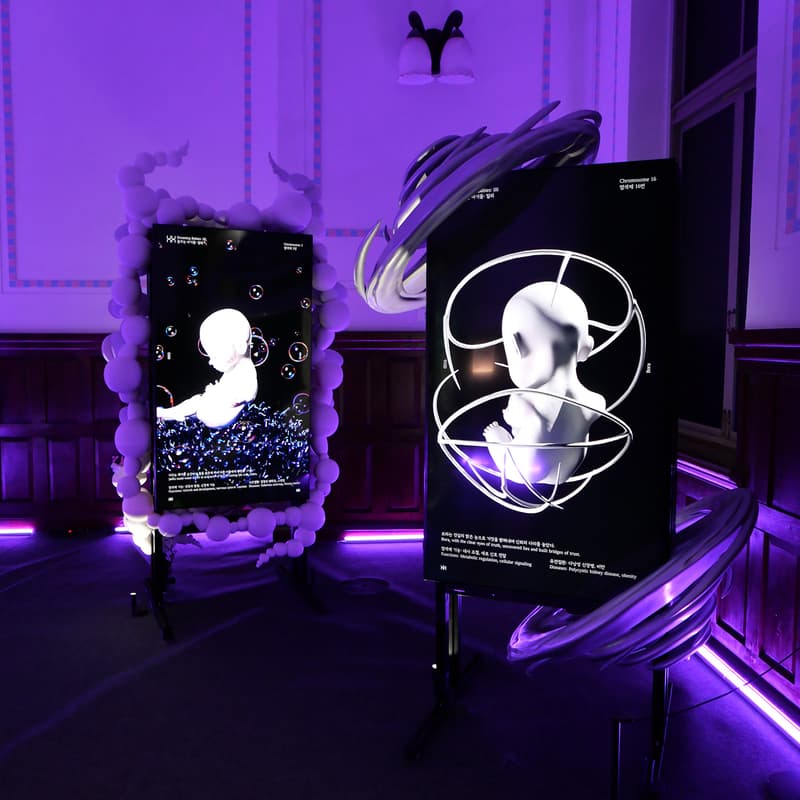
This immersive, interactive installation transforms Gray Area’s gallery into a futuristic nursery for 23 special hybrid human babies, each with a different chromosomal anomaly.
Each baby sleeps and dreams inside of a virtual incubator in space, weaving stories together with the audience through the expression of their own unique identities.
Exhibition Opening Night:
Thursday, September 17, 2026
6 – 9 PM
"Dreaming Babies: illi" at Unfold X in Seoul, South Korea, 2025
Exploring new speculative human designs, Dreaming Babies: illi addresses humanity’s desire to create a perfect being through genetic technologies: the commercializing of fertility treatment, the advancements in the science of cloning, the many possibilities and uncertainties of future human birth, and the ethical dilemmas surrounding genetic modification.
Each simulated baby’s story, generated from real genetic data, is created in collaboration with artificial intelligence. Visitors interact with the sleeping babies in real time by inputting sound through a microphone, connecting with them via the ChatGPT system. The live-rendered videos of babies floating in space can be viewed on each screen, where audiences can observe how genetic anomalies are reimagined not as physical difficulties, but as representations of more unique and special forms of humanity.
More about Dreaming Babies: illi
After experiencing egg retrieval and Preimplantation Genetic Testing (PGT), the artist went through the process of selecting embryos through genetic testing—freezing only those that passed as “normal,” while discarding those that did not. But what exactly defines an embryo with “normal” genes, and should embryos with “abnormal” genes be discarded? Even now, countless human embryos that fail PGT during in-vitro fertilization are discarded worldwide, never reaching pregnancy or birth. Does an embryo that fails PGT, then, represent a baby that was never born? Perhaps humanity today, in striving to produce only the most “perfect” babies in order to survive, will become the last generation—waiting so long for perfection that it never gives birth at all. Or perhaps we will be remembered as the last generation that discarded too many babies deemed “imperfect.” And what about the embryos engineered to be perfect, or babies born after passing genetic tests—how will they differ from the humans before them? If a flaw arises in one of the 23 pairs of chromosomes, it produces a baby with a corresponding condition—but can we truly call that a flaw? What if a chromosome that deviates from our defined “normal” range evolves instead into something excessively perfect—what kind of super-powered baby might emerge? The human form of the future may take shapes and appearances different from what we know today. Paradoxically, the pursuit of perfection might yield babies that appear like strange mutants, while those considered “imperfect” may in fact embody the very image of the “perfect” baby we once imagined.
This AI-based installation reinterprets the genome not as an object of pathology, but as a site of imagination and mythology. Each chromosome—often associated with genetic disorders or congenital conditions—is reborn as a baby character with a name, an alter ego, and an imagined being, endowed not with deficiency but with a poetic and abstract superpower. By naming and animating what society often silences or conceals, the work challenges the stigma surrounding disability, difference, and genetic variation. Rather than treating disability and genetic difference as deficiencies, it reimagines them as distinct ways of being. Within this new mythology, the boundaries between the “normal” and the “abnormal” begin to dissolve, allowing difference to emerge as a generative force—one that creates new creative identities, perspectives, and forms of beauty.
Artist
Yoon Chung Han is an interactive media artist, award-winning interaction designer, researcher, and educator. Over the past fifteen years, she has created a wide range of interactive 2D/3D audiovisual art installations, including biologic art, data visualization and sonification, multi-channel video installations, and audiovisual interface design. Her recent research focus was on multimodal interactions and data visualizations/sonification using biometric data and environmental data. Her works have been presented in many international exhibitions, conferences, and academic journals, such as ACM SIGGRAPH Art Gallery, Japan Media Arts Festival, London Science Museum, Media City Seoul, ZKM, NIME, ISEA, ACM Multimedia, ACM SIGCHI, IEEE Vis, Ulsan Art Museum, Incheon International Airport, LA Art show, Unfold X, Paradise Art Lab Festival, Gwangju Biennale, and Leonardo Journal. She had solo exhibitions at OCI Museum and Pier Contemporary Art Gallery in Seoul, Korea. She has been invited to give lectures at various institutions and events, including Stanford University, Apple, SXSW, Technarte, Fulcrum Festival, Seoul National University IDCC, CCA, and KAIST. She was selected as an OCI Young Creative in 2018, and her work is part of the collection of the OCI Museum of Art. In 2023, she was appointed as a Creative Ambassador for the City of San José, California, and served as the Art Gallery Chair for ACM SIGGRAPH 2023, the general chair for the IEEE VIS Arts Program (VISAP), and the PacificVis Storytelling Contest. She earned her bachelor and her first Master degree at the Seoul National University, and her second Master degree at Design | Media Arts, University of California, Los Angeles. She holds Ph.D. in Media Arts and Technology at the University of California, Santa Barbara. She is currently an associate professor in the Department of Design at San Jose State University.
Free for Members
Admission is free for Gray Area Members! Join today to help sustain our creative community.
View our FAQ page for more info, or contact us at info@grayarea.org with any accommodation requests.