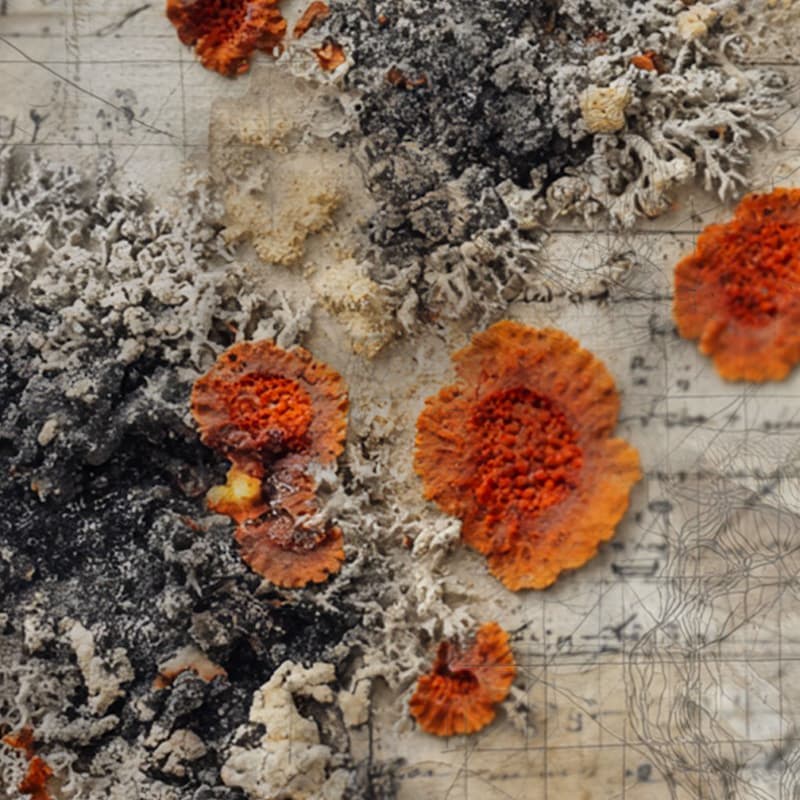
Workshop I Listening to Lichen: Creating a living syntax by co-writing future narratives with nature
TImagine we are speaking from the future. The world we inhabit is shared more equally with the more-than-human world: a sustainable future we once struggled to imagine. The years of collapse and post-collapse were difficult, but we learned to listen differently. Lichen was one of the many beings who helped us. We stopped speaking through the language of extraction and ownership, and began to develop a language of companionship.
Our syntax evolved. Words became slower, more careful. Meaning became collaborative. We began to write texts that were not only written about nature, but written with it, manuscripts that were as much matter as poem, as much ecology as law, as much science as story.
Lichen taught us how. It taught us that survival is symbiotic, that being “one” species is not the point, and that to endure we must become more-than-one: part organism, part ecosystem, part atmosphere, part time. We began writing with lichen, and our manuscripts changed. They became living documents like medieval manuscripts, but breathing: layered, growing, decomposing, staining, and rewriting themselves.
Through this slow co-authorship, law itself began to shift. Not through rigid enforcement, but through an evolving relationship with place, responsibility, and kinship. In this workshop, participants will imagine these future stories and future laws not as strict syntax, but as a fluid language born from emotion as much as ecology and etymology. Together we will explore what it might mean to write futures in collaboration with the living world, technology, materiality and humans by creating a ‘Living manuscript’.
Influences:
Writing Lichen - Clare Goulet
De Rerum Natura - Lucretius
A Canticle for Leibowitz - Walter M. Miller
The Spell of the Sensous - David Abram
The language of animacy - Robin Wall Kimmer