London Brain and Intelligence Summit - Main Conference + AI Workshop
Important Updates
We regret to inform you that Dr Tristan Bekinschtein will not be able to join us at the event due to unforeseen circumstances.
Dr Huan Luo from Peking University will be joining remotely to present her research on Consciousness as Subjective and Constructive.
For those who have already purchased the LBIS main conference ticket, if you would like to also purchase the AI workshop, please use a different account or visit this page (voucher still available): https://lu.ma/dezviory
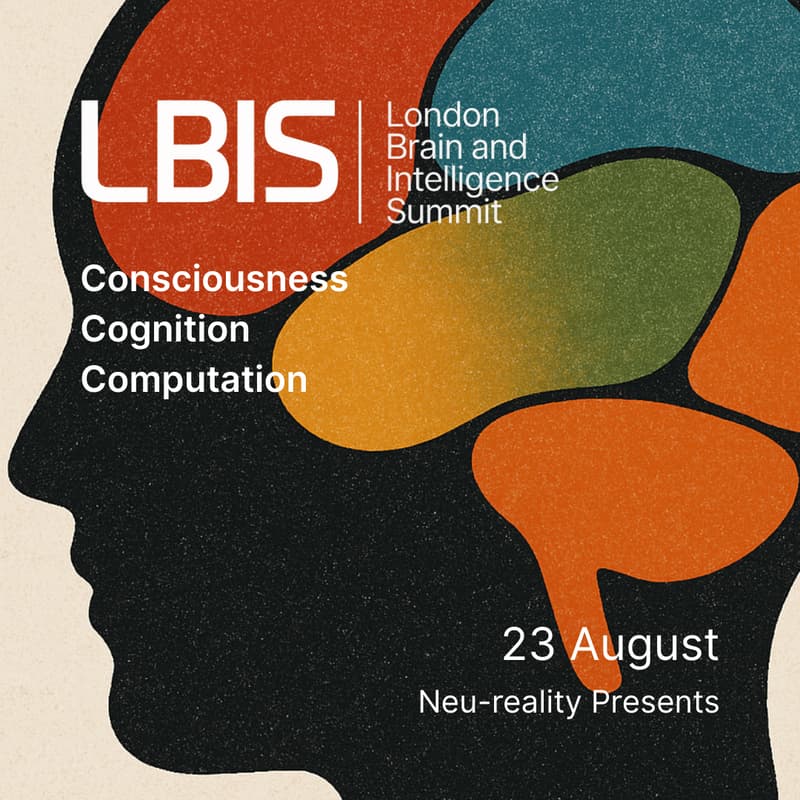
Step into a space where leading thinkers explore the frontiers of consciousness, cognition, and computation. From the science of altered states and the therapeutic potential of psychedelics, to computational models and brain-inspired AI, the summit invites bold ideas and rigorous debate on how we understand the mind—and how we might shape it.
Through keynote talks, in-depth discussions, and a focused roundtable, participants will examine emerging discoveries, challenge assumptions, and imagine new possibilities for human and machine intelligence. This is a place for those curious about the mind’s deepest mechanisms and the transformative technologies that could redefine them.
For more information, visit lbis.noetex.ai
Agenda
AI Workshop
10.00AM-12.00PM | AI Agent Workshop
This workshop explores cutting-edge reasoning techniques in AI and agents, focusing on Chain of Thought (CoT) and the ReAct framework. Participants will learn from a agentic perspective: how to break down complex problems step by step, enhancing reasoning quality, interpretability, and decision-making. This program is designed for students, researchers, and professionals interested in AI, cognitive science, and computational reasoning who want to deepen their understanding in building agentic intelligent systems.
Main Conference
1.00-1.40 PM | Dr Huan Luo Keynote Talk
Flow in a river: consciousness as subjective and constructive
Understanding how consciousness arises from the brain remains one of the most profound and debated questions, which becomes even more urgent in today’s era of powerful AI. Numerous theories have been proposed to account for the neural correlates of consciousness (NCC), with the recent COGITATE project representing a landmark effort in directly testing two leading frameworks. While identifying brain regions associated with conscious states and levels is undoubtedly important, I would like to draw attention to two fundamental yet often overlooked features of consciousness, emphasized by William James over a century ago: its subjective and constructive nature. I will present recent work from my lab showing that the human brain continuously compresses, integrates, and predicts external inputs—constructively weaving them into internal frameworks that give rise to a subjective experiential palace unique to each individual.
1.40-2.20 PM | Dr Andrea Luppi Keynote Talk
What makes the human brain special, and does it tell us anything about AI?
Humans are very clever, and that’s got something to do with how our brains process information. Dr Luppi will bring together pieces of a broader puzzle – from different species, and different branches of neuroscience – to zoom in on what sets the human brain apart from other primates, how this process can go wrong, and what lessons we can draw about how (not) to build intelligent systems.
2.20-3.00 PM | Dr Devin Terhune Keynote Talk
Verbal suggestion and the modulation of consciousness
Verbal suggestions are communications for a change in one’s experience that are framed as something that happens to an individual rather than the result of a deliberate action. They form the cornerstone of a range of clinical phenomena spanning placebo and nocebo effects and hypnosis. Suggestions are increasingly being recognised as an important factor in consciousness science with clear relevance for the link between altered states of consciousness and clinical outcomes. In this presentation, Dr Terhune will show how verbal suggestions can modulate awareness and perception across a diverse array of contexts. On the one hand, this work highlights the potential of suggestions to act as confounding factors in basic research and clinical interventions. On the other hand, it illustrates how suggestions can be harnessed to strengthen experiments and clinical interventions involving the modulation of consciousness. Understanding and leveraging verbal suggestions offers a promising path for advancing consciousness science and clinical practice.
3.00-3.30 PM | Roundtable Discussion
3.30-4.00 PM | Q & A
Speakers
Tristan Bekinschtein
Professor of Consciousness and Cognition, University of Cambridge
Dr Bekinschtein is a biologist, Master in Neurophysiology and PhD in Neuroscience, Buenos Aires University. He has been an EU Marie Curie Fellow and senior researcher at the MRC-Cognition and Brain Sciences Unit, Cambridge, and a Fyssen fellow at ICM, Paris. He has also been an Invited Researcher at QBI, Australia and INECO, Argentina. In 2011 he founded the Consciousness and Cognition Lab, now at the Department of Psychology, University of Cambridge. He is Wellcome Trust Fellow and now Turing Fellow. His lab is primarily interested in the complexity of thought and what makes us human. He works on the cognitive neuroscience of consciousness, primarily on the fragmentation of cognition as we lose consciousness while falling asleep or getting sedated; on the cognitive and neural differences between conscious states; and on the interaction between attention and consciousness in health and disease.
Andrea Luppi
Wellcome Early Career Fellow at the University of Oxford, Fellow of St John’s College Cambridge
A philosopher turned neuroscientist, Dr Luppi trained in philosophy and cognitive science at the University of Oxford and Harvard University, before obtaining a PhD in neuroscience as a Gates Scholar from the University of Cambridge, and completed postdoctoral training as a Molson Neuro-engineering Fellow and Banting Fellow at the Montreal Neurological Institute. His work investigates how brain function and consciousness arise from the complex interplay of brain structure and dynamics across scales. To this end, he combines approaches from information theory, network science and whole-brain computational modelling to investigate pharmacological and pathological perturbations of brain function and consciousness across species and across modalities – such as disorders of consciousness, anaesthesia and psychedelics. His long-term goal is to understand what makes brains conscious and intelligent, how we can achieve more human-like artificial systems, and how we can promote the recovery of healthy brain function and cognition in brain-injured patients.
Devin B. Terhune
Reader in Experimental Psychology in the Department of Psychology in the Institute of Psychiatry, Psychology, & Neuroscience at King’s College London
Dr Terhune completed his PhD on the cognitive neuroscience of dissociation and suggestibility at Lund University and was previously a Postdoctoral Research Fellow in the Department of Experimental Psychology at the University of Oxford and a Lecturer in the Department of Psychology at Goldsmiths, University of London. His research draws on methods and theories from cognitive neuroscience, experimental psychology, and cognitive neuropsychiatry with an aim to characterize different features of awareness, with a focus on dissociative states and hallucinations, and how they can be modulated using verbal suggestion and pharmacological agents.
Huan Luo
Professor at the School of Psychological and Cognitive Sciences, PI of the IDG/McGovern Institute for Brain Research, Peking University
Dr Luo is a full professor at the School of Psychological and Cognitive Sciences and a PI of the IDG/McGovern Institute for Brain Research, Peking University. She got her Ph.D. from the University of Maryland College Park with Prof. David Poeppel. Her research focuses on the cognitive and neural mechanisms of attention, memory, learning, and decision-making, with recent interests centered on the structured nature of human cognition. She currently serves as Senior Editor at eLife and on the editorial board of PLOS Biology. Her lab is among six worldwide participating in the international COGITATE project on the neural basis of consciousness.
Host
Neu-reality
This event is hosted by Neu-reality, a nonprofit platform dedicated to advancing science communication and innovation of neuroscience and AI. Operating between Shanghai and London, Neu-reality is one of China’s leading science media outlets, with over one million subscribers and a global contributor network of over 400 writers and experts. Our work has been recognized by Scientific American, Cell Press, Frontiers, ByteDance, and the Berggruen Institute, among others. We aim to foster meaningful, cross-disciplinary exchange across global communities and bridge Eastern and Western perspectives in science and innovation.
Partner
EAST2046
EAST2046 is a forward‐looking cultural festival blending digital art, community building and cutting‐edge academic inquiry. Rooted in the real experiences of East and Southeast Asian diasporas worldwide, it experiments and collaborates to reframe the relationship between Eastern cultures and the future—building new modes of cultural expression at the intersection of technological innovation and artistic perception. Inspired by Deleuze & Guattari’s “rhizome,” EAST2046 unfolds as a multi-node cultural network, with each event acting as a creative node across diverse spaces.