
Open Atlas Hackathon
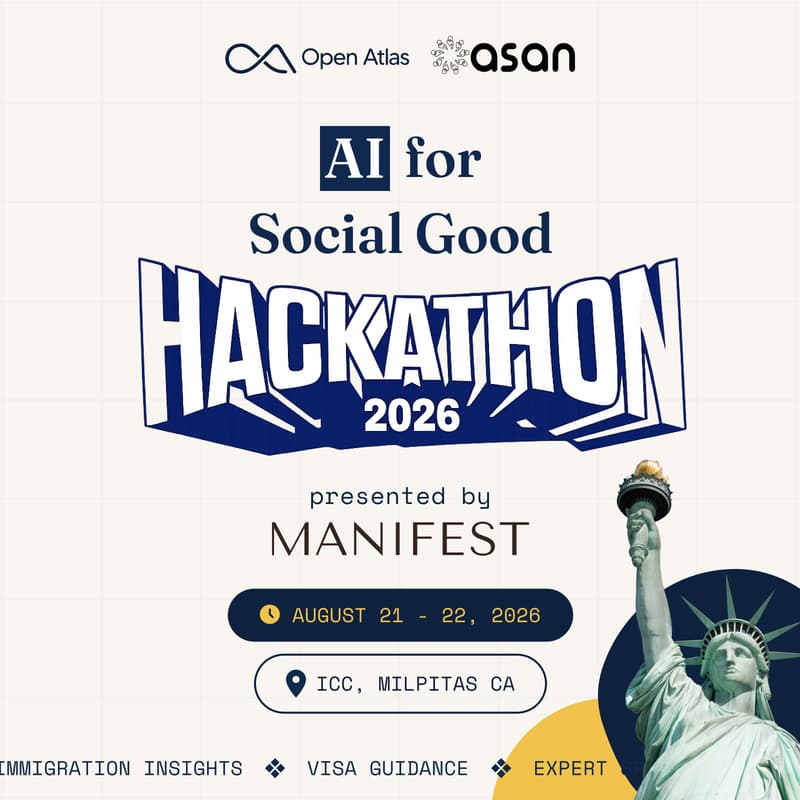
Open Atlas - AI for Social Good Hackathon 2026
Builders, in a room, solving real problems. Ship AI-powered solutions for immigration, healthcare, education, and financial inclusion.
Who can participate
Above legal age of majority in country of residence
US only
About the challenge
The challenge is simple: build an AI-powered solution that meaningfully improves life for people who are usually left out of the AI conversation — immigrants navigating a broken visa system, families looking for affordable healthcare, students figuring out how to fund their education, newcomers trying to land in a new country.
You'll have two months to build, access to sponsor APIs and credits from day one, and mentorship from engineers at top AI labs throughout the submission window. The strongest 8–10 teams are invited to pitch live in Milpitas on August 21 in front of judges from across the Silicon Valley ecosystem.
This is the same community that produces 20% of US unicorn founders. The hackathon is the room's most technical, most ambitious segment, ready to ship.
Get started
Here's how to go from registered to building in under 30 minutes:
Register on Devpost. Click "Register" at the top of this page. Free, no fee.
Join the Open Atlas Slack. Invite link is sent automatically after registration. This is where mentors hang out, where you find teammates, and where sponsor API credits are distributed.
Find or form your team (1–5 people). Going solo is fine. If you need teammates, post in the #team-formation Slack channel with your skills and what you want to build.
Pick a problem. Read the "What to Build" section below. Or bring your own idea — open track is open.
Claim your sponsor credits. Credit codes for OpenAI, Anthropic, cloud providers, and dev tools are posted in #sponsor-credits in Slack.
Start building. Submissions open June 20. The earlier you start, the more polished your demo will be.
Requirements
What to Build
Build an AI-powered solution that addresses a real social good problem. The theme is intentionally broad, but here are seven suggested problem areas where AI can move the needle:
🛂 Immigration & Mobility
Tools that help immigrants navigate visa processes, credential recognition, settlement, and integration into US life. Examples: AI agents that explain immigration paperwork in plain language, credential-translation tools for foreign-trained professionals, community matchmaking for new arrivals.
🏥 Healthcare Access
AI that closes gaps for underserved populations. Examples: insurance navigation assistants, clinical translation tools, mental health support for immigrants, appointment-finding agents for the uninsured.
📚 Education & Opportunity
Personalized learning, skills translation for foreign-trained professionals, accessibility tools, mentorship matching. Examples: GRE/GMAT prep adapted for non-native English speakers, AI tutors for first-gen college students, scholarship-discovery agents.
💳 Financial Inclusion
Credit access for newcomers, remittance optimization, fraud protection, financial literacy. Examples: alternative credit-scoring for thin-file immigrants, AI-driven remittance comparison, financial-literacy chatbots in multiple languages.
🌍 Civic & Community
Tools for nonprofits, public benefit access, language access, civic participation. Examples: SNAP/Medicaid eligibility checkers, voter-registration assistants in non-English languages, nonprofit operations copilots.
💼 Career & Talent
AI for workforce inclusion. Examples: resume translation for foreign-trained workers, mock-interview agents, AI-powered networking for underrepresented talent.
🏠 Newcomer Settlement
Tools that help newly-arrived students and professionals land in the US. Examples: housing-search agents that understand visa constraints, logistics copilots for international students, neighborhood-matching tools.
🤖 Open Track
Anything else that meaningfully uses AI to advance social good. Surprise us.
The bar: AI must be doing real work in your solution not just a single API call wrapped in a UI. Judges will look for substantive use of LLMs, agents, RAG, vision, speech, or other AI techniques.
What to Submit
Every submission must be made through this Devpost page by August 20, 2026 at 5:00 PM PT. Late submissions will not be accepted.
Your submission must include:
✅ Project Name
Short, descriptive, memorable.
✅ Elevator Pitch (2–3 sentences)
What does it do? Who is it for?
✅ Full Description
The problem you're solving and who it affects
How your solution works
AI/ML components — which models, APIs, frameworks you used and what they actually do
What you built during the hackathon vs. what existed before
Complete tech stack
Challenges you ran into
What's next for the project
✅ Demo Video (≤ 3 minutes)
Hosted on YouTube or Vimeo (public or unlisted). Must show the working product. Polish isn't required — clarity is.
✅ Public Code Repository
GitHub or GitLab link with a clear README.md including setup and usage instructions. If your repo is private, ensure judges have access.
✅ Team Members
All team members tagged on the Devpost submission, with their roles indicated.
✅ Track Selection
Pick the prize track(s) you're submitting to. You can select multiple if your project qualifies.
Optional but Recommended
Screenshots or GIFs of the product in action
A 3–5 slide pitch deck (PDF)
A live demo URL if your project is deployed