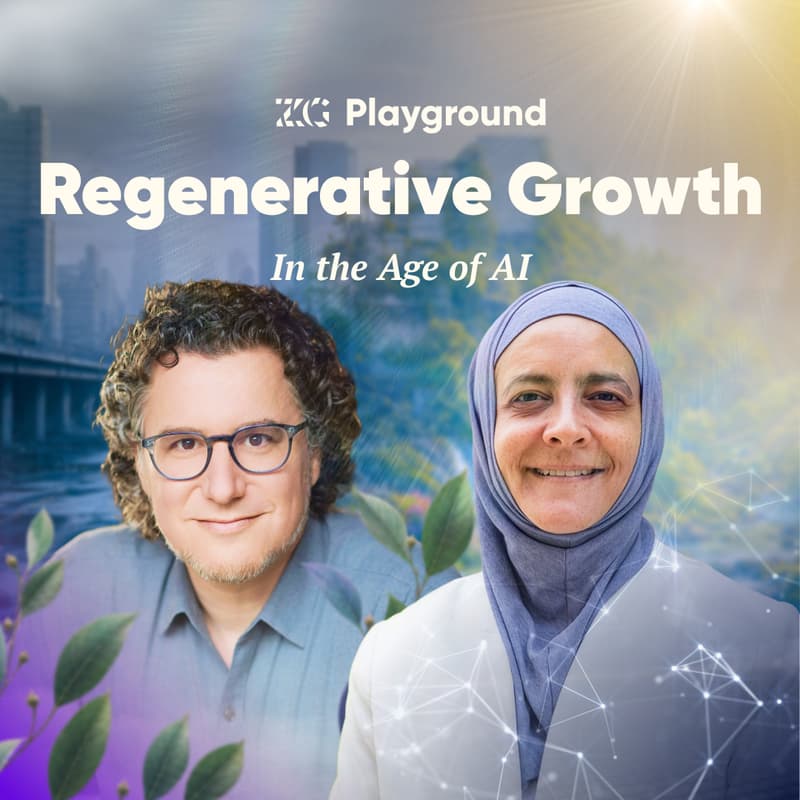

Eric Ries and Rana Dajani: Regenerative Growth in the Age of AI
Join Eric Ries, Rana Dajani and Moh Al-Haifi on August 27th around our virtual fire, where we will be asking ourselves....
“What does healthy growth actually look like, given the current wave of AI acceleration, and with it rapidly rising wealth (and power) inequality around the world?”
There's an elephant in this room we want to address… The "move fast and break things" instinct that built the last twenty years of technology and innovation, has been cracking fast too, especially for those the system often leaves behind or ignores.
Now it's being handed a far faster engine in AI, and most organisations are reaching for it with the same hyper-growth reflex that got us here in the first place, not a different one.
Oxfam's 2026 inequality report found billionaire wealth rose more than 16% in 2025 to a record $18.3 trillion, with the twelve richest billionaires now holding more wealth than the poorest half of humanity. The World Inequality Report 2026 puts a finer point on it: fewer than 60,000 people — the wealthiest 0.001% — now hold three times more wealth than the bottom half of humanity combined, a share that has grown steadily since 1995.
Oxfam also reported that the richest 1% burn their fair annual carbon share in 10 days vs. 1,022 days for the poorest half.
A need for a new reframe of growth is needed now more than ever.
What does it mean to go deeper before going bigger and faster, at the exact moment the tools for bigger and faster have never been more available, and more dangerous?
What we've been noticing over the past few years: many big tech companies, and other highly financially successful companies, often start out with clear, inspiring, and — may we say — "good" missions. Google, to organise the world's information. Tesla, to accelerate the world's transition to sustainable energy. Airbnb, to let anyone, anywhere, belong. But over time, these companies become exactly what they set out to change: extractive, and focused on maximising only one group's benefit: shareholders.
Speakers:
Eric Ries
Eric Ries built his career teaching startups to build and test fast. His 2011 book The Lean Startup gave a generation of founders a shared vocabulary, build-measure-learn, minimum viable product, pivot, and became required reading far beyond Silicon Valley, in corporate innovation programmes, government agencies, and university curricula. He later founded the Long-Term Stock Exchange, a US securities exchange built for companies committed to long-term value over short-term stock pressure, and co-founded Answer.AI, an AI research lab.
His new book, Incorruptible: Why Good Companies Go Bad… and How Great Companies Stay Great (May 2026), is a genuinely different question than the one he made his name on. Rather than how to build quickly, it asks what happens once fast-building succeeds and turns into pressure to keep growing at any cost. Ries argues corporate drift is structural, not a failure of character: as organisations grow, their ownership, incentives, and governance quietly reshape behaviour, pulling even principled leaders toward outcomes they never wanted. He names this pull "financial gravity."
In interviews since the book's release, Ries has been candid that this is a genuine reckoning with his own earlier work. Asked what he would change if he were writing The Lean Startup today, he said simply that he would add the words "for good" to the book's original premise. He has also spoken directly about the limits of his control over how his ideas get used: they were, in his words, "given freely to the world," and if people misuse them, he can only educate and argue his case, not police it.
The book walks through a graveyard of companies that drifted, FedMart, Polaroid, Cadbury, Toys "R" Us, Whole Foods, and Boeing among them, alongside companies he holds up as having resisted the same pull: Costco, Novo Nordisk, Patagonia, IKEA, and Cloudflare. His central design proposal is what he calls the "spiritual holding company," a governance structure built to protect mission from the moment a company becomes valuable enough to be worth extracting from.
Rana Dajani
Rana Dajani is a molecular biology professor at the Hashemite University in Jordan and a Yidan Global Fellow at Harvard Graduate School of Education, currently back in Jordan. Her scientific research is on epigenetics and biomarkers of trauma in refugee populations, and she led the drafting of Jordan's stem cell research ethics law, the first of its kind in the Arab and Islamic world.
In 2006 she began reading aloud to children in her own Amman neighbourhood. That grew into We Love Reading, now a network of trained volunteer Reading Ambassadors running community libraries in more than 71 countries, spreading through trust and obligation rather than franchising or venture capital. It's one of the case studies in The Systems Sanctuary's Scaling Deep report, whose community of practice Zebra Growth is part of, which names her model "interstitial scaling": transformation that happens in the spaces between institutions rather than through them.
Her newest book, Reimagining Systems Change: A Bottom-Up Approach, co-written with Tate Gallagher, sets out a five-pillar framework for building mission-driven institutions from the ground up: leadership, people, funding, impact measurement, and growth, with We Love Reading's own story as the working case study throughout. A companion thread runs through her recent writing on decolonising impact measurement: she argues that standardised, externally-imposed metrics have roots in colonial categorisation, and that communities should be trusted to define what impact means on their own terms rather than have it defined for them by funders.
She's also writing a further, related book examining how essential, undervalued work like caregiving is systematically excluded from how modern economies define success, arguing for a more inclusive and sustainable measure of what a society or organisation is actually for. Her earlier memoir, Five Scarves: Doing the Impossible, was recommended by the World Economic Forum as one of seven books for changemakers and reviewed in Nature; she's currently developing its sequel.
Reading List & Sources
For those who want to go deeper before or after the session:
Eric Ries
The Lean Startup (2011) — the original book, and Eric's bio via the Long-Term Stock Exchange, which he founded
Incorruptible: Why Good Companies Go Bad… and How Great Companies Stay Great
Thought Economics interview — on why good companies go bad, and how to build ones that don't
Porchlight Books Q&A — on writing Incorruptible
The Long Now Foundation - on incorruptible by design
Hacker News AMA — Eric answering questions directly on Lean Startup and Incorruptible
Answer.AI launch post — the AI research lab he co-founded with Jeremy Howard
Rana Dajani
Reimagining Systems Change: A Bottom-Up Approach (Cambridge Scholars, with Tate Gallagher) — Rana's new book on social innovation, the five-pillar framework, and We Love Reading as a working case study
We Love Reading — the community-library network Rana founded; published research archive and training portal
Decolonising Impact Measurement: A More Inclusive Approach — companion article
Five Scarves: Doing the Impossible — Rana's memoir, written at Harvard; shareable freely per Rana
Reviewed in Nature and Nature Middle East
Recommended by the World Economic Forum as one of seven books every changemaker should read
TED Talk: "If we can reverse cell fate, why can't we redefine success?"
Arabic edition available here
One Million Asma campaign — including the documentary, free to screen
Reflections from a Social Innovator (Medium) and Rana's author archive on Countercurrents
WHAT PAST PARTICIPANTS HAD TO SAY
"A stimulating "safe place" to share, be heard, listen and learn. Plenty of people from different perspectives to shake up the conversation and create learning opportunities." - Gwyn Jones
"I felt truly inspired after this session! 😍 Thank you for creating these spaces to connect with leaders who are rethinking business models. It really shifted my perspective on the responsibility we have as marketers to remain transparent and true to the core essence of our businesses. I loved hearing the diverse perspectives and exploring new approaches to driving meaningful change. This conversation genuinely opened my eyes! I'm excited to continue learning and connecting with others who share this vision." - Michelle Guzman Murphy
"This was a refreshing discussion! I found the speakers had developed insights that were very inspirational. I love when people are willing to share their discoveries willingly and open to further development of it all. So often people are working with a surface perspective. The self awareness in this group was obvious to me and I think this is so much more productive moving forward in the complexity of today's world. None of this is easy to navigate. Thanks for the invite. Lots of food for thought!" - Patti Beer
About Zebra Growth
Zebra Growth is a Regenerative Growth Consultancy helping organisations close the gap between what they say, how they grow, and what they stand for, so their next stage becomes clearer, more coherent, and more resilient.
We work with organisations doing meaningful, complex work whose story, systems, and decisions haven't fully caught up with who they're becoming. Whether growth has started to strain or a new opportunity has opened up, we help leadership see what's actually out of sync and build the conditions for growth that can hold.
Our methodology, Regenerative Growth Architecture™, diagnoses the gap between three things that drift apart more often than most organisations want to admit: Story — how people understand and trust you; Traction — how your value turns into marketing, revenue, and opportunity; and Integrity — how you make decisions and stay true to what matters as pressure increases.
When these three are aligned, growth becomes clearer and healthier. When they drift, it becomes heavier, slower, and harder to trust.
Zebra Growth is grounded in a clear insight: more activity rarely fixes a story that no longer fits. The real work is beneath the surface. It is the story, systems, and decision-making conditions that make healthy growth possible in the first place.
We are intentionally cross-functional and cross-cultural, bringing together strategists, creatives, and technologists who understand what it means to grow without losing what makes the work worth doing.
Zebra Growth's vision is simple: to help organisations grow without losing the thing that made them credible in the first place, and to contribute to a future where growth strengthens rather than extracts from the people, cultures, and ecosystems it touches.