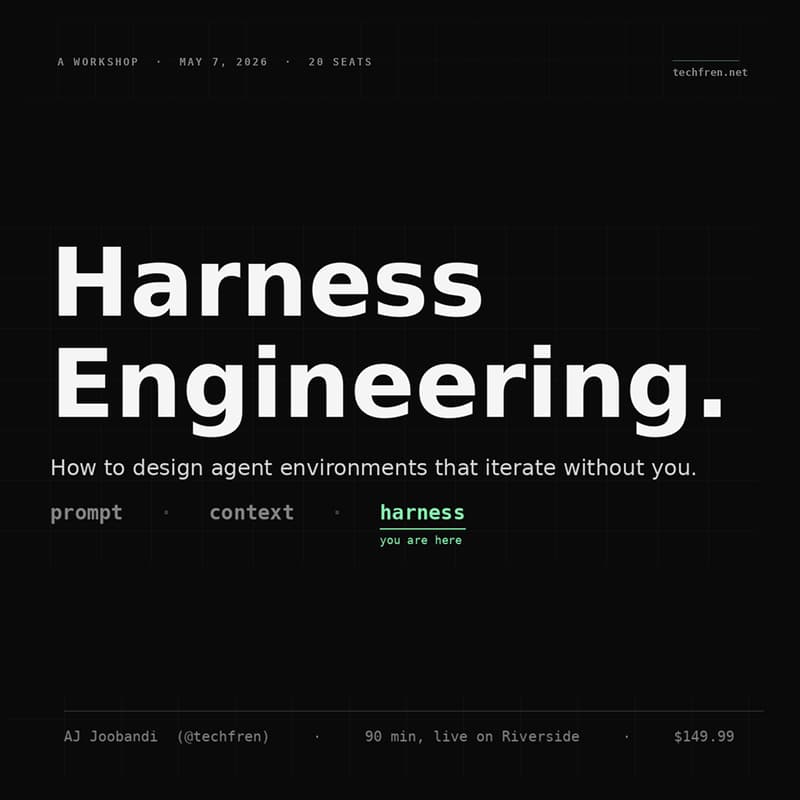
Harness Engineering: How to Design Agent Environments That Iterate Without You
Every reliable agent loop has a secret: not just a prompt, but a harness - an environment with clear assets, metrics, constraints, and stopping rules. Often, that harness is governed by a single prose file.
Harness Engineering the discipline of designing the environment, constraints, metrics, and instruction layer that let agents run useful loops. It's what comes after prompt engineering and context engineering. It's what separates engineers who get results from their agents from engineers who just get noise.
This is a craft workshop. You'll leave knowing how to write the instruction file that runs your next loop and a mental model you can reuse for every agent environment you build from now on.
🪜 The Progression
Prompt Engineering → Context Engineering → Harness Engineering
Most engineers are stuck on context. The real leverage is the harness — the editable asset, the scalar metric, and the prose instruction file that turns any agent framework into a loop that actually produces work.
📚 What you'll learn
The three primitives of every reliable agent harness
How to write a strong instruction file
How the pattern transfers
How to critique an instruction file like a practitioner
✅ Who this is for
ML Engineers, Research Engineers, AI Engineers, Agent Engineers with 2–6 years of experience
Senior SWEs, Data Scientists, and Applied Scientists being asked to ship agent-driven workflows at work
Staff+ engineers building internal agent tools who want a transferable framework, not a framework-specific trick
❌ Who this isn't for
Engineers still figuring out what context engineering is
PMs, founders, or AI-curious execs looking for an overview
Students or hobbyists without compute or API budget to run a real loop afterward
📋 Workshop agenda
The New Skill Layer - Prompt → Context → Harness
Anatomy of a Harness - the three primitives, across frameworks
The Instruction File as a Discipline - instructions, constraints, stopping criteria (you draft your own as we go)
Proving the Pattern - LLM-Wiki and beyond (conceptual walkthrough)
Q&A - Ask away!
What to Run Tonight - setup prereqs, what to expect from your first real run, how to iterate
About your instructor
AJ Joobandi is a software engineer, AI systems builder, and the creator of TechFren, where he reaches 130k+ followers making technical content about agents, developer tools, and the future of software engineering. He’s the builder behind Clickolas Cage, one of the early open-source browser agents, and 100x Orchestrator, a multi-agent lifecycle management system, with 100+ public repositories shipped across his GitHub. Currently Technical Content Lead at Augment Code, AJ specializes in turning emerging AI research and infrastructure into practical workflows that builders can actually use.
Format & logistics
Live on Zoom, 90 minutes, capped at 30 seats to preserve the critique format
Recording included
Ticket: $150
FAQ
Will I get the recording?
Yes. Every registered attendee gets the recording within 48 hours of the session.
What if I can't make it live? You're welcome to buy a ticket for the recording anyway, but the room energy is part of what you're paying for. Plan to show up.
Do I need to use AutoResearch specifically?
No. AutoResearch is the primary teaching example because it has the cleanest public harness, but everything you learn applies to any agent loop: coding agents, data pipelines, knowledge agents, or the custom harness you're building at work.
What compute do I need?
None for the workshop itself. If you want to run AutoResearch the same night, you'll need a single GPU (personal rig, Colab Pro, Lambda, or equivalent). Other agent frameworks have their own requirements.
Refund policy?
Full refund within 24 hours of registration.
—
By registering for this event, you'll also receive a free subscription to the AlphaSignal newsletter — the AI signal feed trusted by 300K+ engineers and researchers.