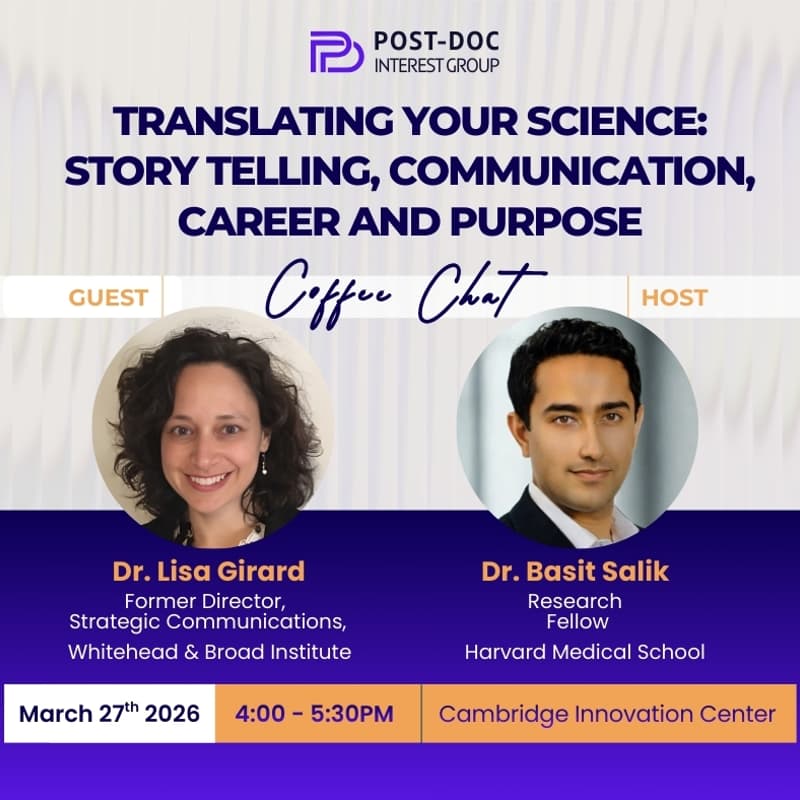

Translating your science: Story telling, Communication, Career and Purpose
Your research may not have the impact it should if you aren’t able to tell its story effectively. Dr. Lisa Girard has spent nearly two decades at the intersection of science and strategy. She learned something most of us miss: the impact of your science and the clarity of your communication go hand in hand.
Join us for a conversation about how to tell your scientific story to a range of important audiences. Whether you are giving a job talk in academia or industry, pitching to investors, talking to a reporter, or answering your family's questions about “just exactly what it is you do” at the next holiday dinner, learning to present your work accessibly is essential.
Not only is it critical for your career, to get the job or get the funding, it is essential more broadly that scientists learn to talk to the world outside of their laboratory. Science is under attack like never before. The media is rife with misinformation and disinformation and scientists must be able to speak clearly to the public to help them be savvy consumers of information and make decisions grounded in science, not fallacy. Lisa will talk about how to tell your story in ways that open doors. Real translation that preserves the science while making its impact clear.
About Guest
Lisa Girard is the former Director of Strategic Communications at Whitehead Institute (9 years). A former bench scientist, Girard has nearly two decades of writing, communications leadership, and content-development experience including previous roles at California Institute of Technology (CalTech), the Harvard Stem Cell Institute (HSCI), and Broad Institute of MIT and Harvard as their Director of Scientific Communication. Earlier in her career, she was HSCI’s Associate Director of Strategic Alliances, as well as creator and editor of HSCI’s StemBook and CalTech’s WormBook. She earned her undergraduate degree from University of California, San Diego, a PhD from University of California, Berkeley, and completed postdoctoral work at the California Institute of Technology. She lives in the Greater Boston area with her family, including their dog, Stanley. Lisa recently founded Acropetal Science Strategy and Communications Consulting, with the goal of working with scientists, startups, and organizations to help tell their story and articulate their impact through content, pitch, and strategy development.
About Host
Dr. Basit Salik is a cancer immunologist at Harvard Medical School and Brigham and Women's Hospital with a strong academic track record in leukemia biology, immune regulation and therapeutic target discovery. In his current role as a postdoctoral researcher in the Van Galen lab, he investigates hematopoietic stem cell biology, leukemia prevention and mechanisms of leukemic transformation with focus on translational applications. His research has identified therapeutic targets for aggressive leukemia and has been published in top-tier oncology journals. Basit has provided strategic advisory support to early-stage biotech ventures in oncology and immunotherapy. Basit completed a Mini-MBA in Biotech Commercialization and earned his PhD and BBiomedSc with First Class Honours from The University of Queensland, Australia. He is an EIR (Expert-in-Residence) at the Technology Innovation Studio (Cambridge Innovation Center), Senior Vice President of Harvard GSAS Consulting, and engages with ventures through the Harvard Biotech Incubator bringing a perspective that bridges rigorous science with strategic insight.
About TINS
Technology Innovation Studio (TINS) is an innovation studio that uses systems dynamics models to accelerate innovation. TINS carries out interest groups based programming and builds communities through curated events and complements this with expert-led concierge and consulting services. TINS has interests in venture creation and in doing syndicated investments in early-stage deep-tech companies.