
Open-Endedness: Can AI Keep Discovering?
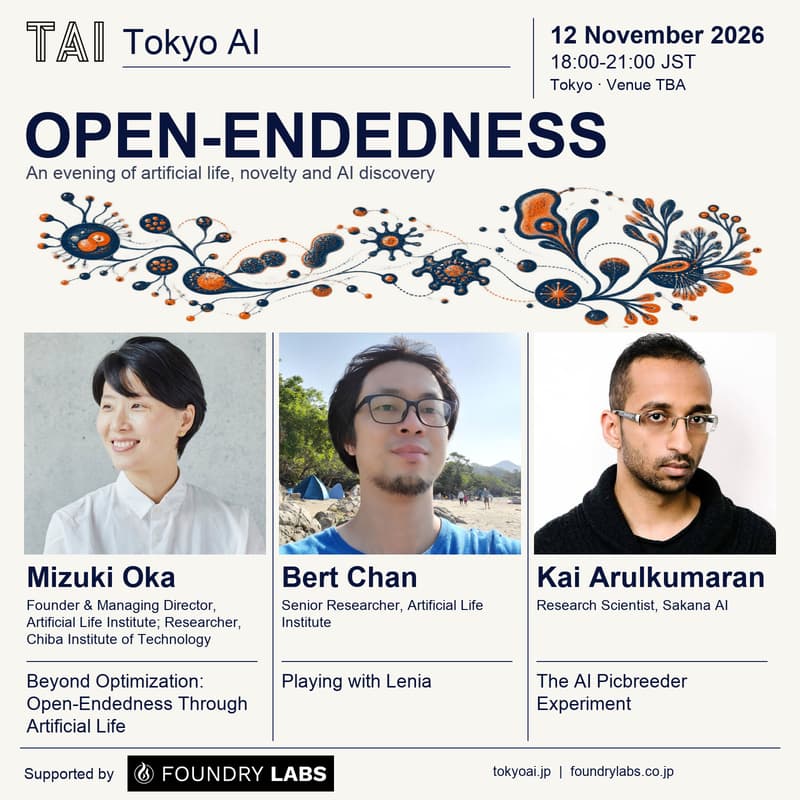
How can an AI system keep producing new ideas, behaviours, or solutions instead of converging on what it already knows? Join Tokyo AI for an in-person research evening on open-endedness. Three talks will explore the nature of open-endedness and work in this area, with useful examples and lessons for people interested in AI, from newcomers to established researchers.
The event will be held in English. Each talk is a 25-minute presentation followed by five minutes of moderated Q&A.
When: Thursday, November 12, 2026, 18:00-21:00 JST
Where: Tokyo, venue to be announced
Agenda
18:00 - Doors open
18:25-18:30 - Welcome
18:30-19:00 - Talk 1: Beyond Optimization: Open-Endedness Through Artificial Life (Mizuki Oka)
19:00-19:30 - Talk 2: Playing with Lenia (Bert Chan)
19:30-20:00 - Talk 3: The AI Picbreeder Experiment (Kai Arulkumaran)
20:00-21:00 - Networking
21:00 - Doors close
Talk 1: Beyond Optimization: Open-Endedness Through Artificial Life
Abstract: What would it take for AI to keep discovering new possibilities, rather than only getting better at tasks we already know how to specify? This talk explores open-endedness through the lens of artificial life, focusing on how agents, environments, and their interactions can create conditions for continuing novelty. Drawing on my research and ongoing work at the Artificial Life Institute, I will connect studies of novelty in online systems with approaches that generate and evolve environments for learning agents. I will discuss what these examples reveal, what they do not yet demonstrate, and how we might evaluate progress toward open-ended systems. The aim is to offer practical questions for researchers and engineers building AI that can explore, adapt, and expand its possibilities.
Bio: Mizuki Oka is the Founder and Managing Director of the Artificial Life Institute and a researcher at Chiba Institute of Technology. Her research explores artificial life and open-endedness, asking how systems can continue to generate novelty through interactions among agents and their environments. Her work spans the study of novelty in online systems and the use of large language models to generate and evolve environments for learning agents. She is interested in connecting these perspectives to understand how artificial systems can discover new possibilities and how such processes can be studied and evaluated.
Talk 2: Playing with Lenia
Abstract: Playing is essential for open-ended learning and exploration in human and other intelligent species. When we create new computation models and discover emergent phenomena, what if we do not only analyze and optimize, but also actively play and interact? This talk explores Lenia, a continuous version of Conway’s Game of Life, through the lens of play. I will share my experience of messing around with Lenia’s beautiful dynamic patterns, as well as expanding into variants like Flow Lenia by playing with the model itself. We will see how machines can use algorithms like quality diversity and intrinsic evolution to play inside vast morphogenic spaces. Finally, I will present our latest efforts to control these self-organizing patterns via reinforcement learning, curriculum learning, and cognitive masking, ultimately transforming continuous artificial life systems into playable “distributed games”.
Bio: Bert Chan is a Senior Researcher at the Artificial Life Institute, previously a Research Engineer at Google DeepMind and Google Brain Tokyo, and a Visiting Scholar at the Institute for Advanced Study in Princeton. He is best known for creating Lenia, a continuous cellular automata system generalizing Conway's Game of Life. His research focuses on open-ended evolution, complex systems, cognitive science, and the intersection of artificial life and artificial intelligence.
Talk 3: The AI Picbreeder Experiment
Abstract: We are in the midst of large-scale industrial and academic efforts to automate the processes of scientific, technological and creative production through AI-driven assistants. Historically, a fundamental property of these processes in their human form has been their open-endedness: their capacity for generating a seemingly endless supply of novel and meaningful new forms. Do artificial agents have any capacity for such fruitful unguided discovery? To answer this question, we turn to Picbreeder, the canonical exemplar of human-driven open-ended search, in which users collaboratively generated a diverse library of images through interactive evolution of small neural networks. We replicate Picbreeder, replacing human users with frontier Vision Language Models (VLMs). We observe clear qualitative differences between the output of our system and the historical human baseline, and attempt to characterize them using metrics of phylogenetic complexity and visual and semantic salience and novelty. In an effort to identify some of the causal factors contributing these differences, we study the addition of exploratory noise to the agents' selection process, of behavioral diversity between agents, and of narrative momentum in the form of memory of past actions.
Bio: Kai Arulkumaran is a Research Scientist at Sakana AI, working on biologically-inspired intelligence as part of the Frontier Intelligence Group. He completed his PhD in Bioengineering at Imperial College London, had work experience at DeepMind, FAIR, Microsoft Research, Twitter Cortex, and NNAISENSE, and most recently was a Research Team Lead at Araya. His research areas are deep learning, reinforcement learning, evolutionary computation, and computational neuroscience.
Organizers
Organized by Tokyo AI (TAI), with support from Foundry Labs K.K..
Privacy Policy
We will use your registration details to manage the event. If you opt in, we may also send updates about future events. Learn more in the Tokyo AI Privacy Policy.