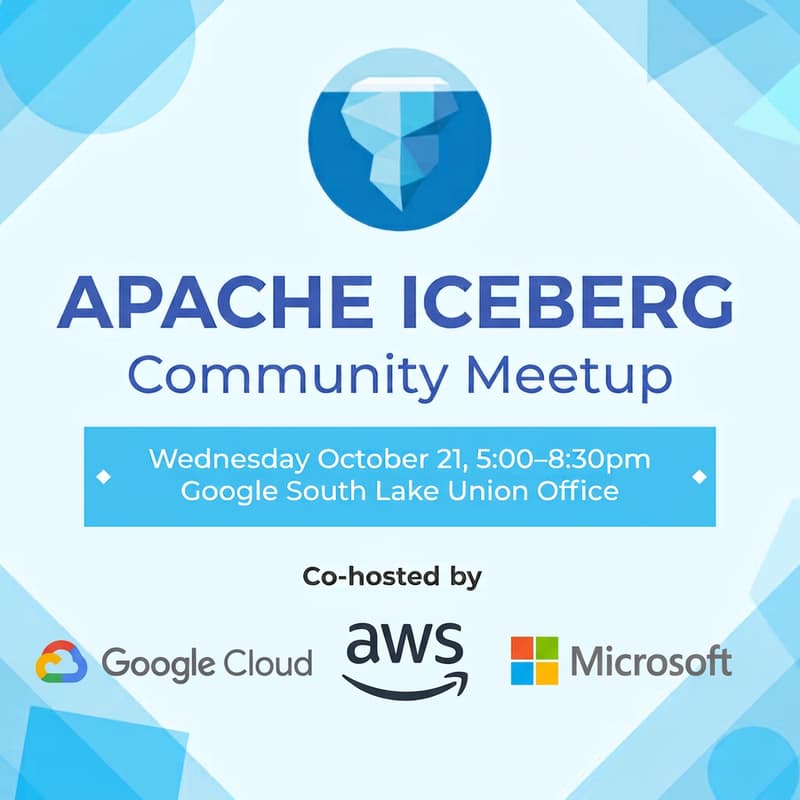
Seattle Apache Iceberg™ Community Meetup
Seattle Apache Iceberg™ Community Meetup! 🧊❄️
Join us on October 21st (Wednesday) from 5:00-8:30 PM at the Google South Lake Union Office.
Parking is available across the street and in the general South Lake Union Area.
⚠️ 🚨
REGISTRATION IS CLOSED
Due to site policy, we cannot accommodate walk-ins. Please stay tuned for future events, we will have meetups more often :)
For a smooth check-in, please have a valid, government-issued ID ready to show at the front desk.
🚨⚠️
Parking and Arrival Instructions:
The Google parking lots are unfortunately not available. There's an off-site parking lot across Valley Street, but parking is limited directly around the office.
The entrance to the Google office is off of Boren Ave N (next door to the Mera SLU apartment building). Look for the Google logo. Do **not** try to enter the Google building by the Tapster bar.
Somebody will be there to let you into the lobby.
Connect with fellow enthusiasts, share insights, and dive into the latest developments in the Apache Iceberg™ ecosystem! Whether you're a seasoned pro or new to Apache Iceberg, this meetup is the perfect place to exchange ideas and spark innovation.
Agenda
5:00p - 6:00p: Doors Open & Networking 💃
6:00p - 7:30p: Welcome Remarks & Presentations!
7:30p - 8:30p: More Networking 🕺
The event will focus on innovations in Apache Iceberg (https://iceberg.apache.org/)
We will discuss topics around Open-Source Data Analytics, Open Table Formats (OTF), software concepts like Transactional Data Lakes or Lakehouse, advancements in AI/ML including generative AI, and many more topics of mutual interest that leverage Apache Iceberg.
During the sessions, we will provide you tips to get involved within the community, you will learn more about how the community is collaborating to grow the technology, and software/solutions that ease problem solving and improve user experiences.
Presentations
We'll have three talks to present!
Sorting, Partitioning, Clustering oh my!
Kurtis Wright - Amazon Web Services
A technical deep dive into Iceberg's data layout options.
Iceberg provides two primary ways of reducing network calls to object store and increase query performance. First is through partitioning data across different sections of a table. The second is by sorting data inside a data file as well as across data files. We will explore how these two features have been implemented in Iceberg's reference Rust/Java implementations. Then take a preview of Clustering through the lens of Prior Art. Clustering is an additional way of laying out data and was recently proposed as part of Secondary Indexes.
Operating 300K+ Iceberg-based lakehouses at petabytes scale
Sreeram Garlapati - Salesforce
What does it take to run 100K+ Apache Iceberg lakehouses in production at petabyte scale? This talk shares lessons learned from Salesforce Data 360, covering various aspects across catalog and metadata management at extreme table counts, compaction and snapshot-expiry strategies, concurrent commit handling etc. We'll explore patterns that push Iceberg beyond batch analytics: incremental data processing, secondary indexes for low-latency lookups, distributed NVMe caching for hot data, zero-copy sharing with external engines, and bringing your own data lake without moving data. Attendees will leave with practical patterns for architecting and operating Iceberg reliably at scale.
Grounding Agents in Truth
Sathish Rajendiran & Hari Nagarajan - Western Digital
AI agents can be extremely confident—and still be completely wrong. Trust begins with the data foundation beneath them.
This session explores how an enterprise warehouse can evolve into an open, AI-ready lakehouse on AWS, using Apache Iceberg across Bronze, Silver, and Gold. We'll share architectural patterns for CDC ingestion, standardized modeling, governed data products, and open access across multiple consuming engines.
We'll explain why Iceberg's ACID transactions, schema evolution, stable field IDs, and snapshots matter for consistent, reproducible analytics and AI. We'll also show how a semantic layer and knowledge graph add the business meaning and relationships that agents need to reason over enterprise data—and how snapshot-based verification helps ground their answers.