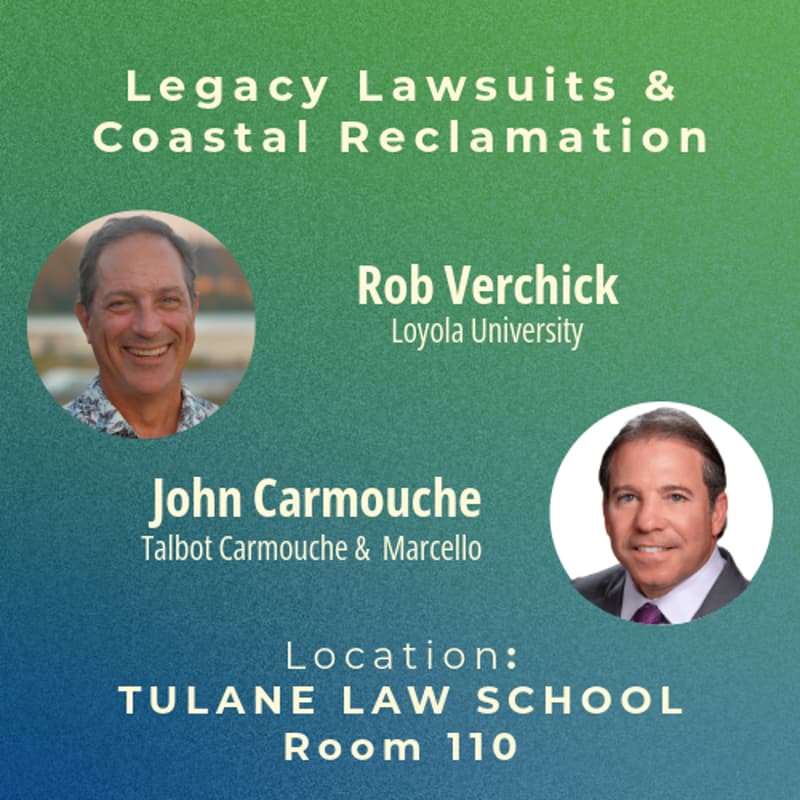

Legacy Lawsuits & Coastal Reclamation
PANEL DESCRIPTION
Coastal communities are running out of land, time, and funding. As erosion accelerates and sea levels rise, legacy lawsuits have become one of the most talked about and debated tools for addressing decades of environmental damage along the coast. However, where are these cases actually headed, and what do they mean for the future of coastal reclamation? This panel brings together experienced practitioners for a candid discussion about the current state of legacy litigation, what is working, what is not, and what lawyers should be watching next. Panelists will cover recent legal developments, practical hurdles, and the broader effects these lawsuits may have on industry, government, and coastal restoration efforts.
Moderated by Camilla Stapleton.
JOHN CARMOUCHE, TALBOT CARMOUCHE & MARCELLO
John H. Carmouche is the senior partner with the law firm of Talbot, Carmouche & Marcello. He has collected over 20 multi-million settlements on behalf of victims of corporate negligence. As the lead trial attorney, his fight against global oil companies to restore the coast of Louisiana has put Talbot, Carmouche & Marcello as one of the top plaintiffs’ law firms in Louisiana.
John Carmouche is a native of Napoleonville, Louisiana, a husband, and a father of four children.
John Carmouche has 29 years of civil trial experience and specializes in fighting corporations in discovery and trial. He recently obtained a $52,000,000 jury verdict against Shell Oil Company for polluting the soil and drinking water of property located in Cameron Parish.
John handled the “sinkhole” litigation, an environmental disaster, in Assumption Parish as the lead litigator against some of the world’s largest insurance companies and corporations. He settled a lawsuit for over $90 million and negotiated many other multi-million dollar settlements.
John’s 29 years of diverse legal experience enable him to be a strong advocate for clients. He has carried that over to be a fighter for the people. He was Chairman of the Board of the Donaldsonville Marine Institute, which helps kids in trouble get educated so they can have a different life. John also served on the board of Prevent Child Abuse. Lastly, he is on the board of Hunters for the Hungry to help the poor in Louisiana.
ROB VERCHICK, LOYOLA UNIVERSITY
Rob Verchick is one of the nation's leading scholars in disaster and climate change law and a former EPA official in the Obama administration. He holds the Gauthier-St. Martin Eminent Scholar Chair in Environmental Law and directs Loyola's Center on Environment, Land, and Law. He was a fellow at Harvard University's Radcliffe Institute of Advanced Study in 2023-2024.
Verchick has written more than 60 articles and four books, including the best-selling The Octopus in the Parking Garage: A Call for Climate Resilience (2023). His work has appeared in many venues, including the California Law Review, Southern California Law Review, and the environmental law reviews at Harvard, Stanford University, and University of California, Berkeley.
He has taught as visiting professor at Yale University, Peking University in China, and Aarhus University in Denmark. He has received several teaching awards, including at Loyola, Tulane, and Harvard.
Verchick comments frequently on radio shows such as NPR's All Things Considered and has written commentary for The Washington Post, the Los Angeles Times, Slate, and other publications.Verchick is also the author of the Substack newsletter, “Blue Tomorrow,” a clear-eyed take on climate resilience, oceans, and coasts.
In 2009 and 2010, Professor Verchick served in the Obama administration as Deputy Associate Administrator for Policy at the U.S. Environmental Protection Agency. In that role, he helped develop climate change adaptation policy for the EPA and served on President Obama's Interagency Climate Change Adaptation Task Force.
Verchick — who grew up in the sun-scorched Las Vegas desert and survived Hurricane Katrina as a resident of New Orleans — has spent a career studying environmental resilience across the country. Committed to "place-based" analysis, he has paddled swamps, scaled glaciers, and dived among endangered corals all to understand what is at stake and how we can protect the things we need and love.