

AISHK Reading Group Social Dinner: Machine Learning and Human Values
Last month, we examined AI–human alignment from one angle: why it's so difficult to get AIs to do what humans want. This month, we turn to the other side of the equation—what about the human in the alignment problem?
This month's reading:
Brian Christian’s The Most Human Human: What Talking to Computers Teaches Us About What It Means to Be Alive. (Chapter 1) https://www.penguinrandomhouse.ca/books/201876/the-most-human-human-by-brian-christian/9780307476708/excerpt
Just as there are now thousands of subtly different AI models with varying levels of openness and safety controls, "humanity" comprises at least 8 billion living people, each possessing different levels of any attribute you could name—even those we consider "core" human traits (emotional attunement, ambition, precision, cognitive flexibility, identity, and so on). So just as some people treat others with kindness and empathy (justified or not), others treat them with coldness, indifference, or outright cruelty (justified or not).
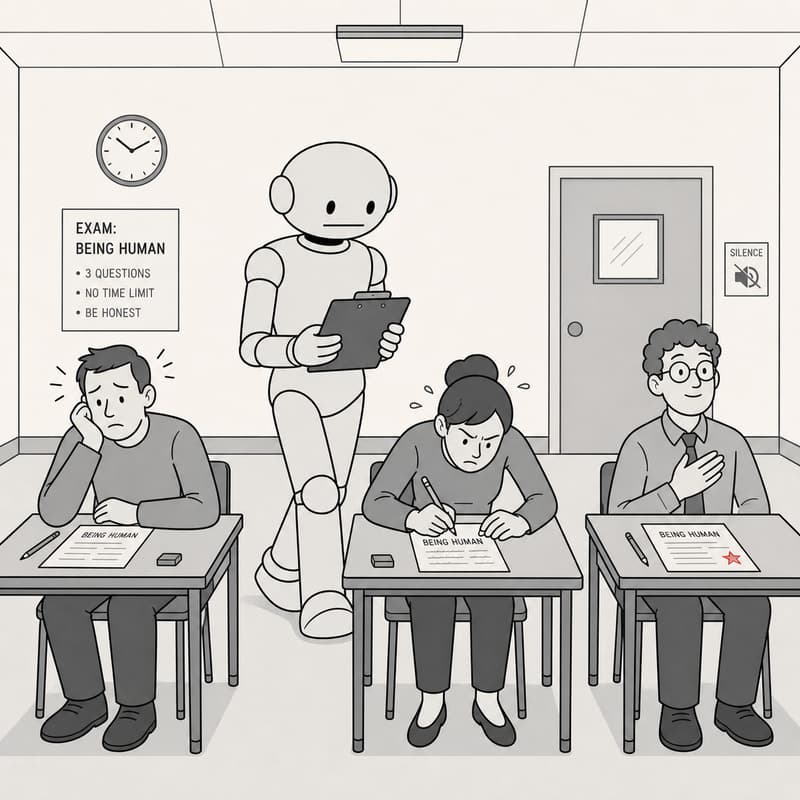
In an age of models that convincingly simulate empathy, sympathy, and other soft "human" traits, we ask: what makes humans human enough? This month's reading is the first chapter of Brian Christian's The Most Human Human: What Talking to Computers Teaches Us About What It Means to Be Alive. Written in 2011, before modern AI reached today's sophistication, the book nonetheless poses and grounds a striking question—what does it mean to face competition in an arena we never expected to defend: being human?
Venue: Museum Café 8
Guests are requested to make at least 1 purchase at the cafe.
Discussion questions:
1. No human is kind, understanding, creative, or encouraging all the time. Have you ever encountered someone acting frustratingly like a traditional "machine"—showing little empathy in a difficult situation, perhaps by rigidly following "the stated rules"? What might an AI have said or done instead? Would replacing that person with an AI have made any difference, for better or worse?
2. Asked why it's so hard to design a bear-proof garbage bin, a park ranger once replied: "There is considerable overlap between the intelligence of the smartest bears and the dumbest tourists." In the same spirit, what minimum bar could we set on some moral, emotional, or other human attribute such that the least human human still clears it, yet the most human AI does not? And what would it mean for us if no such clean line could be drawn on any reasonable principle?
3. Humans have never before been credibly challenged on being "human enough." A fear response can take the shape of fight, flight, freeze, or fawn. Which of these reactions to AI have you observed in others? Which have you noticed in yourself?
4. Fear can be a productive motivator. What might AI push us humans to strive to improve?
5. To be human is to be flawed. Computers were traditionally considered "flawless" at their tasks—and therefore inhuman (think of a calculator and complex arithmetic). What does it mean now that we have AIs that are also flawed in many ways?
Bonus questions:
1. Not everyone likes other people. Some prefer minimal interaction, especially when surrounded by disagreeable company, and many find relief in talking to a stranger who offers only minimal responses—or to a computer—precisely because neither will pass moral judgment. (For sympathetic portraits of this mindset, see Shoji Morimoto's Rental Person Who Does Nothing; for unsympathetic ones, see r/misanthropy.) What might this fact about humanity imply for the alignment problem?
2. Does disliking other humans make one "less" human?
3. Could a person dislike humanity so much that they become less human than an AI?
Note: For a sense of chatbot quality in 2011—the kind of "AI" being competed against in the Loebner Prize—visit A.L.I.C.Ebot (https://www.pandorabots.com/pandora/talk?botid=b8d616e35e36e881). Those new to the field may notice how different "AI" was then, and why "AI safety" held little interest for the general public.
Who should come?
No technical background required. The Most Human Human is written for a general audience, blending history, reporting, and accessible explanations of key ideas in machine learning and AI ethics. Whether you work in policy, governance, research, law, business, or you’re simply trying to understand how AI systems are already shaping human decisions, you’re welcome.
Come ready to scrutinize real systems, not just abstract thought experiments, and to ask how the lessons from Christian’s case studies should inform alignment and safety work here in Hong Kong and beyond.