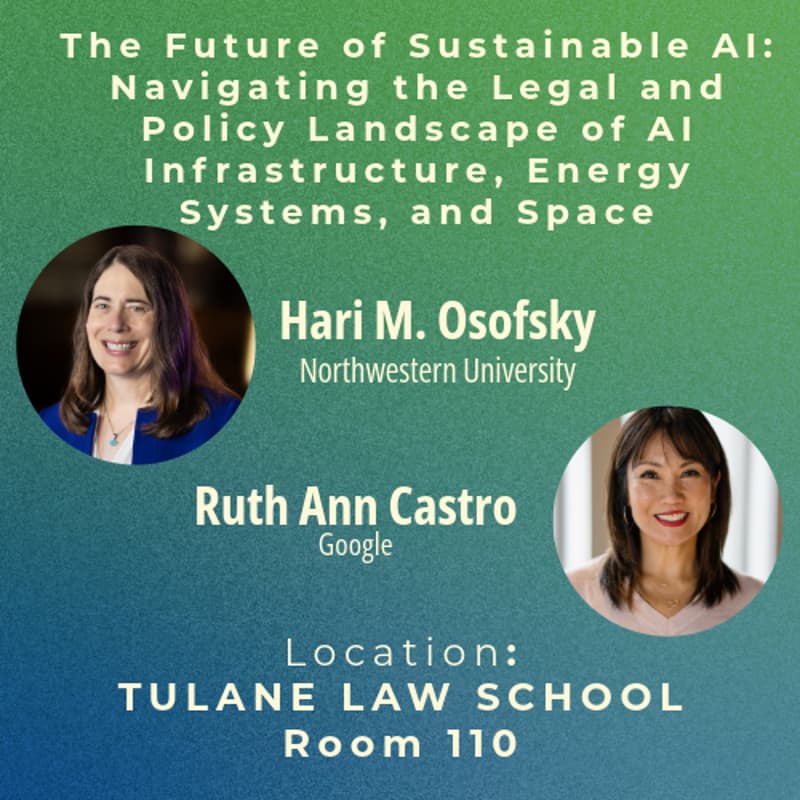

The Future of Sustainable AI: Navigating the Legal and Policy Landscape of AI Infrastructure, Energy Systems, and Space
PANEL DESCRIPTION
The rapid expansion of artificial intelligence is reshaping global energy demand and infrastructure development, creating significant legal and regulatory challenges. This panel will explore how the accelerating demand for computing power intersects with climate goals, energy regulation, and environmental law.
Panelists will consider how law and policy are guiding efforts to scale energy and computing infrastructure in a sustainable manner. The discussion will focus on regulatory approaches affecting renewable energy deployment and energy efficiency standards; permitting, siting, and operational compliance for energy infrastructure; the integration of emerging technologies into energy systems; and the legal implications of novel solutions such as space-based energy. Attendees will gain insight into how legal and policy frameworks can support the transition to more sustainable and resilient energy systems in an increasingly data-driven world.
Moderated by Isabell Dodge.
HARI OSOFSKY, NORTHWESTERN UNIVERSITY
Hari M. Osofsky is the Myra and James Bradwell Professor of Law at Northwestern Pritzker School of Law and a Professor of Environmental Policy and Culture (courtesy) at the Weinberg College of Arts and Sciences. She is the inaugural Director of the Northwestern University Energy Innovation Lab, which brings together the expertise of the scientists and engineers who reimagine technology with that of bipartisan leaders and scholars across disciplines to advance needed energy innovation. At this critical moment of disruption in the energy industry, the Lab’s initial projects aim to make progress on how rapidly evolving technology, regulation, and investment can most effectively optimize energy use in data centers and shape the use of AI throughout the energy system – including with respect to private-sector satellite data and potential space energy systems – to promote new efficiencies and breakthroughs. She also serves as the inaugural Director of the Rule of Law Global Academic Partnership, a collaboration of over 150 law schools from six continents that is advancing nonpartisan civic education, research, teaching, and programming. Its initial projects focus on judicial independence and separation of powers, the role of lawyers and legal representation, the role of universities and academic freedom, and due process.
RUTH ANN CASTRO, GOOGLE
Ruth Ann Castro is Senior Counsel for Environmental Health Safety (EHS) & Sustainability at Google, where she provides strategic legal support for the company’s global infrastructure, operations, and sustainability initiatives. With over 25 years of experience, Ruth Ann provides legal guidance at the intersection of computational demand and grid resiliency. Ruth Ann serves as a key legal advisor on Google’s data center development, hardware lifecycle management, and facility environments. Her work includes establishing global compliance frameworks, managing high-risk operational incidents, and counseling on environmental risk allocation in complex real estate transactions. She also provides legal oversight to ensure sustainability disclosures are accurate, defensible against regulatory challenges, and compliant with evolving global standards. Prior to joining Google, Ruth Ann spent a decade in private practice focusing on representing industry leaders in environmental complex compliance and litigation matters. Ruth Ann received a Bachelor of Arts from University of California, Berkeley, and her Juris Doctorate, cum laude, from Tulane Law School.