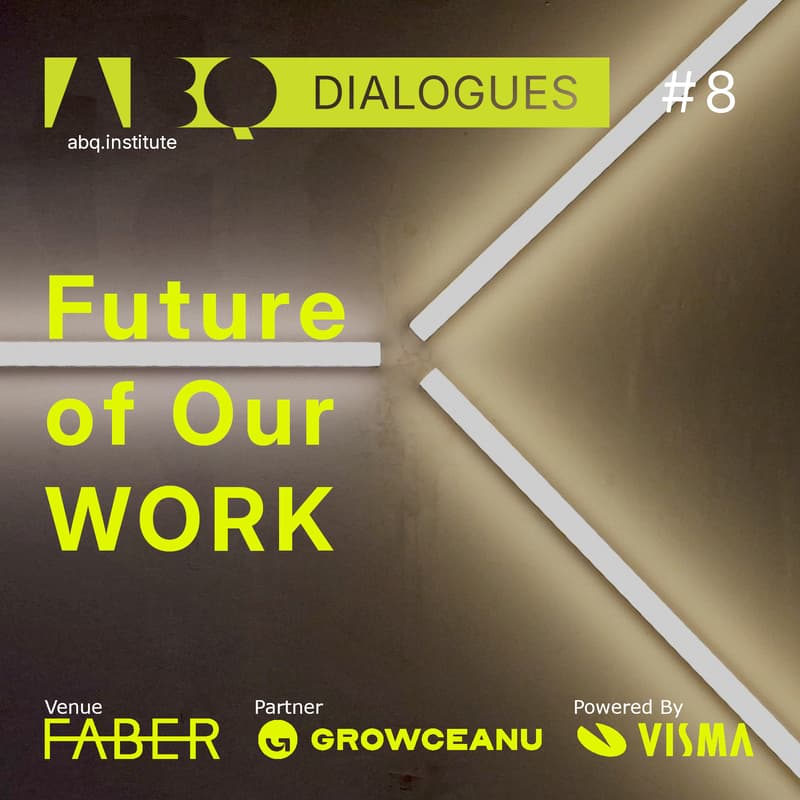

ABQ.Dialogues #8 Future of our Work
ABQ.Dialogues #8/10 Future of our Work
When AI stops being a tool and becomes part of the workforce
For decades, work has been organized around people, roles, departments, processes, tools, and institutions.
Then software entered every workflow.
Then automation started replacing repetitive tasks.
Then AI became a copilot.
Now we are moving toward something more disruptive: AI agents that can act cvasi-autonomously inside companies.
They do not just generate text. They can search databases, trigger workflows, read procedures, update records, answer customers, prepare reports, support decisions, monitor exceptions, and coordinate tasks across digital systems.
The next phase of work may not be defined only by humans using AI, but by humans working with AI agents, automated systems, and eventually embodied robots operating inside real organizations.
This changes the question.
Not only:
What jobs will AI replace?
But also:
Who manages the relationship between humans, AI agents, procedures, data, responsibility, and trust?
Speakers
Adelina Rosca, Founder & CEO of Rosman Talent Solutions SRL and Board Member and President-Elect of the IESF - International Executive Search Federation (IESF).
Andreea Adămuţ, People Director at Visma Romania
Razvan Ogircin, Managing Partner at AIMS International Romania
Elena Ciocan, Vice President of Mobile Infrastructure Radio Networks R&D at Nokia
Diana Nastase, HR Director at Flex, leading people operations for the Timișoara site and across European Design Centers in Germany, Hungary, hashtag#Italy, Sweden, and Romania
David Pongor, Student TU/e (surprise guest)
At ABQ.Dialogues #8, we open a conversation about the future of work when intelligence becomes operational, automation becomes more autonomous, and organizations begin to include non-human actors inside their daily processes.
This is not a conversation about hype. It is not a conversation about replacing people. It is a conversation about agency, governance, meaning, competence, responsibility, and the kind of work culture we want to build before the systems become too embedded to question.
Why now: work is becoming partially non-human
The AI transition is no longer limited to productivity tools, chatbots, or isolated experiments.
Inside companies, a new layer is emerging:
o AI agents connected to internal knowledge bases.
o Automation flows connected to business procedures.
o Decision-support systems trained on organizational data.
o Digital workers that can execute tasks across tools.
o Synthetic colleagues that can answer, summarize, classify, recommend, escalate, and increasingly act.
Soon, the question “Do we use AI?” may become outdated.
The real questions will be:
o Who supervises AI agents?
o Who defines their permissions?
o Who audits their decisions?
o Who trains employees to work with them?
o Who protects human judgment when systems become faster, cheaper, and more confident than people?
o Who is accountable when an automated system makes the wrong call?
o Who decides which parts of work must remain human?
Work is not disappearing.
But it is being reorganized.
And if organizations do not consciously design this transition, it will be designed by vendors, efficiency pressures, procurement decisions, and default settings.
The big question
If AI agents become part of the workforce, does Human Resources remain only about humans?
Or do organizations need a new discipline:
Human + AI Resources?
Maybe the future HR department will not only onboard employees, but also help onboard AI systems.
Maybe people operations will need to understand not only motivation, culture, learning, and leadership, but also human–AI collaboration, agent governance, digital responsibility, and organizational trust.
Maybe the next frontier of work is not simply automation.
Maybe it is coordination between humans and non-human workers.
What we’ll explore
At ABQ.Dialogues #8, we will examine how work changes when AI moves from assistance to participation.
We will explore:
AI agents inside organizations — what happens when AI systems can act across tools, databases, documents, tickets, CRMs, ERPs, and internal procedures.
The new operating model of work — how roles, teams, workflows, and accountability change when part of the work is done by autonomous or semi-autonomous systems.
HR in the age of AI workers — whether HR should evolve toward Human + AI Resources, and what competencies this would require.
Onboarding AI agents — who defines their purpose, access rights, limits, escalation rules, and performance indicators.
Human judgment under pressure — how to preserve responsibility, expertise, and critical thinking when AI systems produce answers faster than organizations can evaluate them.
Trust, control, and accountability — who is responsible when an AI agent makes a mistake, discriminates, leaks data, creates confusion, or quietly optimizes for the wrong goal.
The emotional and cultural impact — how employees experience AI colleagues: as help, threat, surveillance, competition, or augmentation.
Leadership and governance — what CEOs, HR leaders, CTOs, legal teams, and operations leaders need to decide before automation becomes invisible infrastructure.
The humanoid question — what changes when robots are no longer science fiction, but potential participants in logistics, care, hospitality, manufacturing, retail, security, and office environments.
The future of meaning at work — what remains valuable about human contribution when machines can perform more tasks, faster and cheaper.
Why this matters for Timișoara
Timișoara has a strong technology, automotive, engineering, manufacturing, services, education, and business operations base.
This means the region will not only watch the AI transition from the outside.
It will feel it directly.
o In software teams.
o In HR departments.
o In shared service centers.
o In factories.
o In customer support.
o In education.
o In product development.
o In management.
o In entrepreneurship.
The region has enough technical competence to build with AI. But the harder challenge is not only technical.
The harder challenge is organizational and cultural:
o Can companies redesign work without reducing people to supervisors of machines?
o Can HR become a strategic function in AI transformation, not only a support function after decisions are already made?
o Can local organizations create responsible models of human–AI collaboration before external platforms impose their own logic?
o Can Timișoara become a place where the future of work is not just adopted, but shaped?
Who should attend
This dialogue is for people who are already feeling that work is changing faster than organizational language can describe it:
HR leaders, people operations teams, recruiters, L&D professionals, organizational development specialists
CEOs, founders, executives, and team leaders redesigning how their companies work
CTOs, product leaders, automation teams, AI builders, and digital transformation managers
Legal, compliance, data protection, and governance professionals
Educators preparing students for an AI-mediated labor market
Employees and professionals wondering how to stay relevant, capable, and human in the next phase of work
Researchers, policymakers, and civic thinkers interested in the social consequences of intelligent automation
Anyone asking: what happens to work when some of our colleagues are no longer human?
What’s needed?
To respond well to the future of work, organizations may need:
a clearer language for distinguishing tools, copilots, agents, automations, and digital workers
AI governance that is not only technical, but also organizational and human-centered
HR involvement in AI adoption from the beginning, not after implementation
new onboarding models for AI agents: purpose, limits, permissions, escalation paths, audit trails
new training models for employees working with AI systems
protection against deskilling, over-dependence, and blind trust in machine outputs
clear accountability structures when human and AI actions become entangled
new leadership practices for hybrid human–AI teams
a public conversation about which parts of work should be automated, augmented, protected, or reimagined
a local ecosystem capable of turning AI adoption into capability, not dependency
About ABQ.Dialogues
The ABQ Dialogues are a human-centric conversation series where diverse voices explore how emerging technologies reshape the fundamental aspects of our lived experience and collective future.
The Dialogues follow ABQ’s main pillars: education, entrepreneurship, and societal impact by bringing together diverse professional voices in a progressive learning journey. We aim to highlight technology’s impact, creating deeper understanding of how AI, Blockchain, Bio-engineering, and Quantum Computing are reshaping our world.
The Dialogues prioritize how these innovations impact the most fundamental aspects of human experience. From healthcare systems and longevity to artistic expression, psychological well-being, social connections, and community faith structures, we explore both current changes and future implications for how we live, work, create, and find meaning. The Dialogues prioritize people over technology, ensuring that human values and needs guide our collective understanding of technological transformation.
Events Format
We propose a monthly conversation series that creates space for dialogue between experts and the public. Each session combines expert presentations with interactive questions and answers, open discussions, and networking opportunities that promote community connections. We believe this format encourages inclusive participation, amplifying voices from multiple sectors and backgrounds while building knowledge progressively across the series.
Our goal is to generate practical insights that serve individuals navigating technological change, community leaders shaping local responses, and organizations implementing new technologies.
After each dialogue, we publish findings for public access, followed by a written article and audio version on our Substack, with human review and refinement from contributors and panelists.
ABQ.Dialogues are a 10-part monthly event series, with 3-hour sessions divided between expert conversations, public interventions, and networking.
If you want, I can now make this more provocative and punchier, in a style that is better optimized for registrations.
Made possible by our partners:
Visma Romania – Main sponsor, leading business software development company
Growceanu – Platform for accessing high-growth investments.
Faber – Host venue, independent cultural center and community hub
The ABQ.Institute Team