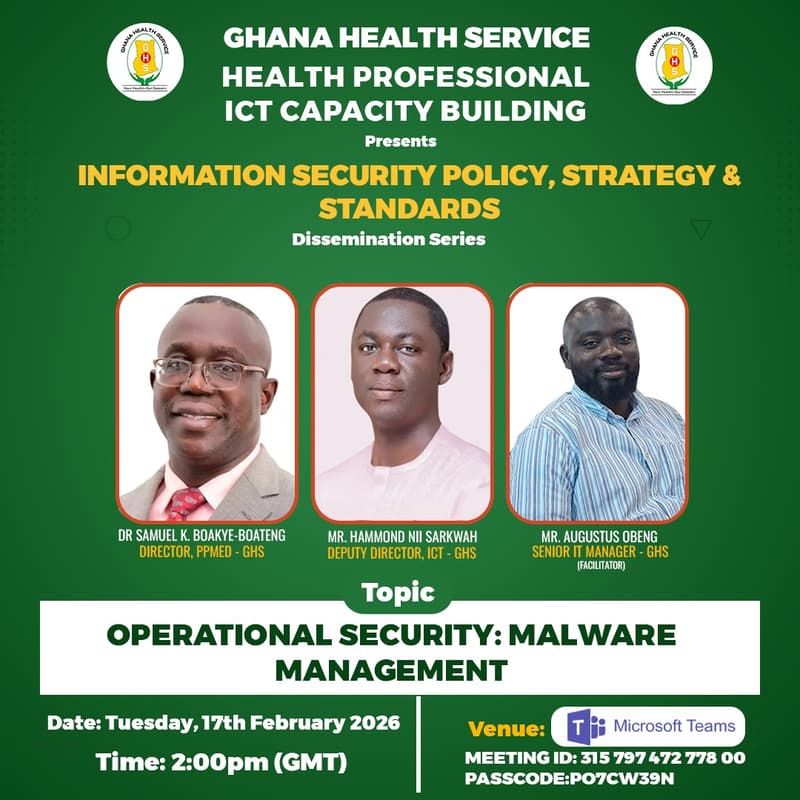
Operational Security: Malware Management
Information Security plays a critical role in the health sector due to the volume and sensitivity of data routinely handled in the delivery of healthcare services. The Health Sector has been designated as a Critical Information Infrastructure (CII) by the Cyber Security Authority (CSA), as any disruption to its systems, networks, processes, or information assets could have a devastating impact on national security and the social and economic well-being of the population.
As a public health institution, the Ghana Health Service (GHS) is responsible for safeguarding Protected Health Information (PHI) and ensuring the confidentiality, integrity, and availability of its digital systems and data. In response to this responsibility, GHS has developed and is implementing an Information Security Policy, Strategy, and Standards to guide, direct, and protect its ICT ecosystem.
These policies apply to all digital assets of the Service and are binding on all staff and third-party service providers. They are designed to proactively identify and mitigate risks that could compromise system availability, data integrity, confidentiality, service delivery, and the Service's reputation.
Purpose of the Webinar
This webinar forms part of the ongoing dissemination of the GHS Information Security Policies and focuses specifically on Operational Security (Section 4.7), with emphasis on Malware Management, Detection, and Prevention.
Webinar Objective
The objective of this webinar is to strengthen staff awareness and operational capacity to implement the Ghana Health Service Operational Security Policy by promoting compliance, continuous monitoring, and effective prevention of technical vulnerabilities, while ensuring the security and privacy of computer systems and networks in accordance with applicable data protection and cybersecurity regulations.
Presentation Highlights
Overview of Operational Security controls within the GHS Information Security Policy
Understanding malware threats and their impact on health sector systems
GHS requirements for anti-malware software, firewalls, and intrusion prevention systems (IPS)
Malware detection, isolation, and incident escalation procedures
Controls on unauthorised software, devices, and UPnP access
Role of logging, monitoring, audits, and vulnerability management in securing systems
Staff roles and responsibilities in ensuring compliance with data protection and cybersecurity regulations
Live Demonstration
A live practical demonstration will be conducted
For more inquiries, call Gideon +233 55 432 8935 or Benjamin +233 24 124 6642