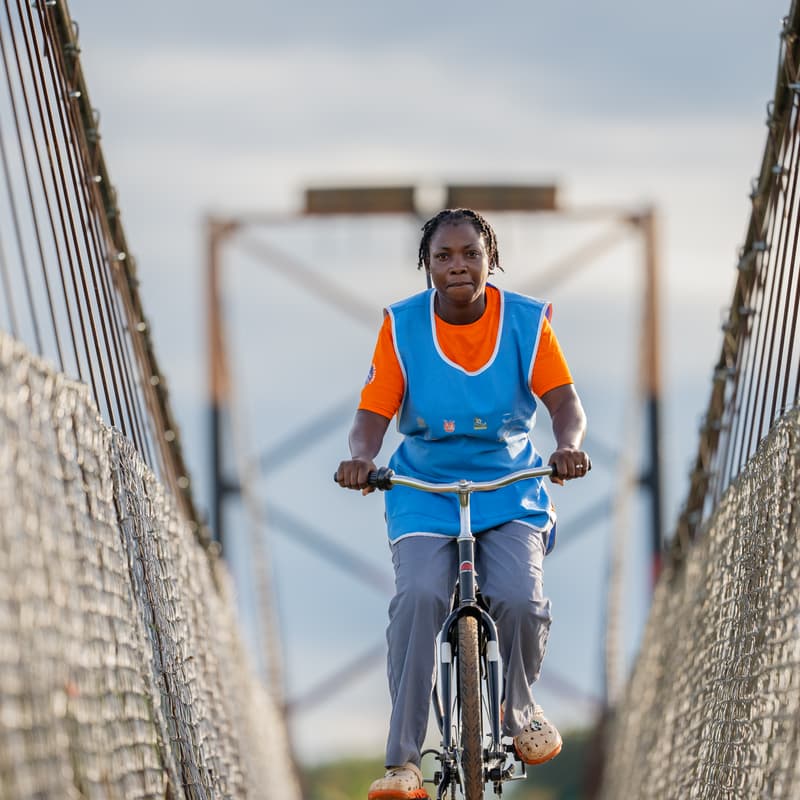

From Mobility Poverty to Safe Access: Closing the First and Last Mile Gap for Rural Communities
About the session:
For millions of people in rural communities, the greatest barrier to opportunity is not always the absence of services, but the difficulty of reaching them safely, reliably, and affordably. This is the reality of mobility poverty: when distance, terrain, cost, and seasonal isolation cut people off from health care, education, markets, and livelihoods.
In this session, World Bicycle Relief and Fika will explore how practical rural mobility solutions, bicycles, and small-scale access infrastructure, such as trail bridges, can help close the first- and last-mile gap. Drawing on evidence, implementation experience, and lessons from the different geographies, the conversation will examine what it takes to move from promising mobility interventions to scalable systems through better financing, stronger planning, government uptake, and cross-sector partnerships.
The discussion will be enriched by speakers from CAMFED, Spring Impact, IDinsight, One Acre Fund, and Living Goods who bring perspectives from girls’ education and leadership, evidence, scaling and replication, smallholder agriculture and rural livelihoods, community health delivery, and broader policy and systems change. Together, these voices reflect the wider ecosystem required to turn safe access from a transport issue into a shared development priority.
Session objectives:
Make mobility poverty visible by illustrating the barriers posed by distance, terrain, cost, and risk, and why safe access matters for health, education, and livelihoods
Share evidence on what works, including RCT findings and cost effectiveness for bicycles and trail bridges
Identify practical pathways to scale, including government adoption, market channels, financing, and partner integration
What to expect:
The session will combine storytelling, evidence, and discussion, including a short video montage, opening reflections, plain-language data, and a conversation focused on how to move from evidence to action. Participants will also have the opportunity to engage with practical examples of rural mobility challenges and solutions.
Hosts:
World Bicycle Relief
Fika (formerly Bridges to Prosperity)
Guest perspectives may include:
Spring Impact
One Acre Fund
Living Goods
CAMFED
IDinsight
Who this is for:
This session is for funders, NGOs and implementers, government actors, policymakers, and practitioners working across transport, health, education, agriculture, climate resilience, and rural livelihoods. No technical background is required. Key ideas such as mobility poverty, safe access, and first- and last-mile connectivity will be explained in plain language.
What you will get out of it:
A clearer understanding of mobility poverty and how it affects rural communities
Evidence on the impact and cost-effectiveness of practical rural mobility solutions
Insight into how these solutions - bicycles and bridges - can scale through systems, partnerships, and financing.
A chance to connect with organizations working to expand safe access and rural mobility
Photo credit: Luke Katemba
Location & access
Accessibility matters deeply to us, and we do our best to choose spaces that reflect that. That said, some of our Oxford venues are in historic buildings without lifts. This room is unfortunately not accessible for wheelchair users, those with mobility challenges, or anyone needing step-free access.