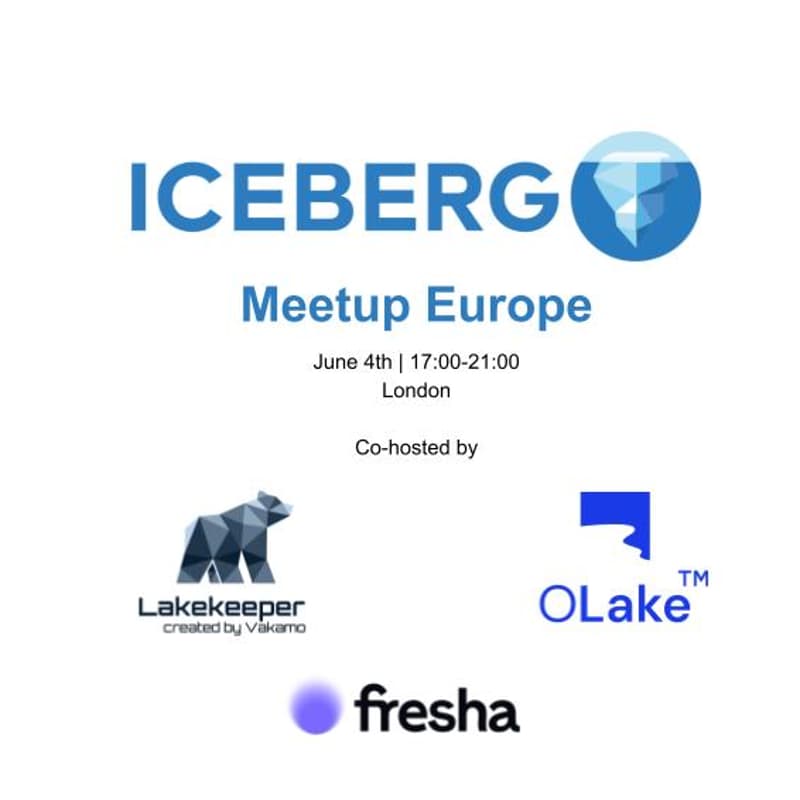

Apache Iceberg™ Europe Community Meetup - London Hub
Apache Iceberg™ Europe Meetup - London Hub!
Join us for the Apache Iceberg™ Europe Meetup in London! Our event is hosted in London co-hosted by Fresha and Vakamo.
🎟️ When registering, please select one of the two ticket types:
In-Person Ticket: Join us on-site! Your name will be used to pre-register for venue access.
Remote-Only Ticket: Can’t make it in person? No worries—register to join the live stream, receive event recordings, and stay connected with the community.
Agenda
5:00 pm – Registration & Networking
6:00 pm – 1st set of short talks
🎙️ Emiliano Mancuso (Fresha)- Snowflakes and Sparks: Iceberg Format Compatibility vs System Interoperability
🎙️ Miles Richardson (EnterpriseDB ) - Bringing Postgres to the Lakehouse
🎙️Shubham Satish Baldava (Datazip) - Rethinking Apache Iceberg Compaction Efficiency for CDC Pipelines
Networking break
🎙️Xander Bailey and Sreesh Maheshwar (Palantir) - Iceberg in the Enterprise
🎙️ Viktor Kessler (Vakamo) - Apache Iceberg REST Catalog - How to solve Governance
8:15 pm – More Networking
9:00 pm – Event close
Livestream
How to Get to the Venue
Address:
The Bower, 207-211, Old St, Tower, London EC1V 9NR, United Kingdom
Building Access
Fresha Office(8th Floor)
🪪 ID Requirements
Presentations & Speakers
🌟 Bringing Postgres to the Lakehouse
In this talk, we’ll introduce and demonstrate Postgres Analytics Accelerator (PGAA), an extension for reading and writing Iceberg (and Delta...) tables. We’ll cover the technical details, including why we moved our focus from Delta to Iceberg, how we embedded DataFusion as a query engine into Postgres, why we added a Spark engine with GPU acceleration, and how it works with WarehousePG. We’ll also discuss customer requirements, what we’re hearing from enterprise data teams, and how Iceberg allows us to “meet customers where they are,” with an interoperable, incrementally adoptable path to modernization.
Miles Richardson is a Principal Product Manager at EnterpriseDB (EDB), the leading Postgres Data & AI company with over 20 years of experience delivering enterprise-grade Postgres solutions. Miles joined EDB in 2023 through the acquisition of Splitgraph, the company he co-founded to bring analytics to Postgres, a vision he continues to pursue at EDB. As part of the Analytics team at EDB, Miles is focused on “bringing Postgres to the Lakehouse," and helping organizations modernize their enterprise data stack around Open Standards and Open Source.
🌟Snowflakes and Sparks: Iceberg Format Compatibility vs System Interoperability
At Fresha, we tested whether Snowflake and dbt could become a direct write path into Iceberg: S3 storage, Lakekeeper as the REST catalog, and StarRocks as a downstream query engine. The tables were valid Iceberg, but the operational contract was weak: refresh semantics, catalog operations, file layout, table properties, compaction, and downstream performance all required workarounds or repair. This talk is a production case study in the difference between format compatibility and system interoperability. “Supports Iceberg” is not enough as the writer determines whether the table is actually portable, maintainable, and fast.
Emiliano Mancuso is VP of Architecture & Data Engineering at Fresha, where he leads the teams designing the company's core data and infrastructure foundations across London, Warsaw, and Pristina. A hands-on architect, his work bridges platform engineering and distributed systems to enable scalable, high-performance services across Fresha's global platform. Originally from Argentina, Emiliano brings deep expertise in data architecture and a passion for real-time, reliable systems.
🌟Iceberg in the Enterprise
This is a field report from running Iceberg across multiple compute engines inside large regulated enterprises, which operate at significant scale -- hundreds of thousands of tables, with individual table sizes ranging from GBs to PBs. We'll speak to two areas that have been a focus for our team: - Multi-engine parity: challenges we are seeing when the same table is touched by Spark, Trino, DataFusion, DuckDB, and Polars clients, and how we're providing a consistent experience for both incremental and non-incremental pipelines. - Enterprise features & requirements: table encryption, fine-grained access control, version-level security, and disaster recovery/retention. For each, we'll share what we've built, what we've contributed back, and the areas we'd love to collaborate with community.
Xander Bailey and Sreesh Maheshwar - Software engineers at Palantir
🌟 Rethinking Apache Iceberg Compaction Efficiency for CDC Pipelines
Every CDC sync quietly adds small files and equality deletes. Over time scans slow down, and most teams do not notice until queries that finished in seconds starts taking minutes. Existing compaction approaches fall short on continuous ingestion. A single rewrite strategy treats small files and equality deletes the same way. Running it frequently causes write amplification. Running it infrequently lets degradation compound. Neither is sustainable under continuous ingestion. This talk covers why a tiered compaction model changes the game, by making the compaction more configurable and efficient depending on volume, frequency and nature of updates. Three independent tiers each targeting a different stage of table degradation, and the tradeoffs behind scheduling each one. Attendees leave with a practical framework for designing compaction schedules for their own CDC pipelines.
Shubham Satish Baldava - Data engineer for last 10 years, worked with multiple countries across the globe creating petabyte level pipelines. Iceberg is revolutionising Data engineering and downstream services including AI, Thats why we are building Iceberg native tools to help companies adopt Iceberg.
🌟 Apache Iceberg REST Catalog - How to solve Governance
Modern data platforms increasingly behave like software systems — but most organizations still lack safe workflows for changing data. Updating a table in production can easily break downstream pipelines, dashboards, or machine learning models.
Modern data architectures need governance that scales across teams, engines, and cloud environments without creating vendor lock-in. In this session, we explore how the Apache Iceberg REST Catalog standard enables a centralized and interoperable governance layer for the Lakehouse. Using Vakamo and its Lakekeeper as a practical example, the talk demonstrates how organizations can implement fine-grained access control, metadata-driven governance, and open interoperability across their data ecosystem. The session highlights how open standards and technical metadata become the foundation for scalable AI and data governance in modern enterprises.
Viktor Kessler, is Co-Founder of Vakamo and the creator of Lakekeeper, an Apache Licensed Iceberg REST Catalog. He’s a big believer in open standards like Apache Iceberg, which he sees as the backbone of today’s modern, composable Data & Analytics systems.
🌟 Designing a Multi-Engine Lakehouse with Apache Iceberg: One Table, Many Engines
What if one Iceberg table could power your entire analytics stack—from interactive queries in DuckDB to batch processing in Spark, ad-hoc exploration in Trino, and real-time dashboards in StarRocks? This talk explores how Apache Iceberg enables true multi-engine interoperability through its open table format, catalog decoupling, and rich metadata model. We’ll cover practical patterns for building a shared data layer across diverse engines without sacrificing consistency, flexibility, or performance. We’ll also discuss how QueryFlux, our open-source multi-engine query router, helps turn this model into something operational by routing queries to the right engine based on workload type and execution needs. Whether you’re modernizing a warehouse or building a new lakehouse, this session shows how to write once, govern once, and query everywhere.
Amit Gilad - Seasoned data engineer with over eight years of experience architecting and managing large-scale data systems. Currently working as ceo at lakeops control plane for data lakes. In the past Amit has played an instrumental role in spearheading Cloudinary's transition to the cutting-edge Apache Iceberg distributed data table format, leveraging his deep expertise in optimizing data storage, enhancing data retrieval processes, and ensuring seamless data operations within cloud environments.